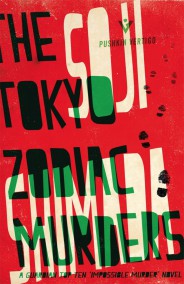
 Some families have all the luck – take the Khardashians, for example, who are universally blessed with charm, intelligence and talent – whereas some miss out altogether. Into this second category would definitely fall the Umezawa clan: not only is patriarch Heikichi found battered to death in his locked art studio, his eldest daughter is then found murdered a few months later and, following that, his six other daughters, step-daughters and nieces all disappear simultaneously and their dismembered bodies are discovered at various intervals buried in different locations around Japan. Then it turns out that Heikichi Umezawa had written a document outlining his intention to do exactly this to these women, with methods of murder and disposal based on their zodiac signs, so the mystery of who could have carried out his nefarious scheme raises its ugly head and remains unsolved for decades…

This is the mystery in Soji Shimada’s hugely influential debut novel The Tokyo Zodiac Murders, which launched a new type of crime writing in Japan known as shin honkaku (new orthodox) mysteries and is now finally back in print in English from Pushkin Vertigo. My only previous experience of shin honkaku was the massively entertaining The Decagon House Murders by Yukito Ayatsuji published by Locked Room International earlier this year and, like virtually everyone who read that, I was delighted when the reprint of this book was announced – Shimada bestrides this genre in his home country, and is seen as a key innovator in crime fiction for the work he has done (TDHM contains an illuminating foreword by Shimada and a superb afterword by Ho-Ling Wong that outline this very well indeed). It is also a highly-regarded locked room mystery, which is where my knowledge of and interest in it stems from, and has been one of my most eagerly-anticipated reads of 2015. So how does it measure up?
Well, to be honest, I didn’t love it. Taking into account the fact that it was the first of its kind allows for many of the problems I have with it, but put into the context of the abundance of imposible crimes and novels of detection that were available significantly in advance of this it struggles to impress. The locked room murder of Heikichi, for instance, is disappointingly routine, and many of the key shocks in the narrative seemed a touch obvious (for all the speculation about Heikichi’s death and who picked up the reins of his scheme, there’s one key aspect that’s never touched…it struck me as odd that no-one had commented on this….and that’s because it was the solution). Additionally, I’m just not sold on the Ellery Queen-esque promises – two! count ’em! – to the reader of you having all the clues to solve the multiple murder…I mean, really? Technically, yes, but there’s some alarmingly esoteric knowledge required – plus one giant off-page leap by our detective – and so it hardly qualifies as fair play.
Possibly on account of an overly-literal translation, it also reads like a novel written in the style of footnotes for most of its duration – the framing of solving the murders 40-odd years later is important, but the info-dump of the first third of the book to bring you up to speed is a killer. The dialogue is so on the nose that it would make Enid Blyton wince (“Yes, it’s amazing! I’m so lucky to know you!”) and the plot is replete with digressions into tangential matters – chemical equations of the action of poisons, for instance – rendered in dust-dry prose. Possibly there’s the argument that Shimada is enriching his milleu, but it’s done with no real care and you can spot these pointless digressions as soon as they appear because he suddenly starts writing travelogue or dropping in a directionless history lesson without any reference to the case. Thus the elements that play a part in the story are easy to pick out because they’re actually interesting or relevant, and those less interested than I might need to skim sections to get through it.
But then comes the solution to the multiple murders. And it is brilliant. Actually quite frustratingly brilliant. Like, genuinely surprising and intelligent enough to justify the reputation it is credited with for creating the honkaku genre; reading this in isolation, you would immediately wish you could write a book with that much simple invention at its heart, and taken in that context it reminds me of the moment I finally got what was so good about John Dickson Carr’s The Hollow Man. Does it completely convince me? No, but I’m willing to forgive a lot of its problems for just how much chutzpah Shimada puts on the page. It’s just a shame that the last 20 pages don’t contain anything new, because it ends on a bit of a whimper when it should have gone out on a blinding and deafening cacophony.
I’ve made no mention of the characters because there sort of aren’t any, and Shimada would be the first to admit this (he does it in his TDHM foreword, in fact). It’s not quite pure scheme – there’s too much redundancy for that – but as a window on another culture discovering the joys of intelligent crime fiction it is just about worthy of your time. Just don’t expect a timeless classic for the ages, however, although arguably the purpose of this type of origin is to get other people excited and encouraged to try themselves so that they may in time exceed you. And in that regard, it succeeds admirably.


 The Invisible Event
I started reading this book about a month back but gave up after reading the first chapter ! However, after reading in your review that the solution is brilliant, I’ll attempt again !
LikeLike
Yeah, it’s not a book that will be to everyone’s taste (which, of course, is true of every book ever published – good work, JJ) so I can understand your packing it in. If I was reading it without knowledge of its reputation, I’m not convinced I would have got through it, but I am glad I persevered. Hope you enjoy the solution as much as I did when you get to it…no Crooked Hinge-style controversy here!
LikeLike
Can’t believe you managed to somehow shoehorn the Kardashians in there JJ 🙂
LikeLike
Hey, you never know, might get me some hits on Google… 😛
LikeLike
I have read next to no Japanese crime fiction so very intrigued by this
LikeLike
I’ve only read this, Decagon House Murders and Edogawa Rampo’s The Black Lizard (which felt to me like a Bond novel told from the villain’s perspective), and I enjoyed the honkaku stories much more than the Rampo – though, like Shimada, he’s an innovator and so more influential than necessarily good by today’s standards (see also: Edgar Allan Poe). The element of detection is certainly explored in a very interesting way, but I wonder if the language won’t translate so accessibly and so that might limit their appeal; John Pugmire of LRI described THDM as having ‘sharp elbows’ and it’s difficult to disagree with him.
Overall, I suspect I may be too Westernised to enjoy Japanese detective fiction fully on its own merits, but when it strays into my patch I’m certainly curious enough to give it a go!
LikeLike
I was looking forward to your review of this book and sort of afraid that you might say something like this! A good friend of mine is reading it now and I feel to blame, having introduced her to honkaku through The Decagon Murder Case. Based on reading that one, I think I’m more turned on to the IDEA of honkaku, of a country actually embracing the genre of fiction I love rather than limiting our access to the best classic fair play mysteries like the U.S. does.but lack of characters and dry digressions don’t sound promising, no matter how whopping the solution might be. Perhaps I’d be better off giving Paul Halter a try! 🙂
LikeLiked by 1 person
Haha, I not sure whether I should apologise or not! The step it represents is very cool, you’re absolutely right, but I reckon there are better examples out there to be found (I thought TDHM a superior book, for example, and one with another staggering reveal). The question is…will anyone find and translate them?
And yes, absolutely, read Paul Halter! Start with, oh, I dunno, maybe The Tiger’s Head. Or The Fourth Door. One of those two.
LikeLike
I’ve been seeing this book a lot on the internet, but I was unsure about buying it. This review, informative and amusing as ever, has definitely resolved that issue! I found the narrative style hard enough to read in The Decagon House Murders, I don’t think I could make it through this one, regardless of the solution. My Carr novels have arrived so I think I shall stick to those for now for my locked room mystery reading.
LikeLiked by 1 person
Yeah, it’s a tricky one – I’d like to be more enthisiastic about it, but I have to be honest about its flaws. Do keep it in mind, it is worth reading if only to see a key stage in the development of a genre, and appreciating something like that in a relatively contemporary work is a pretty rare thing.
However, you have the joy of The Case of the Constant Suicides ahead of you now; let nothing distract you from that!
LikeLike
I’m assuming the TCOTCS is a personal favourite of yours?
LikeLike
Really? Whatever gave you that impression? 😛
It’s not Carr’s best, and it probably wouldn’t quite make my top ten Carrs, but for what it represents in my reading of him and for the sheer joy of it I will love that book in perpetuity. It also manages to balance the various aspects and themes that run through his work near-perfectly in a single book (and quite a short book at that), which is why I maintain that it’s the place to start with him. I sincerely hope that you enjoy it even half as much as I did.
LikeLike
So do I! I think I had a bad start with Carr as my first one was In Spite of Thunder, which I didn’t really like.
LikeLike
I get In Spite of Thunder and To Wake the Dead mixed up, as I read them practically back to back (same with Christie’s The Moving Finger and Murder is Easy), but I do remember that they were both rather talky and would be a slightly dissapointing place to start. For a guy who wrote so mucn brilliant stuff, it really is surprising how few of them are good starting places – he onyl really got the ba;ance perfect in a very small handfull of books, I’d say. once you’re on board you’re fine, but those first few can be quite crucial (unlike Dame Agatha, who has about 15 or 20 books it would be perfectly acceptable to start with!).
LikeLiked by 1 person
I suspect this book has fallen victim to its own hype, because I remember when the first English edition was still new-ish (8, 9 years ago) and the story had yet to build a reputation among Western readers, which it now struggles to life up to.
There was also a limited selection of vintage-and neo-classical mysteries when this one came out. So people were a bit easier impressed 10 years ago than the spoiled lot we’ve become today.
Anyway, I still think it’s a grand and bloody tour-de-force, but can understand why not everyone will be in love with it.
LikeLiked by 1 person
That, I feel, sums it up perfectly. It’s not so much that you’d expect it to be the most amazing book ever, but perhaps its charms were more appreciable than its flaws in a period of drought.
I would love to see more of Shimada’s novels translated into English, partly to see how his other work holds up and partly because I reckon he must have had something pretty special in him….
LikeLike
Oh dear, given what I’ve heard about this novel I was expecting a more glowing review. And so perhaps I’ll bump it down my ever-expanding list of novels to read. Or at least grab a copy from the library rather than purchase it.
In terms of Japanese mystery fiction, do you think you might try one of the translations of Keigo Higashino’s novels? ‘Devotion of Suspect X’ and ‘Salvation of a Saint’ seem to have garnered glowing reviews.
LikeLike
It’s entirely possible I’ll try one of them at some point, but there’s so much else to read first! I take it you’ve not read them and can’t make a recommendation?
LikeLike
No, I’m afraid I haven’t, though I’m quite eager to try one of them out over the next few months… 🙂
LikeLike
Well, you’ll probably get to them before I do in any case, so let me know what you think!
LikeLike
Hmmmmm…
On the one hand, Salvation of a Saint is an impossible crime, and a good one at that. The solution is audacious, but Higashino makes it work, and once you learn why Ayame did it that way, it fits, I think.
On the other, The Devotion of Suspect X is the better book, in my opinion. The emotional core of the book is handled better, and the final reveal was more of a gut punch. (Though I was speed reading Salvation a bit…) The ending is a little contrived, but hey, I felt like it worked.
LikeLiked by 1 person
Okay, cool, I shall bump them up a little on my list of curios…will probably try SoaS first purely on account of the impossibility, many thanks for bringing yet another book to my attention.
Have you read TZM?
LikeLike
Yes, and my opinion is about the same as yours: Good trick (which I got spoiled on, so meh) but very awkward prose. I’m not sure how much of it is Shimada or his translation, I normally don’t have that much of a problem with Japanese prose, but I was speeding a bit, which never helps. Also, I tend to read those other works out loud.
LikeLike
I have now read Salvation of a Saint, and…hmmmm, well. The setup is brilliant – it actually reminds me of The Problem of the Green Capsule in how everything starts so simply and then gradually becomes more and more dense as it goes – and by the halfway stage it’s beautifully poised for further exciting developments. And then those developments don’t come. Ever. Instead the same discussions are just hashed out again and again, some blatantly false leads are followed and it all slowly winds down to the solution which, while clever, is only about a third as clever as the glowing reviews seem to think. It’s…unconventional, and doubtless original, but it would be a better solution to a much shorter book or even a short story.
LikeLike
Pingback: #32: The Impossible Crimes of Sherlock Holmes – I: The Adventure of the Speckled Band | The Invisible Event
Pingback: #158: The Tattoo Murder Case (1948) by Akimitsu Takagi [trans. Deborah Boehm 1998] | The Invisible Event
Only three years late to this one and completely agree with everything you say about it. Clever, clever solution but by no means fair play which makes the message to the reader utterly pointless. Passed the time nicely, but the scheme is bonkers if you think about it – relying entirely on the behaviour of one character to do at least two things that are contrary to their nature in the second part of the plan seems absurdly risky. Also the middle section drags – the thought that the Azoth might be in plain sight all these years is ridiculous.
LikeLike
Yeah, it’s a far from perfect book, and given how the shin honkaku school went on to emphasise logic and fair play you do feel rather that two challenges to the reader overdoes it (there’s no way in hell anyone could actually figure it out from what’s provided herein). I wonder if that’s partly down to the edit, though — maybe there’s stuff missing that would make the case more plain…but then why take it out?!
However, the further I get from this and the more shin honkaku I read, the more I appreciate how this was among the earliest attempts to get the Western style of detection into a very different cultural milieu. So I have to go a little easy on it in spite of its many flaws. And the brief glimpse of Shimada’s shorter fiction from this era reveals someone who clearly has a fabulously focused mind in the manner of construction of plots. Perhaps we’ll see an improvement in his novels if any more jump the language barrier, starting with the rumoured imminent translation of The Crime in the Leaning Manion…
LikeLiked by 1 person
I just finished The Crime in the Crooked House today. (i.e. Leaning Mansion)
I gotta say … imagine Fred Dannay gets drunk, pulls his copy of The Problem of the Wire Cage off the shelf, and cackles “I can make a book ten, twenty, thirty times as crazy and convoluted as that!” He might have written this book.
Don’t get me wrong. You should read it, for two reasons
1 I want revenge for you recommending some of that self published stuff
2 there is nothing quite like it and it has boffin appeal
It has some wonderfully clever strokes, really wonderful, but it’s just so very nutso.
LikeLike
Ha, “revenge”.
I have actually read Murder in the Crooked House but, to be honest, did not really care for it.
THERE ARE HUGE SPOILERS AHEAD. HUUUUGE SPOIIILLLLLLLERRRRRSSS
There’s a lot of setup that doesn’t to contribute to the mystery in any way, so that when Shimada needs to Western-style its clues it becomes hilariously obvious what’s going on. C’mon, about sixteen pages of discussing the precise locations of wall vents in the middle of so much nothing, then the revelation that the walkways don’t meet the walls, then about 258 pages of nothing, plus a giant slide through the middle of the house? How else but sliding a knife down and through all the gaps? And this millionaire guys builds a slightly leaning house in the middle of nowhere just to stab some dude? I like the ridiculous in my impossible crimes, I embrace it fully, but that is…considerably too much.
In fairness to Shimada, I know he was trying something sort of new in the culture, like Crofts and Christie at the dawn of GAD, but the difference feels starker. Doubtless my Western perspective plays a part, but Shimada is very heavy-handed in his laying of clues and important points, where later books like Decagon House Murders, Moai Island Puzzle, Salvation of a Saint, Death in the House of Rain, etc. have seen the clue-finding culture grow and become more understood. So no doubt my lack of appreciation comes in part due to a cultural element of the kinds of books the genre was producing in the country at that time. But it still bothers me that people will look at it from a Western perspective now and call it a masterpiece. It’s not. It’s innovative, but not good.
The other murders, too, underwhelm. With all due respect, there’s no way that “try on my jacket” is going to come off as anything other than creepy (I think I skipped precisely how the door was locked, but it’s definitely something to do with there being too much string — the point is laboured too much for it to be anything else, and it’s such an enjoyable crime scene until then) and the fact that no-one twigs that the Golem is there to be walked on? Fuhgeddaboudit. And saying “something impossible happened but — ohno! — it didn’t really and so that’s how we resolved that apparent impossibility” is, probably literally, the worst form of impossible crime cheat.
Was not a fan, so opted not to write about it on here.
LikeLike
Well, the search for the revenge recommendation continues!
LikeLike
SPOLIERS. Spoilers SPOILERS
Well I missed the doll as stepping stones for sure. I thought the worst part was the dying clue. Even on its own daft terms the logic is silly. “He could only sign one symbol physically, so it’s really meaningful that he did” . And at one point the detective says he knew the mechanism but not the killer. The mechanism is the purpose built house but he doesn’t get that the guy who built it is the killer? Too silly for words. Even if those words are “Gladys Mitchell self published”.
END SPOILERS
LikeLike
While I agree in this particular instance, I do also feel that Japanese dying clues always seem to make so much more sense to me than the English-language ones I can think of, though. The Detective Conan manga is littered with them, and they’re explained very well since too much would need to be changed for them to work in English…and I do find myself thinking “Damn, I wish we had a language that was that cool on the off-chance I had to leave a single-character clue about my mysterious death”.
That’s normal, right?
LikeLike
I hate dying clues entirely. Especially bizarre contortions by victims in pain with lots of blood available for writing with …
Seriously, they are always cheats, because they are always ambiguous, and rely on information hidden from most readers. Exceptions are possible of course but I cannot recall any.
LikeLike
Yeah, they’re generally pretty nonsense. But fun when done well, and the Japanese language seems to know how to do them well!
LikeLike
Pingback: The Tokyo Zodiac Murders by Soji Shimada, translated by Ross and Shika Mackenzie – Mysteries Ahoy!
Just got to this one… relieved to see an opinion matching mine (main difference being the amount of weight given to the solution in the rating :p). This thing is more padded than the squishiest sofa. Perhaps the Kyoto tourist board was handing out grants or something. Although I have to confess I quite enjoy when the detective goes on his strange tirades. I’m sure that’s great fun to translate.
I did think the challenge to the readers were alright – the second one was amusing. Being told that actually you could solve it even before the previous challenge is rude in a good way. Or maybe a bad way given that makes the intervening chapters even more padding. I don’t think getting the full solution is necessarily something any reader would do, but working out who the killer is is possible, since I managed to work it out (well there’s also the obvious red flag clue for a seasoned mystery reader).
I guess the key point of the plot is pretty good. If only it were in a better book.
I wonder if Shimada even considered the idea of female readers at that time. I suppose that’s another thing to borrow from some of the golden age classics.
LikeLike
“ the key point of the plot is pretty good. If only it were in a better book” So much of mystery fiction in one line!
>
LikeLike
I think that with a smoother translation (and probably a bit of a tighter edit) this would be a more enjoyable book — the playfulness of the Golden Age is there, just dressed up with a lot of violence and dismemberment.
Shimada’s recently-translated Murder in the Crooked House was an easier read, but I liked it less. There is playful and there is…overly ornate, and that is most certainly the latter to the nth degree.
LikeLike
Pingback: “The Tokyo Zodiac Murders” by Soji Shimada – Tangled Yarns
I just read this and had the EXACT same reaction- I think I was a bit more susceptible to the atmospheres of the other crimes so I scored it higher on that but I definitely was a bit annoyed by the stilted dialogue and seeming aimlessness/info dropping til I got to the ending and was just like “oh my god.” I agree that the challenges to the reader were obnoxious- though more because (ROT13) vg gheaf bhg gung gurer nera’g nal pyhrf, naq gur snpg gung vg pbhyq unir orra fbyirq ng Xlbgb Fgngvba zrnaf gung gur frireny puncgref nsgrejneq jrer zber be yrff n jnfgr bs gvzr- and I’m also not sure that (ROT13) univat gur bcravat puncgre or snxr vf gehyl snve-cynl pyhvat. But the solution was just so freaking beautiful, especially with the paper money being the trigger.
LikeLike
Yeah, this is a vexing read because of how wonderful it is when the penny drops and yet how little it actually is the novel of fair play detection it purports to be.
In fairness to Shimada, having now read some older Japanese detection reprints, and thus seeing the culture he was writing in, I can understand why he wrote the book as he did, but, man, do Western readers talk this up as the sort of thing it’s not even trying to be.
LikeLike
It reminds me of how people read Sherlock Holmes and expect all the stories to be fair play just because the golden age of mysteries that sprang off of it DID end up largely being fair play… but of course it was because ACD had no conception of the concept of a story needing to be fair play (though IMO a couple stories manage it regardless), and to him there being any clues at all was the innovation! He wasn’t aiming for the thing everyone these days assumes he was aiming for!
Though ACTUALLY, now that I think of it, IIRC the detective in this one goes on a VERY similar rant about Sherlock Holmes halfway through the book and later takes it back soon before coming up with his brilliant yet ass-pull solution… perhaps it’s a sort of meta-commentary? But if it were then how justify the “you have all the clues” shtick that Shimada attempts not once but twice?! I don’t even know.
LikeLike
Pingback: The Tokyo Zodiac Murders, 1981 (Kiyoshi Mitarai #1) by Sōji Shimada (translated by Shika and Ross MacKenzie) – A Crime is Afoot