 While I technically popped by blog Carr cherry a few weeks ago in recommending Death-Watch, it was at best a passing thumbs-up to the man and his achievements. And, following the disappointment of my intended novel under review, the time is probably ripe to dive in, get the first Carr review up and prop open the floodgates. And why not The Hollow Man (a.k.a. The Three Coffins)? Carr’s most well-known work, an arguable masterpiece of detective and impossible crime fiction, surely the most widely written about impossible crime novel on the internet…why not trot out the usual platitudes, recommend it unreservedly and fill the gap in my schedule?
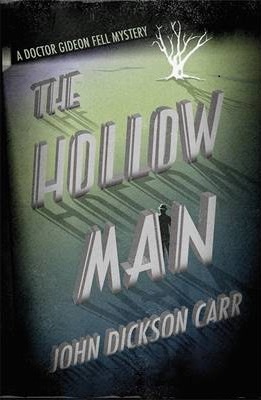
Except, and here’s the different perspective I’m hoping to bring to this, the first time I read The Hollow Man I hated it. I hated it. It was published as part of Orion’s Crime Masterworks series and that alone stimulated sufficient interest for me to give it a go but, being in my nonage of classic crime fiction, I couldn’t really tell you what an ‘impossible crime’ was and so didn’t know what to expect. I somehow knew of Carr vaguely (the internet was not quite so well-informed then as now), had ten or so Agatha Christies to my name – including Murder in Mesopotamia, which I failed to recognise for the impossible crime it is – and figured that alone meant I would be in for a similar kind of experience and knew what I was doing.
Ye gods, wasn’t it ever an effort. The overriding impression that still sticks with me is of trying to read a book while sitting in a thick fog and being shouted at by a fat man in a cape. The opening scene, where Charles Grimaud’s life is threatened in deliberately oblique terms, seemed set in a room full of treacle that the characters were forced to wade through. Everything was laden with barely-disguised double meaning that already seemed like hard work. When we eventually got to his house to find he’d been shot by a stranger who had locked himself in Grimaud’s study and then vanished over snow-covered ground without so much as a footprint to show the way, things promised to pick up. But that be-caped fat man, wheezing and harrumphing and tapping his canes on the floor kept interrupting everyone and seemed intent on proving how bloody clever he was. After the demure elegance of Hercule Poirot and the beguiling worldliness of Jane Marple this idiot was hard to bear. Unfortunately his name was on the back cover, so I had a feeling I would have to hunker down at tolerate him as best I could.
In my memory, I didn’t make it as far as the end of the first part – or ‘coffin’ as it is styled in the book – because eventually it just wore me down. I’m confident in this because when I picked it up again a couple of years later, having now read Hercule Poirot’s Christmas but still not really appreciating the essence of an impossible crime, I remember girding myself to get through no matter what and, upon reaching the end of the first coffin being suddenly struck by the line that concludes it (I shall not spoil it, but taken in context it is glorious). That single line of dialogue chilled me on account of the atmosphere Carr had created…and suddenly it all made sense. The scales peeled from my eyes, etc., etc., and unbelievably I went back to the start and read it all for a third time, but this time with that interim destination in mind. Everything fell (boom, boom) into place with a clarity that made it seem like a different book; I tore through it in a day, and loved every laden phrase and action.
It wasn’t fog I was trying to read through, it was smoke, all the more effective in hiding the doubtless accompanying mirrors. It wasn’t treacle the characters were wading through, it was the weight of a shared history, of some horror behind them too great to simply be glossed over. Gideon Fell, that querulous genius, was simply frustrated that the tangible elements he could grasp were so invisible to other due to their panic-stricken refusal to see what was patently in front of them. And the palpable fear and confusion, the undercurrent of aching terror that wove its way through the background of events, was so hair-trigger fine that it crept deeper into you bones at each new revelation of this inexplicable murder, and rose to a screaming crescendo at the impossible death to come. Every page, almost every word, is part of a jigsaw of such deliberate design that you can’t appreciate it too closely – at this stage in his career, Carr didn’t have the turn of phrase that would propel him to unequalled peaks within the genre, he just wanted to beguile, confuse and astound you. He did. He still will, even over 80 years later.
 Its pedigree is hard to deny: it was rated as the greatest locked room of all time in a poll of experts in 1981, and there’s realistically nothing released since then that’s likely to usurp it (forthcoming Paul Halter translations notwithstanding). A more recent solely-Carr poll over at the fabulously informed Tipping My Fedora ranked it a not inconsiderable third place, which still makes it probably the third-best impossible crime ever written, and therefore it remains more than merely worthy of your consideration. Personally, I’m not sure it would make it into my top 5 Carrs any more, though that would take a lot of explaining, but it is a work of genius; uncompromising genius, no doubt, and not always easy to take, but absolutely a masterpiece of the highest order in how fully it achieves what it sets out to do.
I am going on, having not really reviewed this at all, so need to conclude. My advice: do read it, you must read it, but don’t start here. Check out my five non-Carr impossible murders to set you up, and at the end of the week I’ll post my recommended first five Carrs to put this in the right context. Wonderful things await you…

 The Invisible Event
Thanks very much for the kind words about Fedora and thanks very much for the review – so really enjoyed being reminded of the sheer exultant joy of bagging your first Carr – great stuff 🙂
LikeLiked by 1 person
Kind words nonsense; you’re running an excellent site, thanks for all the recommendations and steers I’ve taken from it in the last year or so. And, yeah, exultant joy is the phrase – it’s wonderful to discover that he akes it all hang together so near-seamlessly, and then to go on to his other books and discover that he repeated it again and again and again…
LikeLike
The Hollow has definitely been a book I have been wanting to read in its entirety, having only just read part of the The Locked Room Lecture chapter. I’ll be interested to see which Carr novels you recommend later on this week as I don’t think any of the Carr or Carter Dickson novels I have read have ever knocked my socks off. The Emperor’s Snuff Box, She Died a Lady and The Skeleton in the Clock are probably the ones I enjoyed the most out of the ones I read but I feel like their probably not the strongest ones out of Carr’s whole repertoire.
LikeLike
I don’t know if I’m necessarily recommending the strongest Carrs – possibly only one of them as they currently stand would be in my top five – so much as the five books that will introduce him as quickly and favourably as possible. A lot of his great work can often be buried under unusual turns of phrase or quite stifling atmosphere, and I’d argue you need to be innured to that before you’re necessarily going to get the most out of him. The “top five Carrs” list still has plenty more agonising over before it’s ready…!
LikeLike
Oh, and She Died a Lady is a wonderful book.
LikeLiked by 1 person
Pingback: #18: My Blog Name in Books | The Invisible Event
Pingback: #65: On the Loss of the Rue Morgue Press – an open love letter | The Invisible Event
Pingback: #88: The Lord of Misrule (1994) by Paul Halter [trans. John Pugmire 2006] | The Invisible Event
Pingback: #102: Paul Halter Day – II: The Impossibility of More Impossibilities | The Invisible Event
Pingback: #131: Adventures in Self-Publishing – The Third Gunman (2016) by Raymond Knight Read | The Invisible Event
Pingback: #148: So, Like, What Is an Impossible Crime or a Locked Room Mystery? | The Invisible Event
Pingback: #157: The Tuesday Night Bloggers — A Background of History in The Red Widow Murders (1935) by Carter Dickson | The Invisible Event
Pingback: #171: JDC OOP – WTF? | The Invisible Event
Pingback: #176: Leonardo’s Law (1978) by Warren B. Murphy | The Invisible Event
Pingback: #189: The Tuesday Night Bloggers – Back to the Beginning with Agatha Christie’s The Murder of Roger Ackroyd (1926) | The Invisible Event
Pingback: #241: Fair-Play Detective Fiction 101 – The Results! | The Invisible Event
Pingback: My Book Notes: The Hollow Man (aka The Three Coffins), 1935 (Dr Fell # 6) by John Dickson Carr – A Crime is Afoot
Pingback: The Hollow Man (AKA The Three Coffins) by John Dickson Carr (1935) – Mrs. K. Investigates
Having previously read many other Carrs, I just read The Hollow Man for the first time yesterday soon after having seen the new Knives Out movie, which I would be very curious for your review on once you’ve seen it! The Hollow Man is mentioned at length in the movie, most notably in a brief discursion by Blanc on the impossible crime chapter, and a couple of other books are referenced as well. (I’m going to a Mysterious Bookshop talkback with Rian Johnson later this week and I’m curious to know which authors besides those explicitly referenced- basically just Carr, Christie, Sayers*, and Poe, and I believe he mentioned Chesterton in an interview- he’ll mention as influences, and I wouldn’t be surprised if it’s basically just those. His more diverse influences from the mystery genre, not unsurprisingly, seem to be film- and it’s very reasonable given that he has to tell his stories in a cinematic language that is very different than the mechanisms available to writers.)
The book itself was interesting- some parts of it felt padded out and clunky, but overall the mystery was fascinating and the solution made a lot of sense- except that, and this is almost definitely a “me problem,” I could not totally visualize the technical stuff which allowed the impossible crime to happen, which meant that the satisfaction of unraveling the impossibility only half came off. I totally understood the point you mentioned about being first thrown off by the tone- it’s so similar to my first experiences with Carr and I probably would have HATED this one had it been my first of his books, rather than something in the teens at this point. A lot of my enjoyment of the book came from my understanding of how Carr operates.
*The Sayers in question is, frustratingly to me, Whose Body?- I SORT OF get why based on some plot stuff, though not really, but it doesn’t change that it’s tied for Sayers’s worst book with Five Red Herrings (the latter is much more skillfully written and plotted but also INCREDIBLY DULL and my only Sayers DNF, while Whose Body? is just a badly plotted mystery with some interesting ideas). That said, and I know you’re more of a Sayers skeptic than I am, there is one other Sayers reference in the film that is absolutely amazing and that I’m kicking myself for not having realized earlier.
LikeLike
I think you hit the nail on the head when you said “A lot of my enjoyment of the book came from my understanding of how Carr operates” — it being my first sniff, this overwhelmed me rather, but I’m intrigued to reread it in the coming years to see what I make of it now I’m so much deeper in his output.
I’m intrigued by the new Knives Out film, though I think I solved the murder from watching the trailer (rot13: gur svefg crefba gb nccebnpu gur obql va gur frnyrq ebbz fgnof vg jura ab-bar’f ybbxvat, evtug?). Lovely to think that someone’s committed to making puzzle mysteries, getting attention for it, and talking about JDC while doing so.
Maybe recommend to Johnson that he read The Red Death Murders, eh? 😉 I’ll remember you when I’m rich and famous…
LikeLike
If you actually want to know, ROT13: vg vfa’g gur svefg crefba jub jnyxf va, ohg gur frpbaq (ohg rira orggre, vg’f gur cbyvpr puvrs jub oryvrirf vg zhfg unir orra gur svefg crefba gb jnyx va, orpnhfr fur ernq gung puncgre bs Gur Ubyybj Zna ng Oynap’f hetvat!). Vs vg znxrf n qvssrerapr, guvf bayl fcbvyf cneg bs gur zbivr naq VZB vg jnf n IREL rnfl fbyir juvyr jngpuvat.
I will say, I think that the movie either rewards or punishes serious golden age mystery fans (depending on your POV) by not being very difficult to solve if you’ve read enough of the classics. It is still interestingly set up and while I do consider myself to have effectively solved it I really only got like 90% of the total.
LikeLike
Thanks, I shall read the rot13’d bit after I’ve seen it; I’m more just putting my thoughts on record here so that I can be all smug if I’m right 😄
LikeLike
Oh and we got a VERY VERY strict warning that there will be no time for audience remarks to RJ as he will be leaving immediately after so no can do I’m afraid… honestly I don’t even know if we get an audience Q&A
LikeLike
NOOOOO!!! My one chance of fame!!!!!
LikeLike
Seriously, though, I hope it’s a good time. He seems like a decent guy.
LikeLike