
Short stories
#145: Some Reflections on Editing ‘The Mystery of the Locked Room’ (1905) by Tom Gallon
Believe it or believe it not — though in all likelihood you’ve actually forgotten about it — Ye Olde Book of Locked Room Conundrums is nearly ready. Version 1.0, containing 13 of the intended original 15 stories, should be available by the end of the month, missing two stories because the process of wrangling them into shape when it’s just me, TomCat, and our spare time is proving rather more long-winded than previously thought. A v1.1 may be available at a later date once I’ve got these two remaining stories edited into readable form, but I figure most of something is better than all of nothing.
Continue reading
#144: The Corpse in the Waxworks, a.k.a. The Waxworks Murder (1932) by John Dickson Carr
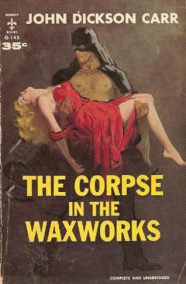 The penultimate case for John Dickson Carr’s first sleuth, Henri Bencolin, opens with a wonderful demonstration of the reputation which that juggernaut of justice enjoys among the less salubrious sections of French society: ‘Bencolin was not wearing his evening clothes, and so they knew that nobody was in danger.’ The palpable sense of relief this engenders in all who see him as he travels from tavern to tavern captures the character with a clarity that shows how much Carr grew as an author over his opening five books, and augurs well for the Fellian delights that would follow soon upon the heels of this as Carr hared his way up the detective fiction firmament and into history. And it sets the scene nicely for a deceptively complex little book that almost feels like a short story in its setup, but is wrought into something more by the expert pacing Carr has honed in the couple of short years since It Walks By Night (1930), showing here his emerging talent for taking a situation that many others would struggle to fill 20 pages with and making every nuance and moment of its 188 pages count.
Continue reading
#129: Some Reflections on Editing A. Demain Grange’s ‘The Round Room Horror’ (1911)

As Ye Olde Book of Locked Room Conundrums edges ever closer — 11 of the 15 stories are now typed and ready, and TomCat is beavering away editing a twelfth — I thought I’d share my thoughts on certain aspects from the preparation, because it’s been an interesting insight into some things I’ve previously had no experience with. My apologies in advance if this seems self-aggrandising, I just think some of this will be of legitimate interest to you and have no desire to make it all “hey look how much work I’m doing”. No-one is making me do this, after all, and it’s honestly a huge amount of fun. Yes, my notion of fun is not like that of other people.
Continue reading
#127: ‘The Third Bullet’ and Other Stories [ss] (1954) by John Dickson Carr
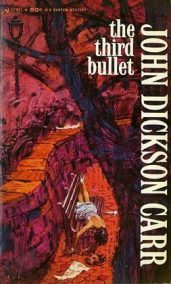 I haven’t reviewed (or read, come to that) a short story collection for a while, and it’s 1954 this month for Crimes of the Century at Past Offences meaning the time is ripe for a long-overdue (har-har) return to John Dickson Carr. I had read a couple of the stories contained herein before, but the majority were new to me, and as ever it’s a delight to see Carr’s imagination wrangle with the shorter form. Given how frequently stories of this ilk fail to conceal their workings and/or killer, it’s also great to see him do both over and over again with consummate ease, as if saying to his contemporaries “C’mon, guys, it’s simple –just do this“. We’ll take them one at a time as is my usual approach with collections — and, yes, most of these were originally published before 1954 and so might be inadmissible. Let’s just get on with it and an independent official enquiry can determine the eligibility of this at a later point.
Continue reading
#121: On the Many Wonderful Faces of Dr. John H. Watson, MD – Part 2 of 2

So, as established yesterday, there’s much more scope in Watson than there is in Holmes. The obvious question then becomes: So what do you do with this?
Take the simple cosmetic changes out of the equation — the casting of Lucy Liu as Dr. Joan Watson in the US series Elementary, for instance, easily one of the least disruptive changes it’s possible to get away with — and what you’re left with is the fact that Watson, being our entry into the Holmesiverse, is allowed to do anything that reflects the experience and perspective of the reader. As discussed yesterday, there are aspects of the character, the constants I referred to, that don’t become him — making him the proprietor of a burgeoning dog-walking business, or a respected scholar of nineteenth century Gothic poetry, or giving him a form of OCD which means he must always cross his legs in the opposite manner to Holmes unless it’s a Tuesday in which case…, etc — but let’s put this aside as given and look at the way certain authors have expanded on Watson without desecrating him beyond all recognition.
Continue reading
#119: An Undertaking – Ye Olde Book of Locked Room Conundrums
So, earlier this week I put up this post lamenting the poor selection of stories for a ‘new’ locked room anthology edited by David Stuart Davies. In response, the internet’s resident doyen of all things locked room, TomCat over at Beneath the Stains of Time, put up this post suggesting an alternative list of equally out-of-copyright stories suggested by a look through Robert Adey’s Locked Room Murders. To wit:
I arranged an alternative line-up of fifteen titles for Classic Locked Room Mysteries or a hypothetical, non-existent anthology, called Ye Olde Book of Locked Room Conundrums…
 The Invisible Event