Orion
 “The impulse for this novel,” says Adam Roberts “was a desire to collide together some of the conventions of ‘Golden Age’ science fiction and ‘Golden Age’ detective fiction, with the emphasis more on the latter than the former.” Well, count me in! Sure, the authors he then cites (Margery Allingham, Ngaio Marsh, Dorothy L. Sayers, Michael Innes) don’t all fill me with delight, but this is a collision of my two favourite genres plus impossible crimes — how could I pass it up?! And it would have passed me by entirely had not blog-commenter ravenking81 brought it to my attention, so my most genuine thanks for that; at its best it’s a fascinatingly successful attempt at merging the two genres in a way that recalls both Isaac Asimov and John Dickson Carr, who, y’know, are the two finest authors to have worked in their respective genres. So that’s a good thing. By definition, however, it is not always at its best.
 #73: The Murder Room is dead, long live The Murder Room!
Mark Twain-esque, it seems that I may have extrapolated incorrectly from reports that Orion’s e-book initiative The Murder Room was ceasing operations and that the books will in fact be available for a little while yet. Former Murder Room publisher Julia Silk – or someone purporting to be Julia Silk, but it seems an unlikely deception to perpetrate as she hasn’t even requested my bank details – has dropped by to let us know that not only a) will the books be available for a while yet (whew!) but also b) there’s new stuff coming as well.
Happy days!
#71: The Case of the Borrowed Brunette (1946) by Erle Stanley Gardner
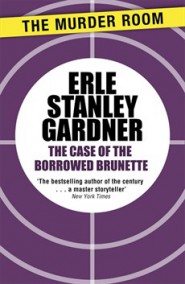 There’s an appealing irony in the assertion that you know an author has hit the big time when everyone remembers the name of their characters over that of the creator themself: Lisbeth Salander, Jack Reacher, Tarzan, Jason Bourne, we erudite types remember them, of course, but the world at large – fuelled no doubt by TV and films – associates more with their representations than their origins. Erle Stanley Gardner – a King of Crime, lest we forget – is not just less well-known than his character, but also the piece of music that character is himself overshadowed by; all together now… Frankly, he must be like the biggest-selling author in the world on those terms. Well, uh, yeah, he kinda is, actually. And yet, despite my avowed love of the man and his writing, it’s taken me 70 posts to get round to reviewing him here; what gives?
Well, two things. Firstly, I’d read a lot of Gardner before starting this blog and had sort of lost track of exactly what I had and hadn’t already encountered, and secondly a lot of it was written at high speed and with, er, some quality control issues and so some of what I’ve read since hasn’t exactly covered him in glory. However, The Case of the Borrowed Brunette is about as classic a Perry Mason – oh, yeah, that’s the famous character, but the way – novel as you’ll get, and showcases a lot of what Gardner did extremely well and also a lot of the flaws in his process.
Continue reading
#67: The Murder Room is closing its doors

Orion’s digital crime arm The Murder Room will apparently be ceasing operations in the near future, meaning to those of us in the UK the loss of high-quality e-books from classic Golden Age authors like Anthony Boucher, Pamela Branch, John Dickson Carr, J.J. Connington, Stanley Ellin, Erle Stanley Gardner, Geoffrey Household, Ronald Knox, John D. Macdonald, Helen McCloy, and E. L. White, and more contemporary fare such as Charles Willeford and many others.
They have excelled in the high standards of their output, the range of authors they promoted, the fact that they made these books available to the widest possible market, and their commitment to the Golden Age long before it was fashionable again. Goddammit, this has really spoiled my day.




 The Invisible Event