OOP
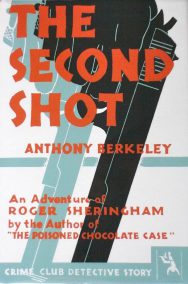
#134: A Puzzle for Fools (1936) by Patrick Quentin
 You’re writing a detective novel during the most productive and creative period that the genre has ever gone through, so pay attention — the tropes aren’t tropes yet, they’re still ingredients, and the standard mix requires the following: a murder or two, an amateur detective, a closed circle of suspects, an imminent sense of threat for our hero to fret over and be dismissed by the professional police, a love interest who must fall under suspicion before our hero realises she just might be his soul-mate…any questions? Okay, off you go. Keep the dunnage to a minimum, avoid long-winded and namby-pamby descriptions — this is entertainment, remember — and for pity’s sake keep it light.
Continue reading
#129: Some Reflections on Editing A. Demain Grange’s ‘The Round Room Horror’ (1911)

As Ye Olde Book of Locked Room Conundrums edges ever closer — 11 of the 15 stories are now typed and ready, and TomCat is beavering away editing a twelfth — I thought I’d share my thoughts on certain aspects from the preparation, because it’s been an interesting insight into some things I’ve previously had no experience with. My apologies in advance if this seems self-aggrandising, I just think some of this will be of legitimate interest to you and have no desire to make it all “hey look how much work I’m doing”. No-one is making me do this, after all, and it’s honestly a huge amount of fun. Yes, my notion of fun is not like that of other people.
Continue reading
#127: ‘The Third Bullet’ and Other Stories [ss] (1954) by John Dickson Carr
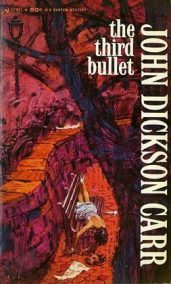 I haven’t reviewed (or read, come to that) a short story collection for a while, and it’s 1954 this month for Crimes of the Century at Past Offences meaning the time is ripe for a long-overdue (har-har) return to John Dickson Carr. I had read a couple of the stories contained herein before, but the majority were new to me, and as ever it’s a delight to see Carr’s imagination wrangle with the shorter form. Given how frequently stories of this ilk fail to conceal their workings and/or killer, it’s also great to see him do both over and over again with consummate ease, as if saying to his contemporaries “C’mon, guys, it’s simple –just do this“. We’ll take them one at a time as is my usual approach with collections — and, yes, most of these were originally published before 1954 and so might be inadmissible. Let’s just get on with it and an independent official enquiry can determine the eligibility of this at a later point.
Continue reading
#124: Invisible Green (1977) by John Sladek
 John Sladek is better known these days as a furiously inventive author of decidedly loopy SF — and I mean that as a compliment — but he did publish two detectives novels in the 1970s that each contained several impossibilities. The first, Black Aura (1974), has two disappearances and a man flying outside a third-storey window (without anything so amateur as wires holding him up, you cynic), and two-thirds of these are explained away superbly — the second disappearance in particular. It is a very good book, if perhaps a little slow in places, and boded well for the next time Sladek opted to dip his toe in our waters. Invisible Green, then, is very much the realisation of this potential, being superior in every single respect, and therefore something of a bittersweet read as we know now that nothing else followed it in the realm of the unachievable provably done.
Continue reading
#119: An Undertaking – Ye Olde Book of Locked Room Conundrums
So, earlier this week I put up this post lamenting the poor selection of stories for a ‘new’ locked room anthology edited by David Stuart Davies. In response, the internet’s resident doyen of all things locked room, TomCat over at Beneath the Stains of Time, put up this post suggesting an alternative list of equally out-of-copyright stories suggested by a look through Robert Adey’s Locked Room Murders. To wit:
I arranged an alternative line-up of fifteen titles for Classic Locked Room Mysteries or a hypothetical, non-existent anthology, called Ye Olde Book of Locked Room Conundrums…
Continue reading
#100: The Dead Room (1987) by Herbert Resnicow
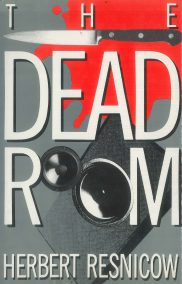 When the unpopular patriarch of a family is found stabbed to death in his locked study, it’s clear that one of the six family members gathered at the ancestral pile must be the murderer (the servants, of course, are excluded immediately). It’s up to our plucky amateur detective team to work out how he was killed and beat the police to the killer before it’s too late while also beginning to realise how they really feel about each other… So far, so Golden Age. Now substitute the following nouns: patriarch/inventor, family/hi-fi company, study/anechoic chamber (sound-testing room, if you will), family members/company executives, ancestral pile/company studio, and servants/technicians. What you have now is the plot of Herbert Resnicow’s The Dead Room. It’s that simple a switch – but for the trappings of its location, this could not be more of a Golden Age detective story, and the entire enterprise is undertaken in the same spirit as those classics. Continue reading
#94: Death in Five Boxes (1938) by Carter Dickson
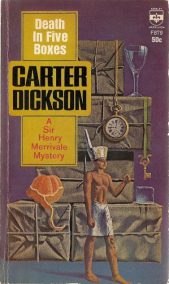 Four people are discovered sitting around a table as if at a dinner party, each with only a glass in front of them. Three of the four have been poisoned into a catatonic state and the fourth has been murdered by being run through with a narrow blade. Of the three who remain alive, one has two bottles of poison in their bag, one has the workings of an alarm clock in their pocket, and the third is carrying four pocket watches in various pockets about their person. At this point you are three chapters into the eighth Sir Henry Merrivale novel written by John Dickson Carr under his Carter Dickson byline and we haven’t even touched upon the revelation that greets you at the end of that chapter…suffice to say, boy are you in for a ride!
Continue reading
#84: The Tuesday Night Bloggers – The Sherlockian Impossibilities of John Dickson Carr – II: ‘The Adventure of the Sealed Room’ (1953)
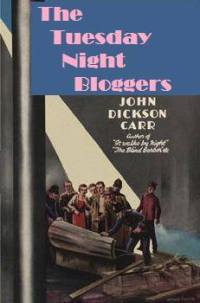
I’m guilty of sedition here: this isn’t technically part of the Tuesday Night Bloggers – they’re looking at travel in classic crime this month – but rather my own delayed TNB post on John Dickson Carr from March before I was sidelined. But, y’know how it is, it’s the second one looking at Carr’s Sherlock Holmes stories and so I feel I should probably post it on a Tuesday if only for internal consistency…my apologies for any confusion (though I suppose I cam writing about a Carr trip…). Just look upon this as my Never Say Never Again.
I talked about the origin of these stories in my first post on this topic, so let’s get straight on with it: this story is built on the reference to a case “of Colonel Warburton’s madness” made at the start of ‘The Engineer’s Thumb’ and so it’s appropriate that it begins in much the same way: someone in distress seeks out Watson (then for his doctoring, now seemingly because he knows Holmes) and is thus ushered into the Great Presence. It’s here that the story plays its most interesting card, as Holmes is rather short with the unfortunate Cora Murray who has just had a Colonel Warburton seemingly shoot himself and his wife while locked together in his study in the house where they all reside:
Continue reading
 Animals and their involvement in impossible crimes enjoy a long history, from the works of Edgar Allan Poe and Arthur Conan Doyle all the way up to the Jonathan Creek episode The House of Monkeys. Approximately halfway between these two we have Roman McDougald’s mandrill Geva, resident of your classical American Millionaire’s Household and on hand when said millionaire is found murdered in frankly baffling circumstances: in his office, stabbed in the back, with both doors into the room unlocked. Yes, unlocked. And yet he failed to leave the room while being attacked – the trail of blood he left leads from his desk to one door, then the other, and halfway back again – or raise the alarm in any way before the killer escaped.
 The Invisible Event