Novella

#432: Adventures in Self-Publishing – Ripples (2017) by Robert Innes

Over at AhSweetMysteryBlog, my good friend Brad is frequently heard to rue how he has — at the tender age of 27 — already read pretty much every single author with a large back catalogue who is likely to interest him, and how even in these GAD-reprint rich times it is unlikely that few if any such authors will emerge to capture his interest.
Continue reading
#358: Adventures in Self-Publishing – Untouchable (2016) by Robert Innes

I’d promised TomCat that I’d attempt to find a quality modern locked room mystery this week, but the book I was going to look at — Lord Darcyverse continuation novel Ten Little Wizards (1988) by Michael Kurland — has (miraculously…?) vanished. So instead, here’s a revival of another occasional series: a selective pick through some self-published impossible crime stories in search of the gold that doubtless exists there somewhere.
Continue reading
#318: The Sinister Six – Murder Begins at Home in ‘Behind the Screen’ (1930)
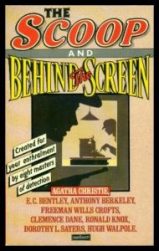
Slightly belatedly, here are my thoughts on the companion piece to ‘The Scoop’ (1931), another portmanteau mystery written for radio by some of the luminaries of the Golden Age. This time around, Hugh Walpole sets the problem of a dead body found in your typical Stage 3 suburban household, and Agatha Christie, Dorothy L. Sayers, Anthony Berkeley, E.C. Bentley, and Ronald Knox contribute to its unpicking.
Continue reading
#280: The Man Who Wasn’t There – An Unseen Side to Sexton Blake in Model for Murder (1952) by Derek Howe Smith
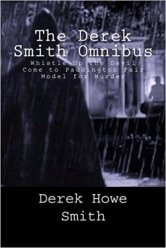
A year before the publication of locked room masterpiece Whistle Up the Devil (1953), and possibly just to get his eye in for the writing of a detective story, Derek Smith wrote a story featuring the popular pulp character Sexton Blake. It was never published, and only came to public awareness when John Pugmire compiled the Derek Smith Omnibus in 2014 which comprised Smith’s two novels, the Blake novella Model for Murder, and a short story entitled ‘The Imperfect Crime’.
Continue reading
#278: Six Were Present – A Collaboration of Titans in ‘The Scoop’ (1931)

Most fans of Golden Age detective fiction (GAD) will be aware of the portmanteau novel The Floating Admiral (1931) in which many luminaries of the form each contributed a chapter in turn to a murder mystery plot (pity poor Anthony Berkeley, who had to unravel all the clues and events to provide a coherent solution in the final chapter). I’m imagining that slightly — but only slightly — fewer of you will be aware of the precursors to this novel written in the preceding year, where the same sort of approach was taken for two mysteries to be broadcast on radio.
Continue reading
#123: Not With a Bang by Matt Ingwalson

So, following Matt Ingwalson’s writing of the first ever guest post here on The Invisible Event, I’m now duty-bound to recommend his third Owl and Raccoon story, right? I mean, sheesh, it’d be awkward if I lay into this. Let’s get that out of the way, then: is this good? No, it’s not good. It’s wonderful.
Continue reading
#122: Broken Bottles and Bloodspots: A guest post by Matt Ingwalson

Author photo: Chris Sessions
 “The impulse for this novel,” says Adam Roberts “was a desire to collide together some of the conventions of ‘Golden Age’ science fiction and ‘Golden Age’ detective fiction, with the emphasis more on the latter than the former.” Well, count me in! Sure, the authors he then cites (Margery Allingham, Ngaio Marsh, Dorothy L. Sayers, Michael Innes) don’t all fill me with delight, but this is a collision of my two favourite genres plus impossible crimes — how could I pass it up?! And it would have passed me by entirely had not blog-commenter ravenking81 brought it to my attention, so my most genuine thanks for that; at its best it’s a fascinatingly successful attempt at merging the two genres in a way that recalls both Isaac Asimov and John Dickson Carr, who, y’know, are the two finest authors to have worked in their respective genres. So that’s a good thing. By definition, however, it is not always at its best.
 The Invisible Event