Impossible Crimes
#70: Five to Try – Starting Paul Halter
After the fun of jointly analysing Paul Halter’s The Seven Wonders of Crime with Kate at CrossExaminingCrime, there’s now collateral damage to tidy up. Namely, that the inevitable question for anyone eager to take the plunge with the French maestro des impossibilités (and, frankly, how can you not be?) will be: Where do I start? Well, start wherever you like, of course, but if I had to pick my first five of the eleven currently available they’d look something like this:
Death Invites You (1998) [trans. 2015]
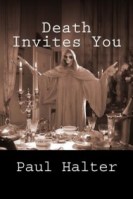 As I said in my review the other week, if you’re starting completely new with Paul Halter and/or impossible crimes then this is the perfect place to do it. The balance of plot and character is just right, the contortions for the murder of a man over a table set for a meal in his locked study – matching exactly the novel he was writing – are not too outré for the novice and, while the locked room element isn’t completely original, there’s no excess of foliage to obscure your view of what’s going on. This was the first book to feature Archibald Hurst and his harried genius amateur Alan Twist together, and it’s a relationship that feels natural from the very first page of them discussing impossible crimes while drinking in a pub. If Hurst ends up rather abject following his expressed desire for some “really meaty” case to get involved with, the reader is treated to the beginnings of a rather special relationship that will bring a great many hours of reading pleasure.
Continue reading
#66: The Bride of Newgate (1950) by John Dickson Carr
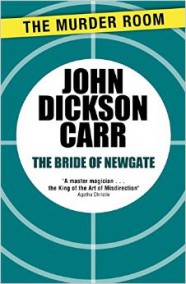 Existing somewhere between an early 2000s romantic comedy – probably starring Chris O’Donnell or Matthew McConnaughaghay – and The Count of Monte Cristo, John Dickson Carr’s The Bride of Newgate was his first foray into the historical mysteries that would come to typify his later career. You never write Carr off – like Christie he waned as he wore on, but there are enough flashes of fire after his peak for everyone to have two or three Later Carr highlights – but these dalliances with the extra detail required show a different side to our man. Mainly they show that he was a massive history nerd – detailing not just what people are wearing, say, but also what they would have removed from their outfit to be left with what they’ve got on – and that he was able to fit this into his wonderful brain and stir up something both necessarily of its setting that also fulfilled the expectations raised by his name on the cover.

I’m not going to tell you the plot – the opening four or five chapters are full of schemes, plans, and revelations enough that you should really experience completely pure – and will instead focus on the writing. Because while he gradually loses his grip on his narrative, his powers of portraiture are sent to their grandest heights with a renewed enthusiasm that is both this book’s chief joy and its main undoing. In a way it’s like a debut: he gets it wrong, but he tries hard and would improve after a few more attempts.
Continue reading
#63: Death Invites You (1988) by Paul Halter [trans. John Pugmire 2015]
Disclosure: I proof-read this book for Locked Room International in October 2015.
 Death Invites You, the third novel published by Paul Halter – who is swiftly gaining a deserved reputation as a deviser of baffling locked room puzzles – is based around the murder of man found dead in his study with the door bolted from the inside, seated at a table set for a meal. The victim, Harold Vickers, is an author who has gained a deserved reputation as a deviser of baffling locked room puzzles and whose next novel – Death Invites You – was due to feature a victim found dead in his study with the door bolted from the inside, seated at a table set for a meal. It is unfortunately never revealed whether Vickers’ victim was an author of some repute working in the field of locked rooms and whose next novel was due to feature such a crime, but, given the hall of mirrors that you enter at the beginning of any Halter narrative, it frankly wouldn’t surprise me…
Continue reading
#62: Death Invites You by Paul Halter is now available!
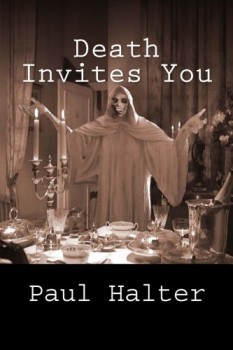
Being the massive Paul Halter fanboy that I am, it is with some delight that I belatedly realise the most recent translation of his from John Pugmire and Locked Room International is now available in print from a variety of sources and in e-book from your favourite rainforest-named purveyor of all things.
A locked-room murder of an expert in locked-room murders, I imagine this is how all crime writers would secretly love to go out. It’s a fiendish little puzzle that I fully and very enthusiastically recommend, and I’ll get a review up in due course. And it has that delightfully grotesque cover…what’s not to love?
Go, go quickly…
#61: The Footprints of Satan (1950) by Norman Berrow
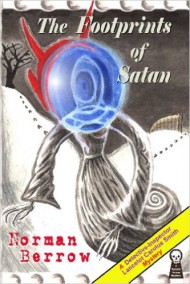 Lacking as I do the talent to devise my own fictional impossible crime and solution, I take refuge in those authors who have done it time and again to such success. The Footprints of Satan, my second Norman Berrow novel after the delightful surprise of The Bishop’s Sword, goes one even better: far from simply devising his own impossibility, he takes an unexplained one from real life, turns it to his own fictional purposes and then explains it away beautifully. Both the foreword and the plot here make reference to an incident from 1855 and reported in no less august a publication than The Times in which a trail of hoof-marks appeared in the snow as if from a cloven-footed creature walking on its hind legs.
Continue reading
#60: How a Lady Commits a Crime, and other reflections on And Then There Were None (2015)

I know, I know: I time my Sherlock Week so that it completely fails to capitalise on the BBC Christmas Special, and only now – several weeks after the event, when everyone else is well and truly done with it – only now do I get round to the BBC’s rather excellent adaptation of Agatha Christie’s island-based murder-fest. Undaunted by my lack of riding the ever-shifting popular wave, there are some things I thought I’d write about. Suffice to say, SPOILERS of all manner and sort follow; if you’re even later than me getting to this, you’re probably better off not reading any farther if you wish to view it completely pure (which, really, you should). I’m discussing the adaptation here rather than the book, but they match so closely in all the key details that I’ll be ruining something for you if you’re hoping the book is massively different. It isn’t. And that is a wonderful thing. Continue reading
#59: On Locked Rooms and Impossible Crimes in fiction – something of a ramble


 For those of you who lament the decline of the modern detective novel –
