Impossible Crimes
 Apologies for my recent blogging absence; a combination of what I understand are referred to as ‘IRL’ circumstances and the fact that everything I picked up and tried to read was absolute dreck put something of a kibosh on things. The sensible thing seemed to be just to write off September and move on. So now I’m back with the oft-cited classic — and so inevitably hard-to-find outside of the USA, where the lovely Mysterious Press have published it — locked room mystery Death of Jezebel by Christianna Brand. Why this one? Well, it’s supposed to be awesome and I’m trying to get into Brand, having been thoroughly meh’d by
 #129: Some Reflections on Editing A. Demain Grange’s ‘The Round Room Horror’ (1911)

As Ye Olde Book of Locked Room Conundrums edges ever closer — 11 of the 15 stories are now typed and ready, and TomCat is beavering away editing a twelfth — I thought I’d share my thoughts on certain aspects from the preparation, because it’s been an interesting insight into some things I’ve previously had no experience with. My apologies in advance if this seems self-aggrandising, I just think some of this will be of legitimate interest to you and have no desire to make it all “hey look how much work I’m doing”. No-one is making me do this, after all, and it’s honestly a huge amount of fun. Yes, my notion of fun is not like that of other people.
Continue reading
#127: ‘The Third Bullet’ and Other Stories [ss] (1954) by John Dickson Carr
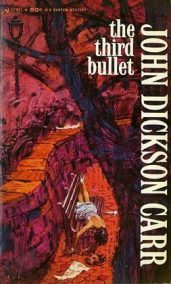 I haven’t reviewed (or read, come to that) a short story collection for a while, and it’s 1954 this month for Crimes of the Century at Past Offences meaning the time is ripe for a long-overdue (har-har) return to John Dickson Carr. I had read a couple of the stories contained herein before, but the majority were new to me, and as ever it’s a delight to see Carr’s imagination wrangle with the shorter form. Given how frequently stories of this ilk fail to conceal their workings and/or killer, it’s also great to see him do both over and over again with consummate ease, as if saying to his contemporaries “C’mon, guys, it’s simple –just do this“. We’ll take them one at a time as is my usual approach with collections — and, yes, most of these were originally published before 1954 and so might be inadmissible. Let’s just get on with it and an independent official enquiry can determine the eligibility of this at a later point.
Continue reading
#124: Invisible Green (1977) by John Sladek
 John Sladek is better known these days as a furiously inventive author of decidedly loopy SF — and I mean that as a compliment — but he did publish two detectives novels in the 1970s that each contained several impossibilities. The first, Black Aura (1974), has two disappearances and a man flying outside a third-storey window (without anything so amateur as wires holding him up, you cynic), and two-thirds of these are explained away superbly — the second disappearance in particular. It is a very good book, if perhaps a little slow in places, and boded well for the next time Sladek opted to dip his toe in our waters. Invisible Green, then, is very much the realisation of this potential, being superior in every single respect, and therefore something of a bittersweet read as we know now that nothing else followed it in the realm of the unachievable provably done.
Continue reading
#123: Not With a Bang by Matt Ingwalson

So, following Matt Ingwalson’s writing of the first ever guest post here on The Invisible Event, I’m now duty-bound to recommend his third Owl and Raccoon story, right? I mean, sheesh, it’d be awkward if I lay into this. Let’s get that out of the way, then: is this good? No, it’s not good. It’s wonderful.
Continue reading
#122: Broken Bottles and Bloodspots: A guest post by Matt Ingwalson

Author photo: Chris Sessions
The Owl and Raccoon novellas of Matt Ingwalson update the impossible crime to a modern setting and, as I have said previously, are hugely recommended reading for anyone with an interest in a good story convincingly told. Ahead of the publication of the third story, Not With a Bang, I asked Matt if he would be willing to oblige us with an insight into his writing and he very kindly offered the following.
Continue reading
#121: On the Many Wonderful Faces of Dr. John H. Watson, MD – Part 2 of 2

So, as established yesterday, there’s much more scope in Watson than there is in Holmes. The obvious question then becomes: So what do you do with this?
Take the simple cosmetic changes out of the equation — the casting of Lucy Liu as Dr. Joan Watson in the US series Elementary, for instance, easily one of the least disruptive changes it’s possible to get away with — and what you’re left with is the fact that Watson, being our entry into the Holmesiverse, is allowed to do anything that reflects the experience and perspective of the reader. As discussed yesterday, there are aspects of the character, the constants I referred to, that don’t become him — making him the proprietor of a burgeoning dog-walking business, or a respected scholar of nineteenth century Gothic poetry, or giving him a form of OCD which means he must always cross his legs in the opposite manner to Holmes unless it’s a Tuesday in which case…, etc — but let’s put this aside as given and look at the way certain authors have expanded on Watson without desecrating him beyond all recognition.
Continue reading
#119: An Undertaking – Ye Olde Book of Locked Room Conundrums
So, earlier this week I put up this post lamenting the poor selection of stories for a ‘new’ locked room anthology edited by David Stuart Davies. In response, the internet’s resident doyen of all things locked room, TomCat over at Beneath the Stains of Time, put up this post suggesting an alternative list of equally out-of-copyright stories suggested by a look through Robert Adey’s Locked Room Murders. To wit:
I arranged an alternative line-up of fifteen titles for Classic Locked Room Mysteries or a hypothetical, non-existent anthology, called Ye Olde Book of Locked Room Conundrums…
 “The impulse for this novel,” says Adam Roberts “was a desire to collide together some of the conventions of ‘Golden Age’ science fiction and ‘Golden Age’ detective fiction, with the emphasis more on the latter than the former.” Well, count me in! Sure, the authors he then cites (Margery Allingham, Ngaio Marsh, Dorothy L. Sayers, Michael Innes) don’t all fill me with delight, but this is a collision of my two favourite genres plus impossible crimes — how could I pass it up?! And it would have passed me by entirely had not blog-commenter ravenking81 brought it to my attention, so my most genuine thanks for that; at its best it’s a fascinatingly successful attempt at merging the two genres in a way that recalls both Isaac Asimov and John Dickson Carr, who, y’know, are the two finest authors to have worked in their respective genres. So that’s a good thing. By definition, however, it is not always at its best.
  People hold weird beliefs: that the moon landings have all been faked, for instance, or that the moon is hollow, or that the phases of the moon have anything at all to do with your love life or finances. Some people might even hold weird beliefs not about the moon. Here’s one: I firmly believe that for the remainder of human history there will never again be anyone who writes the detective novel as well as did John Dickson Carr at his peak. When I eventually narrow my ten favourite detective novels of all time down to a list that is actually ten books long, there’s a real chance all ten of them will be by Carr. And, I’ll tell you now, it will definitely feature
  The Invisible Event