Impossible Crimes
#154: Obelists Fly High (1935) by C. Daly King
 Sometimes it can be difficult to know where to start. C. Daly King’s third detective novel Obelists Fly High is such a time in my life. Is it good? No. Is it terrible? Yeah, it probably is. Now I have to explain that, and give examples from the text to back up my opinions, and it should all just fall into place. But it’s not simply a case of hurling invective at King and his attempts, because in some regards this is very clever — well, no, there’s one development, at the start of the fourth…section (they’re not really chapters) which borders on the very canny indeed. At the same time, I really did not enjoy reading this; it is hideously overlong, here’s a competent short novella in here at best, but explaining why is going to be like nailing jam to the ceiling. Ah, well, here goes…
Continue reading
#153: The Tuesday Night Bloggers – Five to Try…But What’s the Theme?

In what might actually be the first time I’ve contributed to a full month of TNB posts — woo! Mr. Commitment! — I thought I’d finish off with my first Five to Try in a little while on the subject of Crime in Costume. But, this being a blog about detective fiction, I thought I’d leave it up to you to deduce the theme inside of this framing which links all these books together.
The first person to correctly work it out gets…a prize of some sort. Tell you what, they’ll win a pre-publication copy of Ye Olde Book of Locked Room Conundrums, personally emailed to them by me. So as, y’know, to save them waiting an extra three or four days and having to click on a link to download it themselves. I know, I know, I’m too kind. Tell you what — to make it nice and unique, I’ll even add a bit to the introduction about how this was won in a competition on the blog. That makes it a bit more special, eh?
Continue reading
#151: Harper Collins’ The Detective Club Republishing The Conjure-Man Dies (1932) by Rudolph Fisher!

Well, well, well, more good news: following the emergence of Erle Stanley Gardner’s missing Cool and Lam novel, it transpires that another classic — and one I’ve personally been trying to find for a while now — is also due back into circulation.
Continue reading
#150: The House That Kills (1932) by Noël Vindry [trans. John Pugmire 2015]
 Aaaah, the debut novels of celebrated authors. Would anyone read It Walks by Night and predict The Problem of the Green Capsule or Till Death Do Us Part? Does The Mysterious Affair at Styles in any way prepare you for The Moving Finger, or for Crooked House? Often it’s a challenge to look back on the opening salvo of a career that would go on to become notable and find any vestige of that in those first few hundred pages, and it can be even harder when — as in the case of Noel Vindry’s The House That Kills — you’re waiting 80 years to read it in your native language and are told up front of the author’s own huge contribution to the genre. Frankly, it needs to be The Usual Suspects mixed with The Mystery of the Yellow Room (spoilers for that in this, incidentally) as rewritten by David Mamet…and even then it probably won’t match the hype.
Continue reading
#149: The Tuesday Night Bloggers – A Plague of Flaming Phantoms…
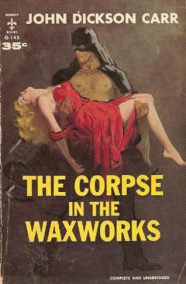 The penultimate case for John Dickson Carr’s first sleuth, Henri Bencolin, opens with a wonderful demonstration of the reputation which that juggernaut of justice enjoys among the less salubrious sections of French society: ‘Bencolin was not wearing his evening clothes, and so they knew that nobody was in danger.’ The palpable sense of relief this engenders in all who see him as he travels from tavern to tavern captures the character with a clarity that shows how much Carr grew as an author over his opening five books, and augurs well for the Fellian delights that would follow soon upon the heels of this as Carr hared his way up the detective fiction firmament and into history. And it sets the scene nicely for a deceptively complex little book that almost feels like a short story in its setup, but is wrought into something more by the expert pacing Carr has honed in the couple of short years since It Walks By Night (1930), showing here his emerging talent for taking a situation that many others would struggle to fill 20 pages with and making every nuance and moment of its 188 pages count.
 The Invisible Event