Genius Amateur
#190: A Smell of Smoke (1959) by Miles Burton
 Over the summer, I read certain sections of Masters of the Humdrum Mystery by the blogosphere’s very own Passing Tramp, Curtis Evans. Certain sections because, to be perfectly honest, Curtis has done an amazing job in analysing so much of the work of J.J. Connington, Freeman Wills Crofts, and John Rhode/Miles Burton that it’s clear I need to do a lot more reading to get the most out of what he has written. Upon (in fact, while) reading A Smell of Smoke I went back to see what insight Curtis could offer to explore Street’s motivations or intentions, but there is no mention of it at all; no fault of his, as Street published over 130 novels under his two most famous pseudonyms, but I suspect I know why it doesn’t get a mention: it isn’t very good at all.
Continue reading
#176: Leonardo’s Law (1978) by Warren B. Murphy
 Benjamin Disraeli had it right when he said “there are three kinds of lies: lies, damn lies, and publishers’ breathless comparisons to the classics”. I’ve been bitten once by this recently, so was doubly shy of the promise on the reverse of Warren B. Murphy’s sole detective novel to feature Dr. David Vincent Leonardo that it would introduce “a splendid new addition to the ranks of Holmes, Poirot, [and] Dupin”. To be upfront about it, obviously that’s not the case, but despite some flaws in the rendering of our genius amateur — of which more later — this is honestly a lot of fun, and joins the ranks of Hmmmm, What If They’d Written More of These? because, yeah, it lacks in artistry, but if you want a swift, reasonably smart, and engaging unheralded locked room puzzle you could do a damn sight worse.
Continue reading
#153: The Tuesday Night Bloggers – Five to Try…But What’s the Theme?

In what might actually be the first time I’ve contributed to a full month of TNB posts — woo! Mr. Commitment! — I thought I’d finish off with my first Five to Try in a little while on the subject of Crime in Costume. But, this being a blog about detective fiction, I thought I’d leave it up to you to deduce the theme inside of this framing which links all these books together.
The first person to correctly work it out gets…a prize of some sort. Tell you what, they’ll win a pre-publication copy of Ye Olde Book of Locked Room Conundrums, personally emailed to them by me. So as, y’know, to save them waiting an extra three or four days and having to click on a link to download it themselves. I know, I know, I’m too kind. Tell you what — to make it nice and unique, I’ll even add a bit to the introduction about how this was won in a competition on the blog. That makes it a bit more special, eh?
Continue reading
#129: Some Reflections on Editing A. Demain Grange’s ‘The Round Room Horror’ (1911)

As Ye Olde Book of Locked Room Conundrums edges ever closer — 11 of the 15 stories are now typed and ready, and TomCat is beavering away editing a twelfth — I thought I’d share my thoughts on certain aspects from the preparation, because it’s been an interesting insight into some things I’ve previously had no experience with. My apologies in advance if this seems self-aggrandising, I just think some of this will be of legitimate interest to you and have no desire to make it all “hey look how much work I’m doing”. No-one is making me do this, after all, and it’s honestly a huge amount of fun. Yes, my notion of fun is not like that of other people.
Continue reading
#118: Jack Glass (2012) by Adam Roberts
 “The impulse for this novel,” says Adam Roberts “was a desire to collide together some of the conventions of ‘Golden Age’ science fiction and ‘Golden Age’ detective fiction, with the emphasis more on the latter than the former.” Well, count me in! Sure, the authors he then cites (Margery Allingham, Ngaio Marsh, Dorothy L. Sayers, Michael Innes) don’t all fill me with delight, but this is a collision of my two favourite genres plus impossible crimes — how could I pass it up?! And it would have passed me by entirely had not blog-commenter ravenking81 brought it to my attention, so my most genuine thanks for that; at its best it’s a fascinatingly successful attempt at merging the two genres in a way that recalls both Isaac Asimov and John Dickson Carr, who, y’know, are the two finest authors to have worked in their respective genres. So that’s a good thing. By definition, however, it is not always at its best. Continue reading
#117: The Tuesday Night Bloggers – The Underwhelming Origins of Ellery Queen in The Roman Hat Mystery (1929)
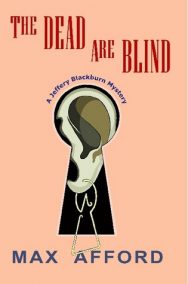 I believe the philosopher John Francis Bongiovi, Jr. said it best: “Keep the faith”. The Dead Are Blind is the third novel by Max Afford I’ve read and, having hugely enjoyed the other two, I found myself struggling to maintain interest through the opening chapters. Certainly from a historical perspective they have plenty to offer – our lead characters are invited to tour a radio studio on its opening night, something of a gala event at the time, and so this is chock-full of fascinating tidbits from Afford’s own experience of working in radio. But the mix of dense description and fixation on minute details that are hugely unlikely to become relevant later puzzled even my will and left me a bit apathetic by the end of chapter two.
 The Invisible Event