The detective fiction genre is built around the essential structure of a crime, an investigation of that crime, and the revelation of the guilty party who committed the crime, and good heavens didn’t the Golden Age map out a lot of different ways to walk that path. And there are few people better placed to discuss this than President of the Detection Club and recent recipient of the CWA Diamond Dagger Martin Edwards, who celebrates three decades as a published author this year.
Continue readingCarter Dickson
#790: On the Morals of Golden Age Detective Fiction, via Crime and Detection [ss] (1926) ed. E.M. Wrong
That title is doing a lot of work, isn’t it? Fair warning: this goes on a bit.
At the online Bodies from the Library conference last weekend, I gave a talk inspired in part by E.M. Wrong’s introduction to the 1926 anthology Crime and Detection. And, in addition to coining the term “Wellington of detection” that inspired the thinking I laid out last weekend, there is plenty of material in that piece of prose to get the cogs turning.
Continue reading#782: Below Suspicion (1949) by John Dickson Carr

![]()
![]()
![]()
![]()
![]()
After a year — a year, people — of mind-numbing repetition and drudgery against a background of tragedy, Below Suspicion (1949), John Dickson Carr’s forty-sixth book in twenty years and the 18th to feature Dr. Gideon Fell, was exactly what I needed…for the simple reason that it is so very, very different. Ten years from now I could reread this and be appalled that I ever thought it so great, but right now it is manna from heaven: eerie, baffling, infuriating in many ways, and fascinating given the direction we know Carr’s career took from this point in how it blends the classic detection he had excelled in with the historical mysteries he was about to launch himself into.
In GAD We Trust – Episode 19: Reissue! Repackage! Repackage! [w’ Various People]
On the back of the Reprint of the Year Award run by Kate at CrossExaminingCrime, I thought it might be interesting to see what those of us who submit titles for that undertaking would choose to bring back from the exile of being OOP.
Continue reading#761: The Skeleton in the Clock (1948) by Carter Dickson

![]()
![]()
![]()
![]()
![]()
On the afternoon of November 4th 1927, Sir George Fleet stood unaccompanied on the flat roof of Fleet House and was, as several independent witnesses assert, pushed to his death by invisible hands. Twenty years later, Scotland Yard receive three anonymous postcards marked “Re: Sir George Fleet” exhorting them to “examine the skeleton in the clock” and asking “what was the pink flash on the roof?” because “evidence of murder is still there”. Enter Chief Inspector Humphrey Masters, dragging the Old Man, Sir Henry ‘H.M.’ Merrivale, in his wake…Merrivale himself having just bought a grandfather clock which has a skeleton suspended inside of it.
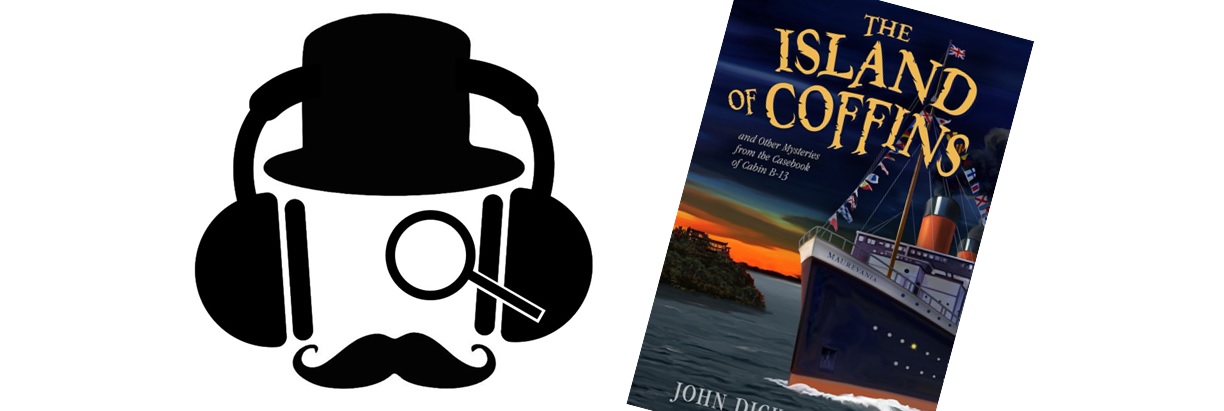
In GAD We Trust – Episode 14: The Island of Coffins (2021) by John Dickson Carr + The 9.50 Up Express (2021) by Freeman Wills Crofts [w’ Tony Medawar]
We’re all prone to speculate at times about how wonderful it would be to discover a previously-unpublished work by a beloved Golden Age author, and for today’s podcast episode Tony Medawar rejoins me to tempt you with two forthcoming collections of hard-to-find material from two of the genre’s titans — John Dickson Carr and Freeman Wills Crofts.
Continue reading#710: “And what would you call the right surroundings for reading a ghost story?” – The Dead Sleep Lightly (1983) by John Dickson Carr [ed. Douglas G. Greene] Part 2 of 2

Two weeks ago I looked at the first four plays in this collection, so let’s get on the with final five.
Continue reading#704: “That’s an interesting choice of phrase, young man…” – The Dead Sleep Lightly (1983) by John Dickson Carr [ed. Douglas G. Greene] Part 1 of 2

It’s fair to say that no-one has done more for the curation of John Dickson Carr’s work than Douglas G. Greene: collecting various obscure short pieces in the likes of The Door to Doom and Other Detections (1980), Merrivale, March, and Murder (1991), and Fell and Foul Play (1991), writing the staggeringly comprehensive (and recently reprinted) biography The Man Who Explained Miracles (1995), and enabling, through Crippen & Landru, publication of two — soon to be three — collections of Carr’s radio scripts edited by Tony Medawar.
Continue reading#702: Shedunnit x The Invisible Event – Locked Room Mysteries