#148: So, Like, What Is an Impossible Crime or a Locked Room Mystery?

locked-room

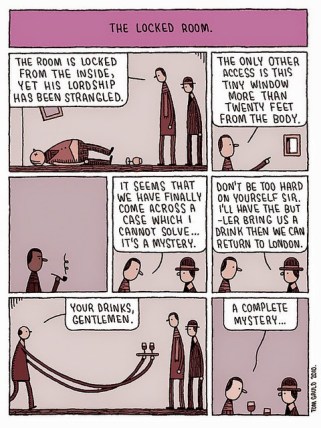
Recent experiences of reading Darkness at Pemberley by T.H. White and What a Body! by Alan Green  — oh my days, I’ve only just noticed that they’re both named after colours… — have made me wonder on the above question.  See, both are listed here, on a compendium of the best ever locked room mysteries voted on by an international collection of people who know about this stuff, and both are listed here, on a rundown of the favourite locked room mysteries by resident blogosphere expert TomCat…yet personally, in the face of public opinion from such well-informed and respected sources, I’m reluctant to consider either of them as locked room mysteries.  Even taking my famously contrary nature out of the equation…what the hell?

Continue reading

#132: When Inspiration Becomes Theft

Plagiarism

Zing!

The other day, I posted this dismissal of Raymond Knight Read’s The Third Gunman which is really nothing more than a rewriting of John Dickson Carr’s The Hollow Man, and then John Grant over at his superb Noirish blog posted this look at the 1934 film The Ninth Guest which follows rather closely the premise of Agatha Christie’s And Then There Were None…except the film predates Christie by five years, so technically ATTWN follows it closely, much to my amazement.

Continue reading

#125: A Sudden Flush of Youth (or Two) in Agatha Christie’s Endless Night (1967)

Although Agatha Christie’s later works put her out of era for this blog, I’m still keen to look at these books on account of the level of impact she had on the genre.  So The Mirror Crack’d from Side to Side (1962) was an early review when I was less rigid in my restrictions, but alas I had nothing to say about The Clocks (1963).  Then came the one-two punch of A Caribbean Mystery (1964) and At Bertram’s Hotel (1965) before Poirot once again got a short shrift with the rather forgettable Third Girl (1966), which Brad has analysed with typical adroitness here.  So, because I’m reading these chronologically, this brings me to Endless Night.

Continue reading

#102: Paul Halter Day – II: The Impossibility of More Impossibilities

Paul Halter Day 2

Declaring that the detective novel was the only form of literature that put the reader to work, [S.S. van Dine] argued that “a deduction game emphasising fair play within a limited setting” would be the story structure with the best potential to result in masterpiece mystery stories […] But when the elements of the game are too severely limited and the building materials are all the same, only the first few builders will get all the glory and there will be an over-abundance of similar novels…

—Soji Shimada, in his introduction to The Moai Island Puzzle

Continue reading

#92: Character v Plot

Character v PlotSo here’s a starting point that doesn’t belong on a blog about crime fiction between 1920 and 1959 with frequent diversions into apparent impossibilities: I freakin’ love Batman. The whole Bruce Wayne/Batman duality in almost any form is an absolute joy to me – I’m not going to geek out here over the many, many years I’ve spent reading the comics nor the sundry disappointments of the various cinematic fusterclucks (I’m looking daggers at you, Schumacher…Burton, you’re borderline), and shall instead make the following observation: the second I heard Batman v Superman: Dawn of Justice was announced, I’d practically bought my ticket on the fact of it being a new Batman incarnation.
Continue reading

#83: “One gets to remembering things in a place like this…” – a meta-analysis of Agatha Christie’s At Bertram’s Hotel (1965)

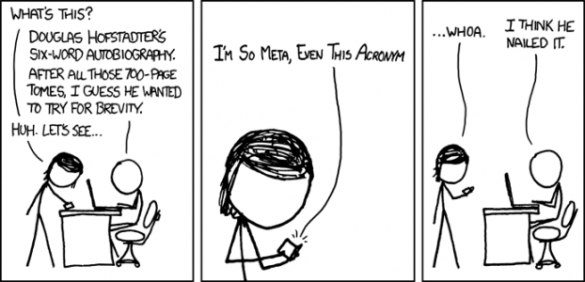
It is a truth universally acknowledged that as Agatha Christie approached the twilight years of her career the quality of her output dipped somewhat.  And yet, as I’ve said elsewhere, what these novels appear to lack in merit from a plot perspective they arguably make up for in a kind of critical self-analysis of her own position in the firmament of crime fiction.  And At Bertram’s Hotel, the tenth Miss Marple novel, provides yet more opportunity to potentially read too much into her writing from this perspective.  I mean, don’t get me wrong, she’s no Douglas Hofstadter, but who’s to say this is a completely bad turn of events*?

meta Continue reading

#74: “Old people know how valuable life is, and how interesting…”, portrayals of age in Agatha Christie’s A Caribbean Mystery (1964)

Agatha Christie was 74 years old when she published her ninth Miss Marple novel, A Caribbean Mystery, by which time – as I said in my review of The Mirror Crack’d from Side to Side – she would have known a lot about the procedures of ageing.  There were still 13 books to come from her pen (well, 11 really, since the final Marple and Poirot books had famously been written some years previously) and this belief in her own abilities is echoed in the treatment of her beloved elderly spinster as, in spite of the infirmities she suffers and the attitude others take towards her, she continues to outfox murders left, right, and centre.

Christie, of course, had less to prove by now than she would have done in her younger days and so this isn’t a “We’ve Still Got It” Oldies v. Whippersnappers cage match – the Clint Eastwood movie Space Cowboys comes to mind, and can thankfully be dismissed – but is instead a moderately elegiac reflection on old age, youth, and the folly of both (contrast it with the far earlier Partners in Crime, where Bright Young Things Tommy and Tuppence prove their worth at a range of investigative styles).  And since I’ve been in a bit of a reading funk for a few weeks now (which I promise I’ll not mention again) I thought I’d try a bit of a textual analysis on this theme to see if it got me anything interesting.

Continue reading

#60: How a Lady Commits a Crime, and other reflections on And Then There Were None (2015)

AttWN

I know, I know: I time my Sherlock Week so that it completely fails to capitalise on the BBC Christmas Special, and only now – several weeks after the event, when everyone else is well and truly done with it – only now do I get round to the BBC’s rather excellent adaptation of Agatha Christie’s island-based murder-fest.  Undaunted by my lack of riding the ever-shifting popular wave, there are some things I thought I’d write about.  Suffice to say, SPOILERS of all manner and sort follow; if you’re even later than me getting to this, you’re probably better off not reading any farther if you wish to view it completely pure (which, really, you should).  I’m discussing the adaptation here rather than the book, but they match so closely in all the key details that I’ll be ruining something for you if you’re hoping the book is massively different.  It isn’t.  And that is a wonderful thing. Continue reading

#29: The spurns that patient merit of th’unworthy takes: To complete or not to complete?

MBC

I will probably put this very poorly, so bear with me.

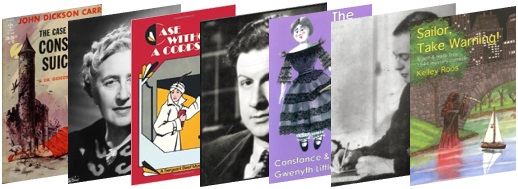
I am an Agatha Christie fan.  I am also, you may have noticed, a fan of John Dickson Carr, and of Edmund Crispin, Leo Bruce, Rupert Penny, Kelley Roos, and Constance & Gwenyth Little.  What these detective fiction writers have in common is two-fold: firstly they are all dead, so their output is now a fixed and known quantity, and secondly it is my express intention to read everything they ever published in the crime fiction sphere.  In some cases this may not be achievable – though with the recent increase in GA reprints it’s to be hoped that these will be picked up before too long – but I intend to give it my best shot nonetheless.

Continue reading