![]()
![]()
![]()
![]()
![]()
Official Case #13 for the Cool & Lam Detective Agency, Top of the Heap (1952) finds A.A. Fair, nom de plume of Erle Stanley Gardner, on slick-but-unmemorable form — mixing ingredients in a way that is at once comfortably familiar for this series yet tries to ring a few changes at the same time. And while it’s certainly not a bad book, for this reader — an avowed fan of Gardner and Fair both — it all sort of fell apart in the closing stages in which so much surmise is piled up that it’s to be wondered whether some sort of meta-textual commentary on the concept of ‘solving’ a case is being offered. It’s not, but, wow, is Donald Lam ever out on a limb or five here, and it shows.
A.A. Fair
#1326: Bedrooms Have Windows (1949) by A.A. Fair
![]()
![]()
![]()
![]()
![]()
The twelfth published novel from Erle Stanley Gardner under his A.A. Fair nom de plume, Bedrooms Have Windows (1949) finds L.A. P.I.s Bertha Cool and Donald Lam once more skirting the law in pursuit of a case whose precise shape is obscured by the sheer number of actions dragged across its trail. And while this should be getting pretty tiresome by now, the truth is that since series nadir Crows Can’t Count (1946) Fair has delivered some blisteringly fast and fun little crime thrillers that go a long way to show how to write entertainingly: let everything fly at the page, and have someone as unshakeable as Donald on hand to unpick whatever madness you throw him into.
#1275: Fools Die on Friday (1947) by A.A. Fair
![]()
![]()
![]()
![]()
![]()
As my grandfather used to say, “When you fall off the horse, get back on the horse”. And that’s why he made such a controversial judge at gymnastic competitions. But the fact remains that lately I’ve had some disheartening reading experiences with favoured authors — John Dickson Carr, J.J. Connington, Freeman Wills Crofts, A.A. Fair, Craig Rice, Cornell Woolrich J.J. Connington again, maybe Rice a second time — and so the tempting thing is to leave them alone for a while, wait for that memory to fade, and then return. But, no, I’m not doing that, I’m reading Fair again now, because why not? That’s what the horse is here. It was a pommel horse all along.
#1230: Crows Can’t Count (1946) by A.A. Fair

![]()
![]()
![]()
![]()
![]()
How do you go about discussing a book you couldn’t even be bothered to finish? The tempting thing is not to review it at all, but I’m committed to certain undertakings on this blog — the complete works of Freeman Wills Crofts, the complete John Thorndyke stories of R. Austin Freeman, more Walter S. Masterman than most people will ever consume — and the full Cool & Lam by A.A. Fair, nom de plume of Erle Stanley Gardner, is one of them. So how to write about Crows Can’t Count (1946), the tenth published Cool & Lam novel, and the first time this normally lively and entertaining series has draaaaaaagged me into the doldrums of an almost spiritual level of indifference?
#1189: Give ‘Em the Ax, a.k.a. An Axe to Grind (1944) by A.A. Fair

![]()
![]()
![]()
![]()
![]()
On the day when the United States of America celebrates its independence, let’s turn our eye upon American author Erle Stanley Gardner, here publishing the ninth novel to feature Bertha Cool and (the triumphant return of) Donald Lam, Give ‘Em the Ax, a.k.a. An Axe to Grind (1944). Having been invalided out of the Navy with tropical fever, Donald is back in America and straight back to work: initially asked to rustle up some dirt on the suspected gold-digging new wife of a businessman, it’s not long before things become unsurprisingly more complex, and the small matter of murder rears its head. How, though, does a car accident which Bertha witnesses play into proceedings?
#1165: Cats Prowl at Night (1943) by A.A. Fair

![]()
![]()
![]()
![]()
![]()
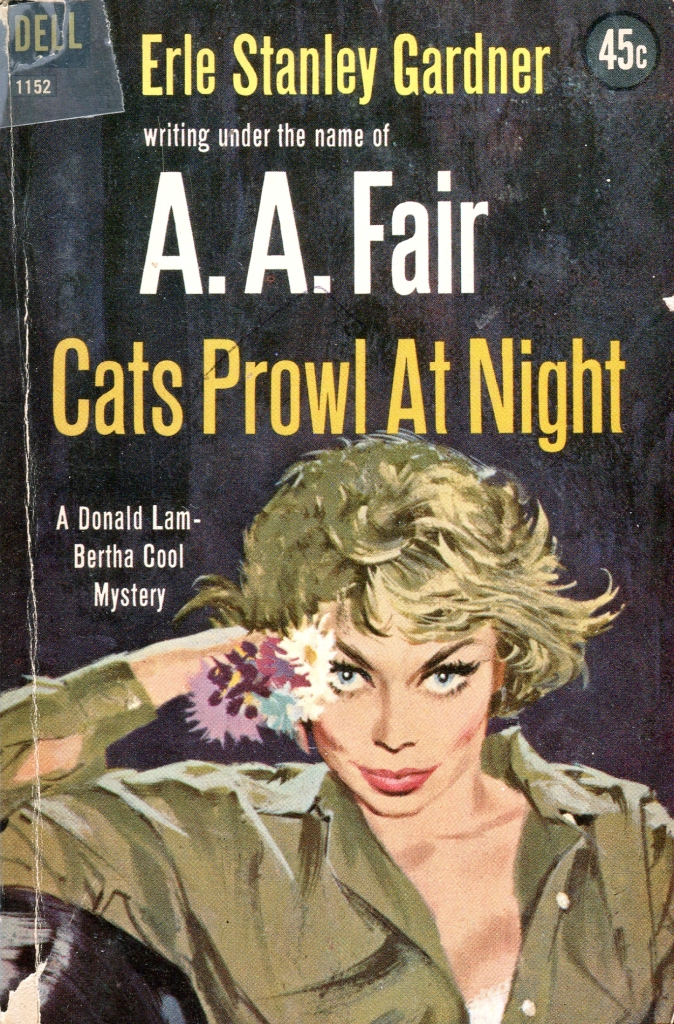
Look, I can’t swear to it, but I have a suspicion that Cats Prowl at Night (1943), the eighth published book in Erle Stanley Gardner’s series featuring Bertha Cool and Donald Lam, written under this A.A. Fair nom de plume, just might be the first title of his I ever read. Reading it now, some 20 years later, it tickled enough memory buttons to be tauntingly familiar while also furiously out of reach, but the distinct aspect that separates this book from its brethren — namely the absence of pocket dynamo Donald Lam from its pages — feels familiar, if only because I get the sense I started these books with no sense of Lam as a character.
#1124: Bats Fly at Dusk (1942) by A.A. Fair

![]()
![]()
![]()
![]()
![]()
With considerations of the era taking Donald Lam out of the Cool and Lam Detective Agency, Bertha Cool is left to fend for herself when a blind man wishes to hire her services in tracking down a young woman who, he claims, has disappeared. It’s an unusual jumping-off point in itself, but the real delight here is how intelligently Erle Stanley Gardner, writing under his A.A. Fair nom de plume, explores and explains the way the blind man is able to identify so many different people — and how intelligently he is able to come to conclusions about the woman whose wellbeing is his concern. And then others start to express an interest in the same woman; and then someone is murdered…
#1055: Owls Don’t Blink (1942) by A.A. Fair

![]()
![]()
![]()
![]()
![]()
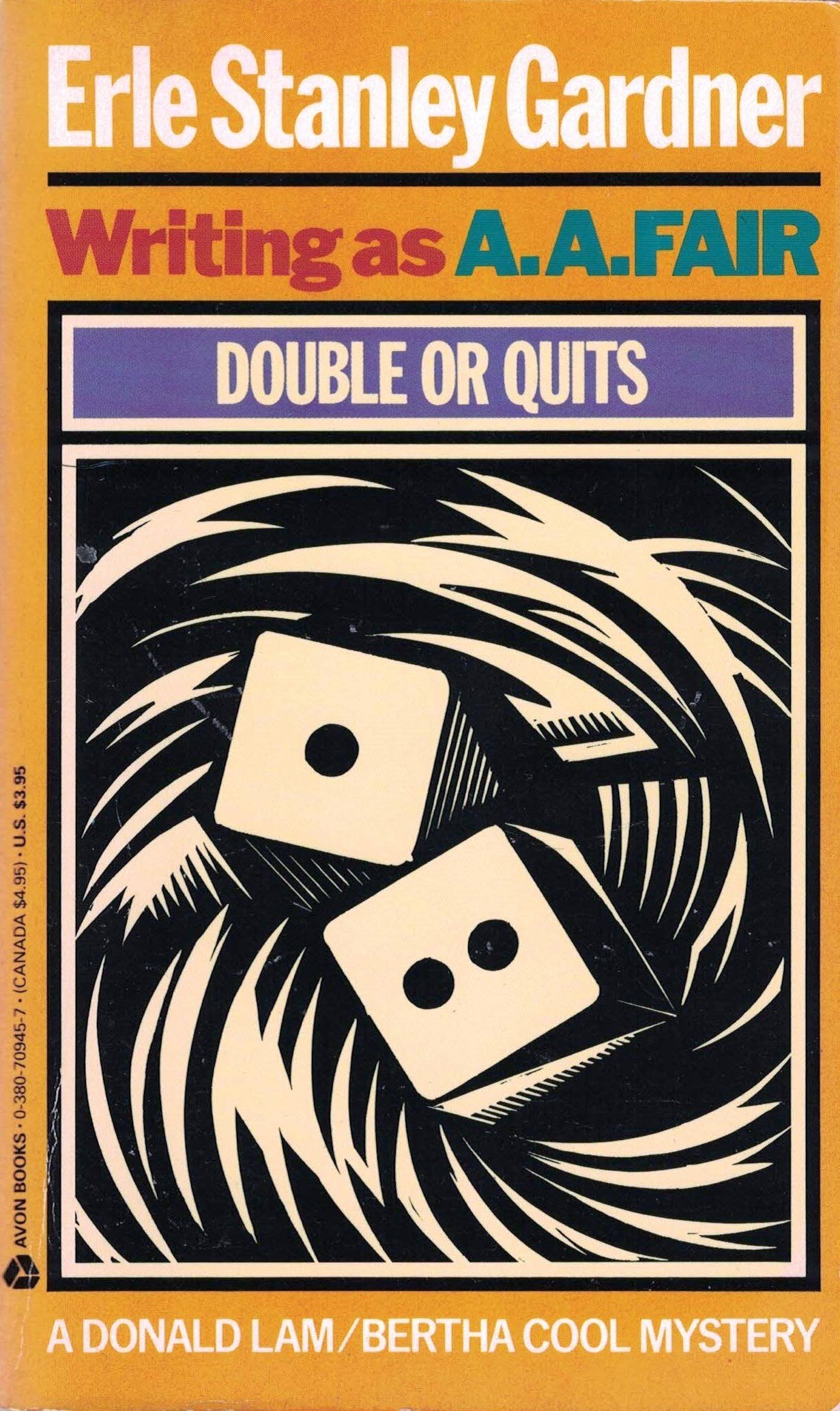
If I remember correctly — and, let’s face it, I probably don’t, since I read them years ago and all out of order — Owls Don’t Blink (1942), the sixth title to feature Erle Stanley Gardner’s irrepressible P.I. duo of Donald Lam and Bertha Cool, starts something of a hot streak for the series. Hired by New York lawyer Emory Hale on behalf of an unknown client to find an ex-model who was last heard of in New Orleans some three years ago, you know Gardner has something special up his sleeve when the resourceful Donald is able to produce the woman within twenty pages. From here, it’s a criss-cross of obscured motives and identities, and enough skulduggery for Yorrick’s remains.
#1011: Double or Quits (1941) by A.A. Fair

![]()
![]()
![]()
![]()
![]()
Where the novel of detection delights in tropes so as to better lull you in and then sock you with an unexpected development, I’m starting to suspect that the private eye novel likes tropes so that you’re as comfortable as possible throughout without ever having to pay too close attention. You sign up for wealthy families, suspicious deaths, shady hangers-on, and plenty of business malfeasance, all the better to then unfurl a complex final chapter explanation which probably works as well as anything else, but, hey, at least it was entertaining while it lasted. And the world absolutely has a place for that kind of book, just don’t expect me to get too excited when I encounter one of them.
#984: Spill the Jackpot (1941) by A.A. Fair

![]()
![]()
![]()
![]()
![]()
Two days before her wedding to Philip Whitewell, Corla Burke upped and disappeared from her place of work, leaving behind all her personal property: “she simply vanished into thin air, and hasn’t been heard from since”. Following a slender lead to Las Vegas, the groom-to-almost-was’s father Arthur hires the B. Cool Detective Agency to “find out what happened to Corla, why she disappeared, where she is now”…and so we’re off. And, of course, everything will go to plan for pint-sized investigator Donald Lam and he definitely won’t find himself pursued, beaten up, and accused of murder. No, wait — fry me for an oyster, that’s exactly what happens to him…good lord, however will he get out of this jam?