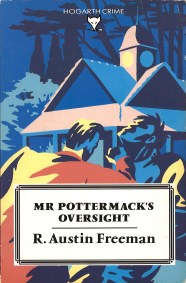
When digging his garden to lay a foundation for a new sundial, quiet, unostentatious bachelor Marcus Pottermack uncovers a previously-unknown well. That same day, he receives yet another demand for money from the man who is blackmailing him, and it’s only a matter of time before one problem is used to solve the other. And when curiosities about the man’s disappearance are raised in passing with Dr. John Thorndyke, it’s only a matter of time before that pillar of truth is on the trail of quiet, unostentatious Marcus Pottermack. And yet, for all its conventional-sounding setup, Mr. Pottermack’s Oversight (1930) is a delightfully unconventional inverted mystery.
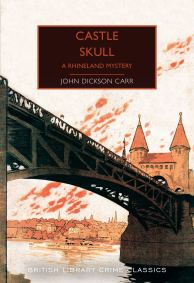
I’m being a bit cheeky here, using what I believe will be the cover for the British Library Crime Classics reissue of this due out early next year when it’s not actually my copy — I’ll show that below — but, c’mon, it’s a thing of beauty. The skull-shaped castle the title promises and narrative delivers has been somewhat done to death in previous editions, and it’s nice to see someone being a little more liberal in their interpretations. Though, now I’ve said that, the BL will change the cover ahead of its January release to a castle made entirely of skulls, presided over by a man made of skulls, punching Skeletor with a skull-shaped boxing glove.
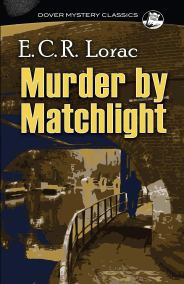
Back when E.C.R. Lorac was a semi-forgotten also-ran, I snapped up this Dover Press reissue before I figured the book would vanish into oblivion, hoping I’d smartly acquired an obscure gem. Skip forward a mere couple of years and the British Library Crime Classics series continues its exemplary work in reviving a wide range of authors and texts, and Murder by Matchlight (1945) has been dragged from its dusty and semi-overlooked corner into the full glare of publicity. Goddamn it, there goes half my retirement plan; oh, well, fingers crossed that the bottom doesn’t fall out of the fidget spinner market any time soon…
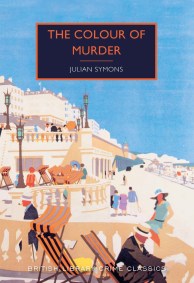
John Wilkins has never quite fitted in anywhere: not in his father’s affections, not in the Army, not at his tennis club, not even in his marriage. Even when he feels as if he acquits himself well at something, there’s still a part of his mind he closes off for fear that he’ll realise “that the whole thing is a daydream and you’re just being stupid”. And so when a chance encounter with librarian Sheila Morton stirs in Wilkins something he’s not experienced for quite some time — “I’m not attractive to women” he tells us on more than one occasion — it’s also the first step along a road that ends with murder. The question is, whose murder?
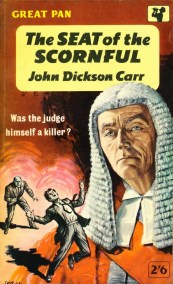
It’s cold outside, it’s dark outside — yes, thank-you, The Southern Hemisphere, no-one likes a smartarse — Christmas is over; time to battle through with some beloved authors. First up, and most beloved of them all despite a recent charge by Freeman Wills Crofts, Mr. John Dickson Carr and Dr. Gideon Fell, here engaged in no showy impossibilities but instead the sort of low-key case for which Carr doesn’t get enough credit. Where the relative simplicity of this might lead to this being overlooked, I’d argue that its restrained execution and structure are so brilliantly without flaw that the more easily you dismiss it the more you’re falling into the very trap it lays.
As discussed previously, we are here today to find out how good I am at spotting clues and things in the detective novel London Particular, a.k.a. Fog of Doubt (1952) by Christianna Brand. We’ll be doing this by examining my thoughts on a chapter-by-chapter basis and there will be spoilers. Do not read futher if you wish to remain unspoiled.
In German there is schadenfreude, pleasure at the misfortune of others, which I believe is the intended response to Richard Hull’s Murder of My Aunt (1934). I’m sorry to say that in reading it I experienced more the Spanish vergüenza ajena, that toe-curling horror of watching someone make a prat of themselves, and not in any sort of a good way. But in order to (hopefully) prove that I’m not a humourless prig I’ve opted for another light, funny mystery with Alan Melville’s Quick Curtain (1934), having enjoyed but not really retained much of the similarly-republished Death of Anton (1936) from the British Library.
Last Saturday was — as Kate, Puzzle Doctor, Moira, and Martin Edwards have already reported — the Bodies from the Library Conference 2018 at the British Library, and a superb day it was indeed.
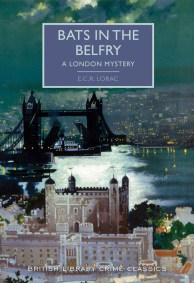
If you seek evidence of my tendency to over-commit where GAD is concerned, look no further than my reading and reviewing two E.C.R. Lorac titles and then buying a further, ahem, six before actually getting round to reading any more. For all her perceived failings — not as rigorous as Christie, not as refined as Sayers, not as dull as Marsh — I’ve found my first few books by Edith Caroline Rivett to distinguish themselves in her approaching fairly standard setups with an air of trying to do something a little uncommon. We’re not reinventing the wheel, but we are putting a different tread on the tyres.
Detective fiction’s Golden Age produced many very witty books — Case for Three Detectives (1936), etc — but Family Matters (1933) by Anthony Rolls is to my mind the first time that the process of killing someone is genuinely funny. As a deployment of the detached third-person narrator it might represent the pinnacle of the genre. In many ways, this stands apart from the remainder of GAD in the way The Ladykillers (1955) stands apart from other Ealing comedies: it is savage and unsparing, and not afraid to show you the darkness beneath…but done with such a surety of touch that you don’t know whether a sentence is a joke or a profound truth until you finish it.






 The Invisible Event