#194: Spoiler Warning 1 – The Ten Teacups, a.k.a. The Peacock Feather Murders (1937) by Carter Dickson

In what I’m hoping will be the first of a semi-occasional series — look, I’ve made a special header image for it and everything — we are here today to discuss the 1937 impossible crime novel The Ten Teacups, published in the U.S.A. as The Peacock Feather Murders, from John Dickson Carr under his Carter Dickson nom de plume. Puzzle Doctor, wrangler of In Search of the Classic Mystery Novel, kindly agreed to reread this one and then exchange some thoughts on aspects of the precise details and workings of the book, and the results of our efforts are below. Suffice to say, if you click to read more of this, there are guaranteed massive spoilers from this point on; don’t say I didn’t warn you…
Continue reading
#193: Sailor, Take Warning! (1944) by Kelley Roos
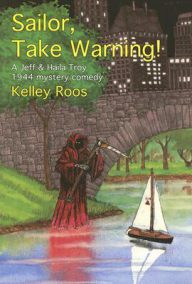 Sometimes you just have to bite a bullet: following the exceptionally sad loss of the Rue Morgue Press, this is the final Jeff and Haila Troy novel currently available, but, well, let’s enjoy it, eh? Audrey and William Roos did such a great job with so many aspects of the writing in these first four books — the dialogue is genuinely funny, the plots mostly move at a great pace, the mysteries are intriguing, and third book The Frightened Stiff is a genuine genre classic for all time — that we shouldn’t get too weighed down with lamenting their unavailability. Common sense will prevail, they’re too good to let go out of print for any length of time, and this won’t be the last we see of the Troys. Right?
Continue reading
#192: The Tuesday Night Bloggers – First Steps Into the Woods with Orion’s Crime Masterworks…
Last week I talked about my first encounter with both Agatha Christie and classic detective fiction, and it got me all reflective about how things built from there and brought us to the point where via magic of some sort you’re reading words that I’ve written and anticipating that this will have something to do with classic crime and detective fiction any minute now…
Continue reading
#191: Five to Try – My Favourite Jonathan Creek Episodes

Once upon a time he was fully justified in looking this smug…
Dan at The Reader is Warned shares with TomCat and myself an enthusiasm for the impossible crime in fiction, and has put up this list of his five favourite episodes of once-great impossibilty-fest Jonathan Creek. Much to the dismay of, I’m hoping, every single right-thinking person in the world, Jonathan Creek has gone somewhat downhill of late, so such a review of past glories is probably in order, especially if you’ve only encountered the show in its recent, non-windmill form. Because it used to be amazing.
So, below are my top episode picks, arranged by first broadcast date; I’ve also stuck to just the normal, hour-long series episodes because, well, it’s another way of narrowing down from a superb field. So that’s why ‘Black Canary’ isn’t on here, before anyone asks…
Continue reading
#190: A Smell of Smoke (1959) by Miles Burton
 Over the summer, I read certain sections of Masters of the Humdrum Mystery by the blogosphere’s very own Passing Tramp, Curtis Evans. Certain sections because, to be perfectly honest, Curtis has done an amazing job in analysing so much of the work of J.J. Connington, Freeman Wills Crofts, and John Rhode/Miles Burton that it’s clear I need to do a lot more reading to get the most out of what he has written. Upon (in fact, while) reading A Smell of Smoke I went back to see what insight Curtis could offer to explore Street’s motivations or intentions, but there is no mention of it at all; no fault of his, as Street published over 130 novels under his two most famous pseudonyms, but I suspect I know why it doesn’t get a mention: it isn’t very good at all.
Continue reading
#189: The Tuesday Night Bloggers – Back to the Beginning with Agatha Christie’s The Murder of Roger Ackroyd (1926)
The first month of 2017 sees The Tuesday Night Bloggers — again, it’s not a closed group, you’re welcome to pitch in whenever you like — reflecting on firsts, debuts, starting points, and anything else that lends itself to the beginning of something (provided it’s detective fiction-related, of course). So I thought I’d get all dewy-eyed over not just my first Christie but also my first classic detective novel ever, the entry-level drug that started me on this path to blogging, obsessing over obscure classics, and spending every spare moment in second-hand bookshops.
Continue reading
#188: Five to Try – Debunked Séances in Detective Fiction
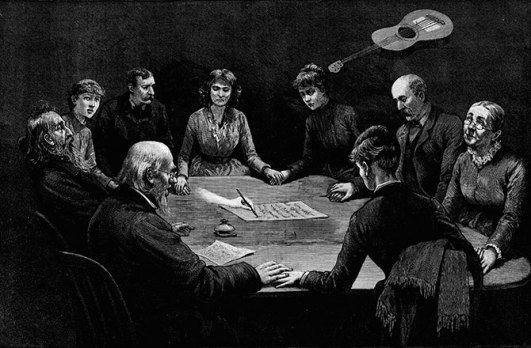
Flying lute? Check. Ghostly disembodied hand? Check. Okay, ladies and gentlemen, let’s call this meeting to order…
Following a recent post on John Dickson Carr’s The Lost Gallows over at The Green Capsule, I was reminded of just how much I love a séance in fiction. Now, to be clear, I’m with Charlie Brooker on psychics and other such manipulative awfulness, but have a real love of sleight of hand and up-close magic (as perhaps evinced in my enthusiasm for fair play detective fiction and impossible crimes therein) and a debunked séance is often a great way to explore the little ways a set of circumstances can be misrepresented, and often some fascinating insights come out of it.
So, here are five great séances from detective fiction, alpabetically by author.
Continue reading
#187: Policeman in Armour (1937) by Rupert Penny
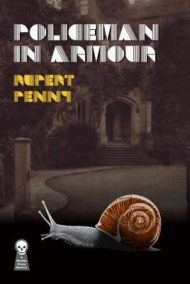 I am swiftly approaching the point where I will be reluctant to read any more Rupert Penny; he published a mere nine books, of which Policeman in Armour is the fifth I’ve read, and I don’t want to find myself in a situation where there’s no new Rupert Penny to pick up and lose myself in. I still have plenty to be getting on with — half of Carr, 10 Christies, 17 Berrows, countless undiscovered gems — but Penny holds a special significance for me because he is such a superb classicist and produced detective plots that walk the fine line between several stools without tripping and getting trapped between any of them (I apologise for any pain that mixed metaphor may have caused you).
Continue reading
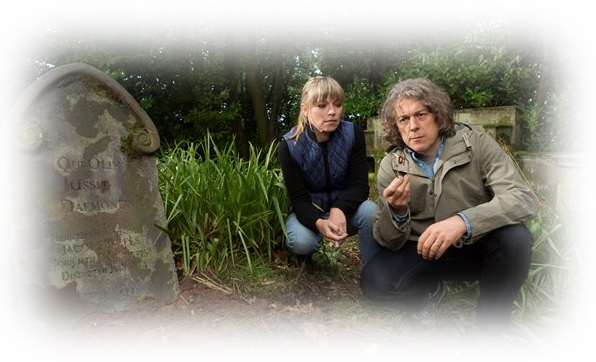
#186: On Daemons’ Roost (2016) and the Sad Decline of Jonathan Creek