Reviews
#425: Minor Felonies – Space Case (2014) by Stuart Gibbs
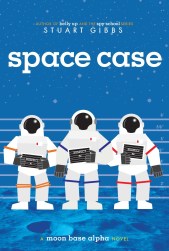
At 12 years old, Dash Gibson is so famous that in a hundred years people will still be learning about him in school — no mere flash in the pan fame for him and his family, their names will go down in human history. Because they are among the first human beings ever to live on the moon.
Continue reading
#423: And So to Murder (1940) by Carter Dickson
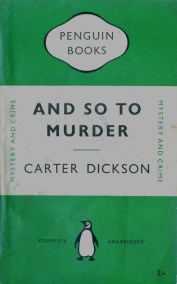


First, some context: when I began investigating the works of John Dickson Carr/Carter Dickson, I read a review of And So to Murder (1940) — his tenth novel to feature Sir Henry ‘H.M.’ Merrivale — which lambasted it so roundly that I decided there and then never to read it. Obviously this was in my pre-The Case of the Constant Suicides (1940) and Death Watch (1934) days, two books which convinced me I’d read the transcript of an old shipping forecast had JDC been the one to deliver it, but I still came to this with a certain…apprehension. Merrivale is on a pretty blistering run up to now, so would this be the point where it all starts going wrong?
Continue reading
#422: Minor Felonies – The Mystery of the Burnt Cottage (1943) by Enid Blyton

As is my standard modus operandi, I started Enid Blyton’s Five Find-Outers series midway through with something featuring an impossible crime, and now return to the beginning to read them in order.
Continue reading
#420: Death Lights a Candle (1932) by Phoebe Atwood Taylor

We’re back in Boston again this week, in another large house with murder insinuating its way among the denizens. Everyone is snowed in when the death occurs, and so good-ol’-boy Asey Mayo must counter the cunning devilry of an ingenious and unscrupulous killer with his own brand of misleadingly languid style, plenty of homespun wisdom, and lot and lots of phonetic dialogue — in fact, this is the first time I’ve actively wondered whether an author was on some sort of pro rata arrangement for the number of times an apostrophe could be used where a letter would be equally good. So that’s another benchmark reached, I guess.
Continue reading
#417: The Ponson Case (1921) by Freeman Wills Crofts
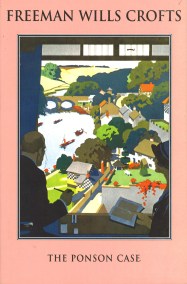
Freeman Wills Crofts’ second novel The Ponson Case (1921) recently enjoyed a reissue thanks to the superlative efforts of HarperCollins and their revived Detective Club imprint. Nevertheless, I’m not passing up the opportunity to flaunt my pristine House of Stratus edition, with a cover so fabulous that it was recently reused for Martin Edwards’ genre-sweeping study The Story of Classic Crime in 100 Books (2017). Since Crofts himself spoiled his debut The Cask (1920) in The Sea Mystery (1928), I’m skipping that for now but shall otherwise read him chronologically until I run out of books, and hope HarperCollins seize the chance for a full reprint in the meantime…
Continue reading
#414: The Four Defences (1940) by J.J. Connington
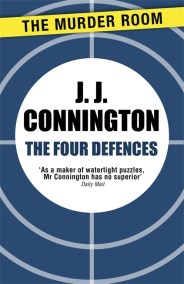
I had only read one previous novel by J.J. Connington — The Case with Nine Solutions (1928) — about which I remember one clever piece of misdirection and little else. I’ve had The Four Defences (1940) for ages, but his fellow-Humdrummer Mr. Freeman Wills Crofts captured my heart and swept me off my feet, so amends were here to be made. Thus, we have the remains of an unidentified body in a burned-out car, an obstreperous coroner insisting on felo de se, and a mystery on our hands. Cue an amateur detective — with the delightfully pleonastic name of Mark Brand, whose job seems to be giving relationship advice on the radio — to break the case…
Continue reading
#411: Six Were to Die (1932) by James Ronald [a.p.a by Kirk Wales]
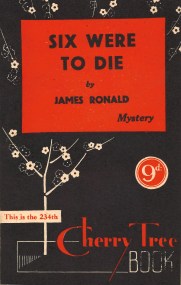
I feel as if I’m encroaching on the territory of John Norris at Pretty Sinister by reviewing a book that isn’t all that easy to come by; worry not, John, I don’t have well-enough stocked shelves to support this kind of habit, so it’s back to normal next week. This title is one that — like What a Body! (1949), The Rynox Mystery (1930), Death Has Many Doors (1951), and Dead Man Control (1936) — was brought to my attention by the Roland Lacourbe library of highly-regarded impossible crime novels, though due to the absence of a French translation did not qualify for the main list. Well, as you can see from the rating above, I think our Francophone brethren are missing out.
Continue reading
#409: A Little Help for My Friends – Finding a Modern Locked Room Mystery for TomCat Attempt #7: The Paris Librarian (2016) by Mark Pryor

I’m not entirely sure how I came across this title, but I picked it up because the blurb promises…well read it for yourself:
Continue reading

 The Invisible Event