FAQ

#59: On Locked Rooms and Impossible Crimes in fiction – something of a ramble

I was recently reading a book on the promise of it providing a locked room murder, to which I am rather partial. When said murder arrived, it took on this approximate form: a large indoor hall with a free-standing stone chapel inside it which has one door and no windows or other points of ingress, a crowd witnesses a lady entering said chapel – which is deserted – alone and the doors are shut, only for them to be opened some time later and said lady found beaten, bruised and devoid of life. It’s moderately classic in its setup and should therefore provide some interest, but once I read the details of the crime I gave up on the book and will not return to it (in fact, it’s already down the charity shop).
This is not due to any squeamishness on my part, or a particular problem I had with the writing or the characters – both were fine, if unexceptional – but rather just because it just wasn’t interesting. It is hard to put this in words, which is why I imagine this post may run rather longer than usual, but there were simply no features of intrigue to me in that supposedly impossible murder. And so I got to thinking…forget plot or prose or atmosphere, take away all the context of an impossible crime, particularly forget about the solutions: what makes an interesting fictional impossibility? Continue reading
#57: It’s 2016, and the rules are changing…

It may come as some surprise to you that I am the Batman of classic crime blogging. Not merely because this blog represents my true face that must remain hidden beneath a socially-acceptable façade, nor due to all posts being despatched from a convoluted series of secret caves beneath my gigantic mansion on the outskirts of a fictional city. No, rather because for the opening couple of months of this undertaking I have stuck, dramatically, to a single rule – an immutable and unyielding precept that has underpinned practically everything I have posted.
Continue reading
#54: The Kings of Crime – IV: Erle Stanley Gardner, the King of Spades
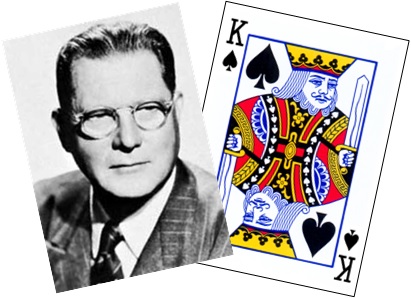
Bookends: The Case of the Sulky Girl (1933)/The Case of the Postponed Murder (1973)
Books published 1920-59: 97
The Case for the Crown
Diversity: Yes, you read that correctly: by my count (and I’ve cross-checked a couple of times just in case) Erle Stanley Gardner published ninety-seven books in the space of 39 years, and that’s not including short story collections and without considering the individual stories themselves – somewhere in the realm of 200 of them (Wikipedia informs me that Gardner set himself a target of 1.2 million words a year – 100,000 a month, approximately the total word-count of The Adventures of Sherlock Holmes – while writing short fiction for the pulps, many of them under pseudonyms). With that much output comes one of two things: the same story, worn infinitely thin and threadbare through retelling, or a range of styles, approaches, forms, characters, and ideas that tell of an imagination on fire, quenched only by its own overflowing.
Continue reading
#50: The Kings of Crime – III: Anthony Berkeley, the King of Diamonds

Bookends: The Layton Court Mystery (1925)/Death in the House (1939)
Books published 1920-59: 21
The Case for the Crown
Diversity: Anthony Berkeley Cox’s commitment to the crime novel is evinced from his first appearance on the scene with the publication of locked-room stumper The Layton Court Mystery (1925) for which he didn’t even bother to make up a nom de plume. Early versions of the book simply had the author listed as “?” – message: you want a puzzle, here’s a puzzle. You were getting – before Carr, before Queen, before Christie was anything close to a household name – the promise of something that had mystery not just in its title but at its very heart (and the follow-up, The Wychford Poisoning Case (1926), was published as by The Author of The Layton Court Mystery!). Sure, it was demystified shortly thereafter with the American publication (as Noah Stewart points out, it makes you wonder where it went on library shelves prior to that, doesn’t it?), but for a little while it was doubtless quite an intriguing notion – the crime novel as we know it was still in its very nascent stages, don’t forget, and while the content may not have quite matched the cover in that regard…well, more on that later. Continue reading
#48: The Kings of Crime – II: Jim Thompson, the King of Clubs

Bookends: Now and on Earth (1942)/King Blood (1973)
Books published 1920-59: 20
The Case for the Crown
Diversity: If you’re going to consider the hardboiled subgenre as part of the history of crime fiction – and you really, really should – the accepted wisdom says you go Chandler or Hammett or, at a push, James M. Cain. I say that Jim Thompson did more than those erstwhile gentlemen combined and should be enthroned ahead of all three of them. Chandler famously said of Hammett that he “gave crime back to the people who committed it for a reason”, but I feel this is more true of Thompson than of Sam: Hammett’s and Chandler’s way in was always their detective characters, who stumbled into something already in motion and acted in the way a detective is expected to. Thompson, by contrast, gave us the petty losers, the cuckolded husbands, the big-dreaming small-town folk, the small-time grifters and any other number of subsections of society who had their own reasons for committing their crimes (sex was always a part of Thompson’s protagonists’ motivation) and made us feel their motives because – forget some fabulous inheritance, or a trust left to my wife who died so I married someone else and we’re pretending she’s the original, or the man who married my one true love and then made her miserable so she killed herself leaving me to avenge her – they were motives the ordinary man could understand, even experience themself. Continue reading
#45: The Kings of Crime – I: John Dickson Carr, the King of Hearts

Bookends: It Walks by Night (1930)/The Hungry Goblin (1971)
Books published 1920-59: 64
The Case for the Crown
Diversity: In a career spanning 41 years John Dickson Carr published seventy-six novels and collections of short stories, wrote a raft of mysteries for radio (many of which can be found here), penned the official biography of Arthur Conan Doyle and a non-fiction account of the mysterious murder of magistrate Edmund Godfrey, wrote a column for Ellery Queen’s Mystery Magazine, and was made a member of the Detection Club as well as a Grand-Master of the Mystery Writers Of America. He created two long-running and dearly-loved sleuths, and in his later career branched out into exquisitely-researched and detailed historical mysteries that weren’t afraid to veer into the nonsensical – the time travel element of Fire, Burn! (1957) – or the fantastical – invoking a deal with the Lucifer himself in The Devil in Velvet (1951) – if they served his purposes.
#44: Who are the Kings of Crime?

The Tuesday Night Bloggers – an opt-in blogging group initially started by ‘Passing Tramp’ Curtis Evans to commemorate Agatha Christie’s 125th birthday but since expanded to include a broader program of authors from the Golden Age – has produced a glorious range of diverse posts from a variety of contributors and perspectives. Mostly I feel incapable of contributing anything half as interesting as what these guys and girls come up with, but Brad Friedman’s recent Ngaio Marsh-themed post on his excellent AhSweetMysteryBlog has got me thinking laterally about something he said, and so I’m going to run in my own direction with an idea that I’m curious about.
Any conversation about Marsh, see, veers into the debate over the Queens of Crime which is rife with obviously-Christie, pro-Sayers (hmmm), anti-Mitchell (yay!), possibly-Allingham (wooo!) debate, but Brad says that his personal “Queens of Crime” included John Dickson Carr and Ellery Queen. And I thought: hang on a minute, male monarchs? There’s a word for that…
Because, who are the kings of crime fiction?
Continue reading
#42: Defining ‘Fair Play’ in detective fiction

 The Invisible Event