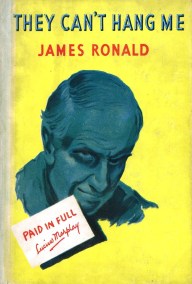
My first encounter with James Ronald was via the puply and hugely entertaining Six Were to Die (1932), in which six business associates found their lives threatened by an ex-colleague they had wronged, and were killed one by one in ingenious ways. Six years later, he wrote They Can’t Hang Me (1938), in which four business associates find their lives threatened by an ex-colleague they have wronged, and are killed one by one in ingenious ways. And, hell, when the book is this good, I wouldn’t mind if he’d written this plot another 25 times. In fact, I wish he had. This, my friends, is a little beauty.
I’ve been able, in only the briefest of online searches, to find little on the British pulp writer James Ronald, but the small amount of his material I have read thus far has been very enjoyable.
I’m fortunate to have the freedom of reading books purely because I enjoy them. Following my nose through several decades of murder and mayhem has brought me to — among other things — the Golden Age and impossible crimes, and both offer more than enough depth and breadth to keep me entertained for many years to come.
It’s fitting that Noah’s review of Dead Men Don’t Ski (1959), is what first brought the book to my attention, because the novel exemplifies for me a strata of fiction that I only got thinking about on account of Noah’s own, far superior, ruminations on the subject. Much like Murder on Safari (1938) by Elspeth Huxley, contemporary familiarity with the milieu would probably see this classified as ‘cozy’ these days — but to do so would be to ignorantly overlook the newness of this sort of setting at the time of writing. I’m tempted to call these Travelogue Mysteries, where the setting appeals as much as the crime on account of how novel it would have been at the time.
My first experience of the French crime/suspense duo Pierre Boileau and Thomas Narcejac was the recent Pushkin Press reissue of She Who Was No More (1952, tr. 2015) and…well, I didn’t love it. But Adey lists this novella and so back on the horse we clamber.
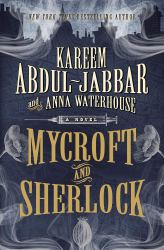
Three years ago, when The Invisible Event was but a callow youth, I happened upon a Sherlock Holmes-universe novel co-written by someone who shared their name with NBA Hall-of-Famer Kareem Abdul-Jabbar. “Wow,” I thought, “that guy must hear the same thing all the time…” — and then it turned out that it actually was NBA Hall-of-Famer Kareem Abdul-Jabbar, and, well, I became even more interested.
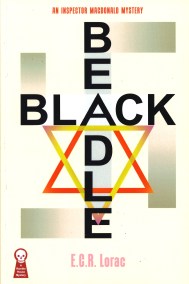
It comes to us all in the end: the moment that a prolific, tantalisingly-just-about-available author we’ve been low-key enjoying without ever really loving suddenly turns in an utter duffer of a book. It happened with the last Lorac I read — Slippery Staircase (1938) — and while Black Beadle (1939) doesn’t quite plow the same ignominious farrow, it’s not exactly leaps and bounds better. And yet Edith Rivett’s take on the standard GAD milieu is so atypical that while she’ll miss the mark on a few occasions, I don’t believe she’ll have written anything without any merit whatsoever. This is still a substandard effort, but with enough wrinkles to warrant attention.
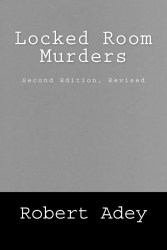
Earlier this year, John Pugmire’s Locked Room International imprint answered the prayers of every impossible crime fan the world over by reprinting the genre reference bible Locked Room Murders (2nd ed., 1991) by Robert Adey, liberally revised by Mystery Scene co-publisher Brian Skupin.
Had I gotten round to this sooner, it may have qualified as a Modern Locked Room Mystery for TomCat attempt, but TomCat has already read this one and so really all that remained was to see if I was equally underwhelmed by it.
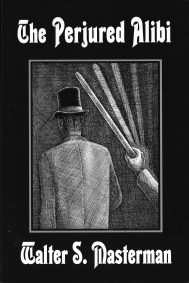
I’m on a bit of a Ramble House kick at the moment: Rupert Penny, Norman Berrow, Walter S. Masterman, with E.C.R. Lorac coming soon. The Perjured Alibi (1935) is my third Masterman title to date, and I’d intended this to be where I’d make the decision whether or not to persevere with him. But, well, I have a copy of Robert Adey’s Locked Room Murders (1991) now and that’s got me thinking that I should at least give the remaining couple of impossibilities a go — especially as it turns out Ramble House have recently republished his debut The Wrong Letter (1926), which I’ve been after for a while. So it would be churlish to stop here…




 The Invisible Event