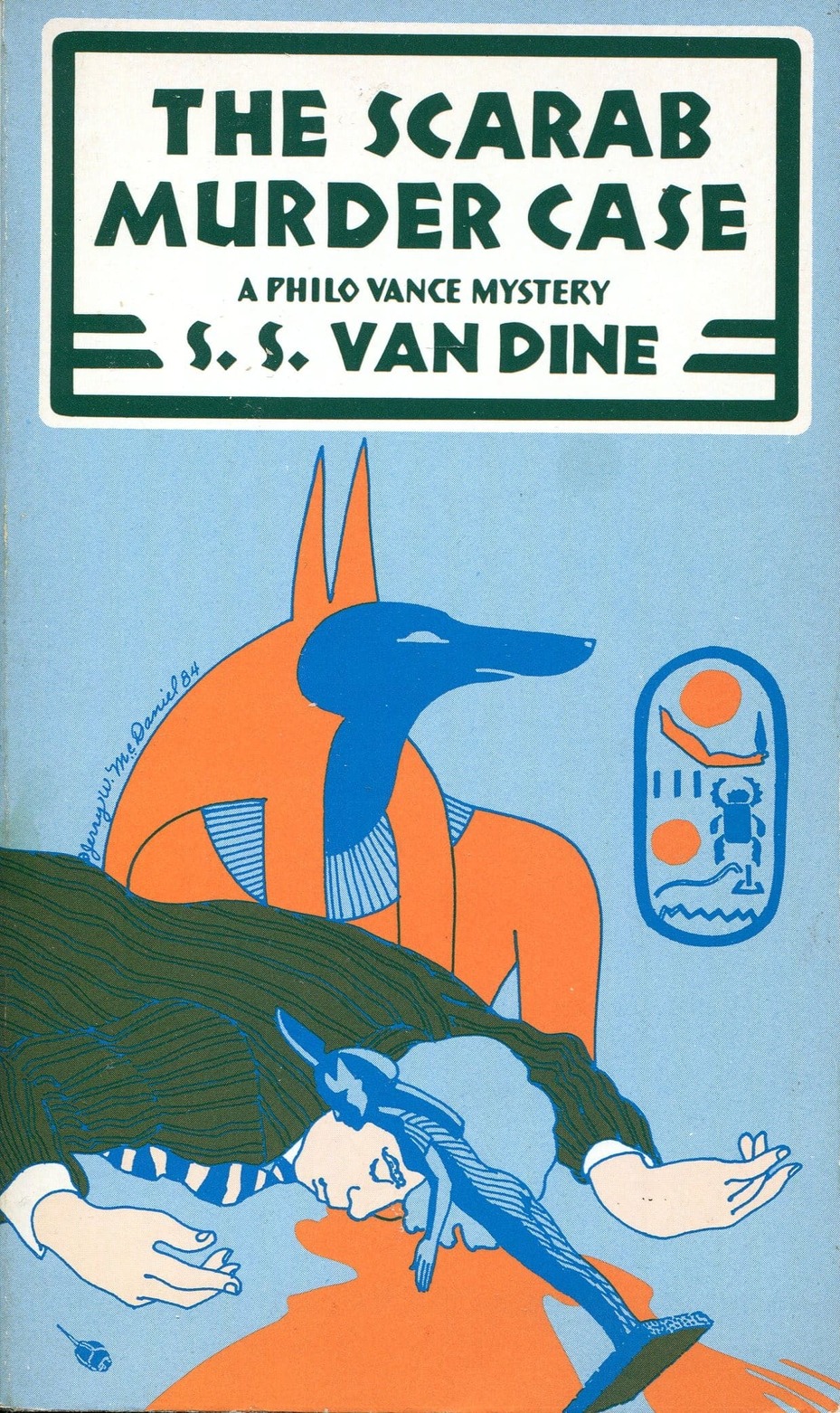


The fifth case for dilettante Philo Vance, this time it is he who brings in District Attorney John F.X. Markham when approached by an Egyptologist who has stumbled upon the dead body of the man who funded his most recent exhibitions. Said body has been battered to death in the private home museum of Dr. Mindrum W.C. Bliss, another expert in the field, and there are plenty of murmurings about Egyptian curses and vengeful gods. So can “sworn enemy of the obvious and the trite” Vance pick his way through a murder that seems either too simple for words or too unearthly for any malefactor to ever be brought to book? Well, naturally he can — what sort of amateur detective would he be otherwise? — but how?
By the time this was published, of course, Van Dine could have put his name on a list of his favourite smells and it would have sold half a million copies and probably reinvented the perfume industry in the process. Which is not to say that he’s not trying here, but it does slightly feel like a book written by someone who isn’t too bothered about plot dynamics or compelling setups. Yes, Bliss’s museum is unusual, and Vance — and so Van Dine — gets to show off his knowledge of ancient manuscripts (“The Sennacherib prism is in Babylonian cuneiform, and dates almost a thousand years later…”), but this is an oddly static book, and one that, after the initial fireworks, started to pall on this reader.
We are two-third of the way through before we leave the Bliss residence on that first day, during which time we’ve seen the case against an obviously guilty man collapse and a variety of interviews of the closed-mouthed members of that household reveal little that Vance didn’t apparently already know. What few clever ideas there are get obfuscated (“Has your request anything to do with what you found on top of the cabinet and put in your pocket?”) and I’m at a loss when, for instance, Vance asks the Sinister Egyptian — Ronald Knox would be only slightly appalled — Hani to get a key item and is able to deduce where it was, where it had been, and where Hani is going to tell them he found it simply by waiting for the man to come back.
There’s a more interesting investigation here — Markham and Sergeant Ernest Heath picking through the rooms and turning up the evidence, while Vance sits smoking Régie cigarettes and calmly informs them ‘Well, y’know, of course…’ and then for a resulting interview to expose some hitherto-denied association between the object and some character. Instead, Vance knows all, sees all, tells all, and doesn’t break a sweat while the character of Van Dine — never was there a first person narrator with so little character — is amazed, assures us each tedious development is an astonishing breakthrough, and generally makes you wonder why these books aren’t written in the third person.
Some interesting ideas occupy the stultifying fog, such as these Egyptologists being seen as “treasure-seeking Occidentals” who are “violating” sacred ground in their arrogant search for ancient treasures, and I couldn’t help but be amused by Vance’s summary of the evils of Prohibition, but by the time a second murder crops up all-to-late to salvage things it’s bleedin’ obvious who the killer is and whydunnit and you sort of wonder at the appeal of these books when 80% of them so far have singularly failed in concealing killer until the end. Still, it’s nice to see some sharp edges remaining in the relationship of the core trio, with Vance, Markham, and Heath often at odds with how to deal with a suspect or situation and chipping the corners off each other in a way that still puts a back up or a nose out of joint:
“I’ve got a little investigating to do as soon as I get the doctor safely booked at Headquarters.”
“Typical police procedure,” murmured Vance. “Book your man and then investigate. A sweet practice.”
And, in true puzzle plot style, the odd gnomic utterance does hold a little interest (“Y’know, Markham, if you had any of that coffee to analyze, you’d be farther away from the truth than ever.”). But once again, the actual evidence is thin on the ground, Van Dine fails to adhere to his own rules for writing this type of book, and I was, for the first time in this series, actually rather bored by the time the finale eventually rolled around. Of course, maintaining the standards set by the earlier books in this series was always going to be tough, and this is still better than 90% of what’s already been forgotten from this era, but it’s a shame to see the shine come off in such a torpid manner. I am at least heartened by the fact that Van Dine was probably aware of this, since it was three years before he followed up this volume with The Kennel Murder Case (1933). So here’s hoping that break did him good…
~
S.S. van Dine on The Invisible Event
1. The Benson Murder Case (1926)
2. The ‘Canary’ Murder Case (1927)
3. The Greene Murder Case (1928)
4. The Bishop Murder Case (1929)
5. The Scarab Murder Case (1930)
 The Invisible Event