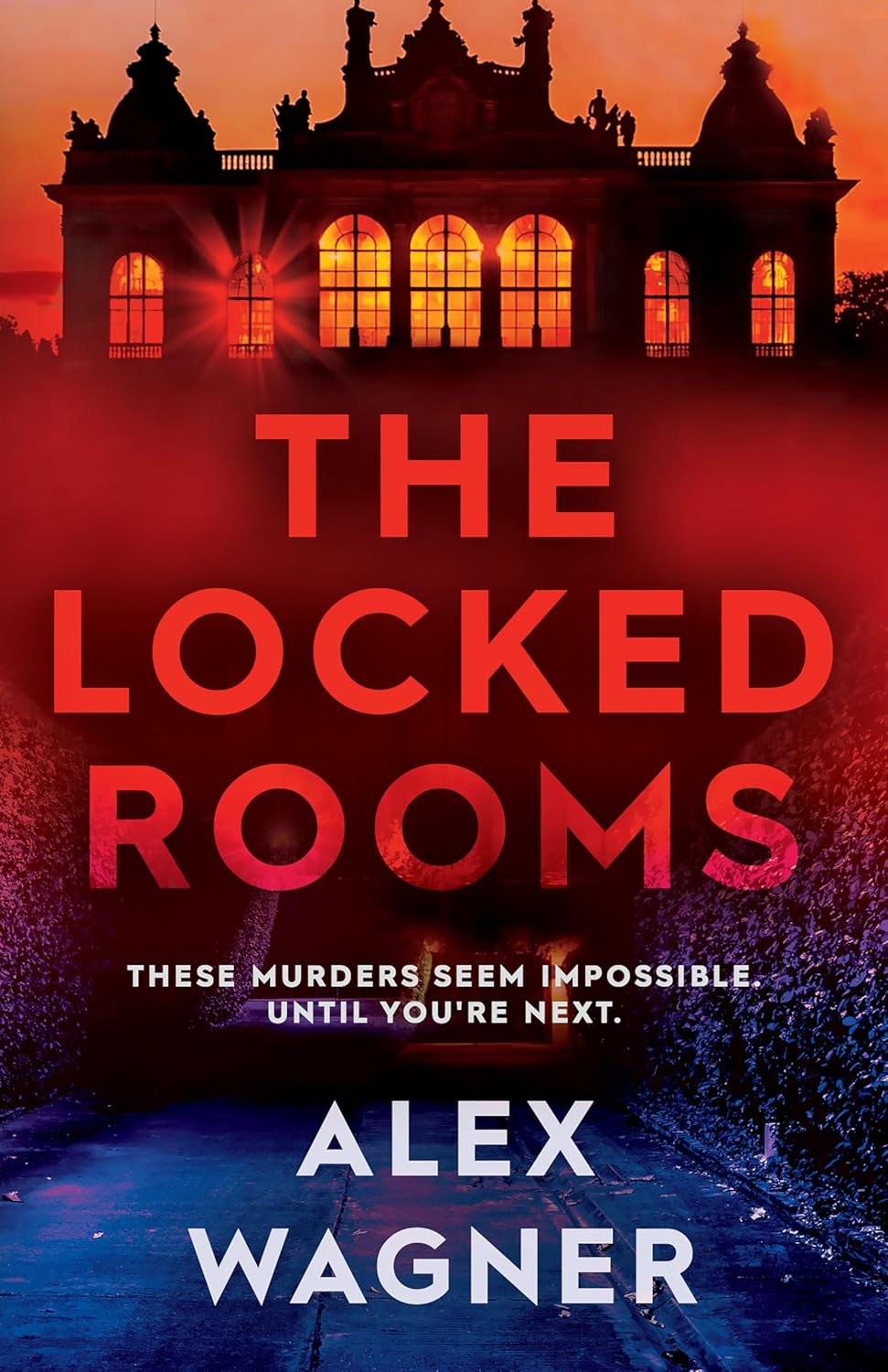
In an age where the term “locked room mystery” increasingly seems to mean “closed circle mystery” — as in, one of the limited number of characters in the story committed the crime, as if you’d want there to be an alternative — how refreshing to come across someone in Alex Wagner who actually demonstrates an awareness of what an impossible crime is.
The Locked Rooms (2025) is the third book in Wagner’s series to feature crime-solving priest Father Simon Westerholt and former police officer Lucia Storm, and is largely concerned with the murders of the grown-up children of Egon Kaplan at this family pile in rural Germany. The octogenarian Kaplan has earned himself the nickname ‘The Pope of Impossible Crime’ for having studied the subgenre for decades as well as having compiled an Adey-like reference work on titles within it (indeed, we’re given an example from this work which could have been lifted directly out of Adey), so there’s an aptness to the manner of these deaths, of which there are plenty.
When Kaplan’s daughter Angelina is found dead in her study, her family find it hard to believe that she committed suicide, and so approach Lucia to investigate. While the setup seems pretty cut and dried — the doors and windows were sealed, and the only entrance to the room was in sight of three people — where is it more likely that an impossible crime should be committed than in the home of a leading expert? And, indeed, the reader has already seen Angelina murdered in the prologue in a way that does not match the description of events as given by witnesses, and so the game is on (and, indeed, the how pretty obvious, even if it does ignore physical evidence).
And so Lucia investigates, the Kaplan children continue to die in impossible circumstances — in locked rooms, in the open air with no-one near them — and a series of bizarre events (birds falling from the sky, a woman apparently falling from an impossible height) plague the monastery where Simon is living out a penance having been banned from any investigative work by his bishop.

It’s a fun book, if perhaps a little prolix — a good edit could cut out a lot of the repetition that occurs throughout, with constant reminders of Simon’s banishment and similar themes — and one with a pleasingly meta layer at times:
[S]he was reacting exactly the way the characters who received mysterious informants in classic detective stories — the very kind her father collected — did. These people always said something that withheld the visitor’s name from the reader — something like “You?” — which revealed absolutely nothing about the identity of the person in question. It was an author’s device, used purely to build tension, albeit a rather clumsy one in Angelina’s eyes.
The setup is described as being “straight out of an Agatha Christie novel” and at one point we’re told that “[m]ystery novels where a murderer commits seemingly impossible felonies are often criticized by readers as unrealistic and divorced from reality”, so you know Wager is enjoying herself, and it connected well with this reader.
It’s also kind of amusing that Egon’s son Oliver is trying to follow in his father’s footsteps and is dismissed by everyone as being a pale shade of his father in terms of appreciation of the genre, nicely communicated when he tries to lecture Lucia on impossible crimes:
“These different variants were once brilliantly addressed by a writer in a mystery novel. In it, the investigator gives someone a kind of lecture on the possibilities of committing crimes in locked rooms. But I don’t remember what the book was called. Or the author. My father could probably tell you.”
Honestly, the chief disappointment for me with this book was the sheer lack of rigour that goes into the investigation. Every single time — okay, except in one case, where the killer simply confesses — the solutions are divined by our investigators (oh, spoilers? Simon does help investigate…) simply because they happen to have a moment of revelation and, yup, everyone simply agrees that’s the answer. Simply for funsies, I came up with alternative explanations for three of the deaths, and there’s nothing to say I’m wrong except that it’s not my book and so Wagner can resolve things however she wants. To an extent, this is where a more formal investigation might have improved thing (I’m pretty sure you can tell if (rot13) oybbq unf orra sebmra naq gura gunjrq bhg), but I can understand why Wagner didn’t write that sort of book, even if I wish she had.
It’s slightly more disappointing because of the fun that could have been had with either a wilder or a stricter approach: Simon is frequently visited by visions of Saint Martin, who converses with him and points out the way to some of the solutions, and while this is utterly insane — the man’s delusional, not Gifted — there could be a way to have this act as a prompt for various realisations. Instead, this ghostly presence merely tells Simon what he needs to know (he calls it being “guided by an angel’s hand.”) and so we’re off to the races.
Also, may much dishonour fall upon Wagner’s house for spoiling ‘Jacob’s Ladder’ (2014) by Paul Halter herein. Infamy, infamy! Although credit for utilising modern technology in a small way to explain away one of the murders. The impossible crime needs to move with the times, and Wagner manages that in a small way here. Call it a no-score draw.
In an era where writers seem disinclined to take on the impossible crime, it’s refreshing to see someone pack five into one book. Sure, they’re not all successful, and yes the investigative side of things would ideally be more rigorous for me to be more fulsome in my praise of this, but the way certain events tie into the central plot is well-handled and I actually rather enjoyed the romantic tension between Simon and Lucia (I must be getting old). So, overall, I would read another one of these if it had impossible crimes in it, and that’s really all I can ask of a book these days.
~
Self-published impossible crime fiction reviews can be found here.
 The Invisible Event