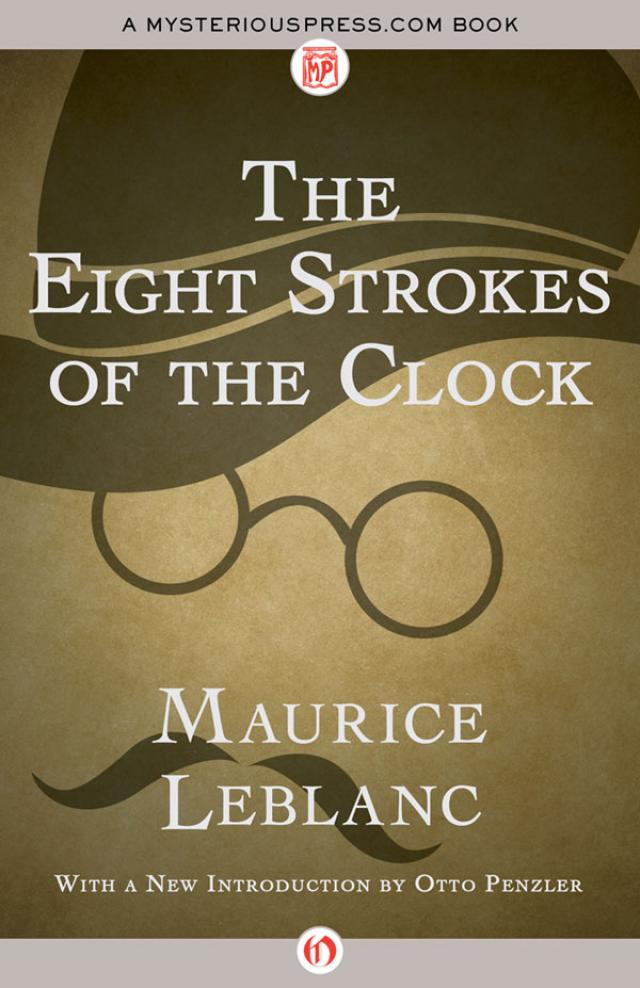
I recently acquired a boxset of 8 Maurice Leblanc novels and short story collections featuring his gentleman bastard Arsène Lupin, and so before I dig into those I thought I should revisit the first Leblanc book I read, the Haycraft-Queen Cornerstone collection The Eight Strokes of the Clock [ss] (1922).
I remember being nonplussed by the brief opening crawl in which Leblanc claimed that the following stories were told to him by Lupin, and that it was Leblanc’s belief that the character of Prince Serge Rénine was in fact Lupin himself. I’m not well-read in the Lupin corpus, but I’m intrigued as to why Leblanc would take this approach — had Lupin’s reputation preceded him, or did something in his previous adventures necessitate a pseudonym? The whole thing is bizarre.
Anyway, to the stories…

Introductory tale ‘On the Top of the Tower’ sees 26 year-old Hortense Daniel living a miserable life in the house of her husband’s uncle and, on the eve of an annual shooting party, about to flee with the only man in the region who seems to be interested in her. And yet the prince Rénine forestalls her and offers her something she has lacked for a long time: curiosity, in the shape of a nearby abandoned estate. What is to be made of the clock chiming despite not having been wound for 20 years? Why is there a gap in the walls that perfectly allows the placement of a telescope they find? And what of the sight that awaits them?
This has a good mix of the gloomy and the fascinating, and now that I’m better versed in the history of the French detective story I can forgive Rénine for over-claiming on the rigour of his deductions (“[Y]ou will see how logically all the facts fit in. When you hold the first link of a chain, you are bound, whether you like it or not, to reach the last.”). There is something akin to Poe-esque horror in the second interpretation put on events, and you can readily believe that the two characters would bind themselves to each other after this initial sortie. A great setup, and a wonderfully engaging opening tale.
A man accused of theft and murder, a childhood friend convinced of his innocence, ‘The Water Bottle’ is fairly classic in its ingredients. What’s especially pleasing about this is the way Rénine seems to have set himself out on a sort of moral crusade, with both Hortense feeling brighter at the story’s opening and the convictions of this unusual man doing much to bolster the hopes of the people who come to rely on him. I also love his indomitable spirit, such as the following exchange when surmising that a flat on the premises must contain the 60,000 francs which will prove the case:
“The place isn’t big enough to swing a cat in. Would you care to see it?”
“However small it may be, it’s large enough to hold sixty bits of paper.”
Leblanc writes well, too, about the stakes they’re playing for, and while the bluff which rounds this off irritated me when I first read it, I have to admit that I loved the hell out of it at second encounter.
When a friend of Hortense is spurned by the man she loves, Rénine is implored to investigate ‘The Case of Jean Louis’ and, well, while what results is hardly staggering by modern standards, there can be no denying that this is engagingly told, and the translator Alexander Teixeira de Mattos has done some wonderful work in rendering this so compellingly in English:
Fate often amuses itself by playing these imbecile tricks, these monstrous farces which seem as though they must have been invented by the brain of a madman or a drunkard.
It helps to have a grounding in early French crime writing, so that when Rénine rallies against “the world of fiction” in which “one can imagine all sorts of fantastic accidents and heap contradiction on contradiction” you don’t throw the book against the wall in frustration at the ending. Again, the sudden reveals which conclude this irritated me when I first read it, but again I really, really enjoyed them this second time around.
Watching ‘The Tell-Tale Film’ at a cinema, Rénine deduces a fatal obsession, and stumbles into the quickest case of Stockholm Syndrome in history. Very French, but absolute nonsense, and not even in a fun way.
“A man goes to his cabin and locks himself in. Half an hour later, he is found inside, dead. No one has gone in. What has happened?”. True, the impossible stabbing in ‘Thérèse And Germaine’ doesn’t take a huge amount of figuring out, and, indeed, it seemed so cut and dried that I was hoping there’d be a little more to it with all that talk of Frédéric Astaing finding the dagger in the bag of the dead man’s wife…but, no.
It has about it a few points of interest, however, such as Hortense refusing to believe that a “pretty woman” could be guilty of a crime — the Noir genre was about to upend her expectations catastrophically — and the general attitude displayed to what is, very nearly, a crime passionnel. So this is not without interest, but also not the strongest offering in the book.
Over the preceding 18 months, five women have been kidnapped off the streets of Paris, and each found a week after her disappearance brutally murdered. With the killer suspected to be female and the press christening her ‘The Lady with the Hatchet’, it’s only a matter of time before Rénine and Hortense stumble into her path with tragic possibilities coming to the fore.
It’s nice to see a more human side to Lupin here, and, while I blanched rather at his casual dismissal of any formal investigation (“An enemy who displays such skill and subtlety would not leave behind her any of those clumsy traces which are the first things that a professional detective seizes upon.”), this takes a side-road into mania and psychology that feels cutting-edge for its era. There’s a modern thriller writer somewhere who wants to use the motive for these killings in a book of their own, I promise you, and Leblanc almost invents the modern serial killer novel here in a fraction of the words usually given over to such undertakings.
It was reading ‘Footprints in the Snow’ in the British Library’s Foreign Bodies [ss] (2017) anthology which made me want to revisit this collection (yes, I read it eight years ago; I never said I was fast). Marks in the snow indicate that a landowner has been murdered and his body hidden in a bottomless well on his property, and it’s only a matter of following those marks to the house of the man who wanted to marry the victim’s unhappy wife. Except, of course, Rénine sees what others do not, and so an alternative explanation presents itself…
This is very Golden Age, though built on a principle that would fool no-one these days. It seems unlikely to me that (rot13) fbzrbar pbhyq jnyx onpxjneqf nyy gur jnl orgjrra gur gjb ubhfrf jvgubhg orvat frra, but I’ve accepted more ludicrous things in my time as a reader of this genre and so I’ll not quibble too loudly. Lovely to see Leblanc take on actual detection just as it was entering its first popular flush and succeed so admirably.
Finally, the last of the “eight good stories, to which we shall have brought energy, logic, perseverance, some subtlety and occasionally a little heroism”, ‘At the Sign of Mercury’ finds Hortense avoiding Rénine so that, he deduces, he cannot fulfil their wager of eight exciting adventures within the given time frame. In a move that feels very apt for the 2020s, he is convinced that this is because she’s in love with him and nothing to do with her having been kidnapped and nearly killed as a result of her involvement in his schemes. Men, eh?
The story itself is sort of nothing, relying as it does on nothing which has come before and so here purely to tie up the promise at the end of the opening tale, and I suppose I’d hoped for a little more in the concluding adventure, for the preceding experiences to have mattered in some way. There’s an interesting idea in here about luck and our perception of good fortune, but on the whole it’s a bit meh and ends Rénine and Hortense’s excitements on a little bit of a damp squib.
I suppose, were I to offer up my usual Top 5 for any collection of short stories, they’d be:
- ‘Footprints in the Snow’
- ‘The Case of Jean Louis’
- ‘The Lady with the Hatchet’
- ‘On the Top of the Tower’
- ‘The Water Bottle’
What I especially like about this collection, even though I would not call it wholly successful, is the way Leblanc acquits himself so admirably to several different styles of writing. The horror of ‘On the Top of the Tower’, the semi-Chestertonian muddle of ‘The Case of Jean Louis’, the clear-sighted logic applied to ‘Footprints in the Snow’, the sense of Lupin really straining himself mentally and emotionally in ‘The Lady with the Hatchet’.
It’s a shame that a little more isn’t done with rich setups like that in ‘Thérèse And Germaine’, and ‘At the Sign of Mercury’ really should be more consequential, but we’ll allow Leblanc the invention and innovation shown herein and not cavil too greatly when he doesn’t completely succeed in every particular. Certainly this collection doesn’t make me regret getting a slew of books by Leblanc, and I very much look forward to more adventures with Lupin in the months and years ahead.
 The Invisible Event