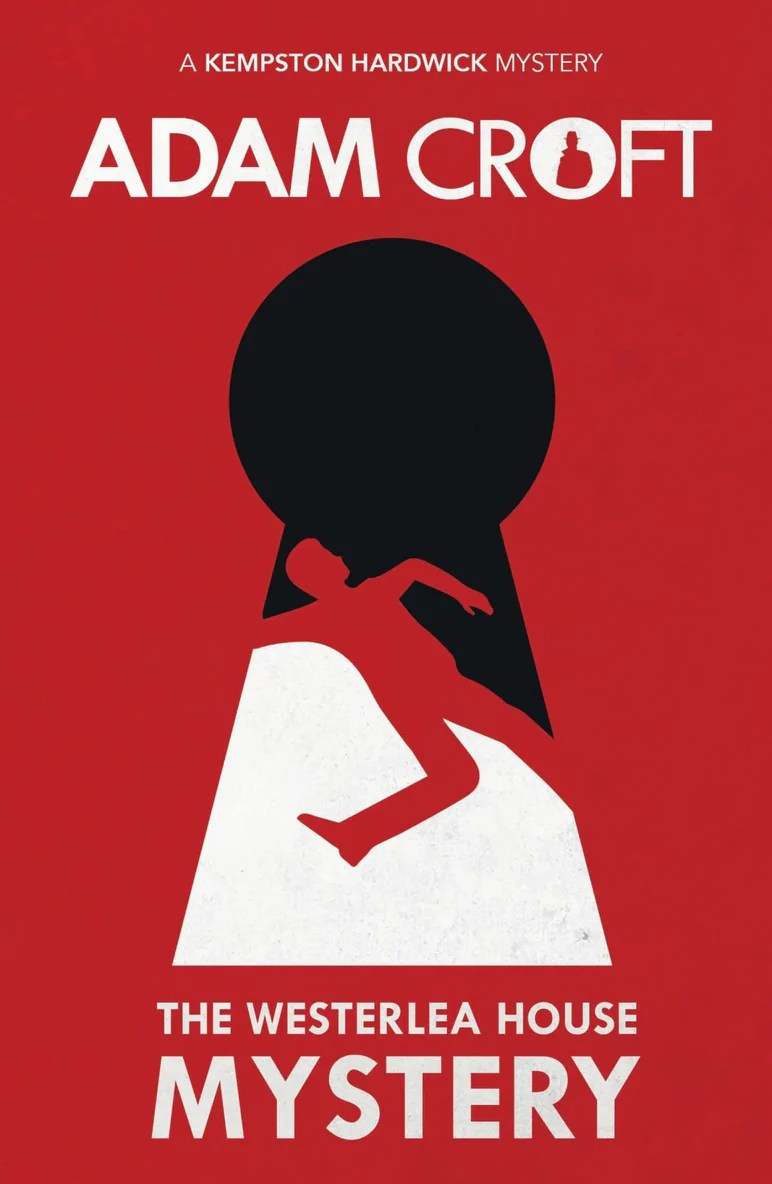
Another self-published impossible crime story, I can’t remember how The Westerlea House Mystery (2013) by Adam Croft came to my attention, but it did, I’ve read it, and we’re going to look at it today.
When paranormal investigator Oscar Whitehouse is found murdered in his home on the evening that a party is being thrown for him and his wife Eliza, the Police Are Baffled and call in amateur sleuth Kempston Hardwick who, it seems, enjoyed some success on a previous case wherein the Police Were Also Baffled. But with a slew of guests milling around downstairs, and with the unpopular Whitehouse providing a positive wealth of motives for the various people he’d also invited to the party, how can Hardwick ever hope to get to the truth? Oh, and Whitehouse was strangled in a room locked on the inside. Did I mention that? So add the puzzle of how to the problem of who and you’ve got a poser on your hands.
The book — a novella, and you feel it only just about makes novella length thanks to a subplot about Hardwick’s house maybe being haunted which has nothing to do with the central murder — is swiftly written with a minimum of atmosphere and scene-setting, which slightly tells against it and yet also works in its favour since it really does just get on with things. Instead of hand-wringing and a realistic depiction of how the police officers in charge of the case (one “imperious”, the other “wet”) could justify bringing in an outside investigator, the police just phone up Hardwick and tell him he’s investigating this crime and then…sit back and watch, I guess. It could be more realistically handled, but since we know it’s going to happen anyway, well, why not cut to the chase?
True, Hardwick is faintly-limned through a backstory paragraph…
The whys and wherefores of murder and serious crime had always fascinated Hardwick. Ever since he was a young child he had sat open-mouthed as his father regaled him with tales from Dame Agatha Christie and Sir Arthur Conan Doyle. Christie’s books, in particular, held a special kind of appeal, often concentrating, as they did, on modes of transport and crimes committed in faraway lands. This appealed greatly to Hardwick’s own love of travel and foreign climes; things he’d become well accustomed to in his formative years.
…but mostly we just get the direct approach being a little blunt, but leading to some good laughs when Croft drops in the odd humorous description — a chair being dragged across the floor with “the sound of a dying elephant” — or tart aside into the dialogue.
“The quote is intended to give comfort that Oscar is now at peace and at one — at home — with the Lord,” replied the vicar.
“Well I’m sure he’d rather be at home with his family, personally, but I’m sure we can agree to disagree.”

At times, it really does feel like Croft has a firm grip on the conventions of the puzzle mystery. When Hardwick’s Watson — well, not Watson, because this is written in the third person, so…accomplice, I guess — Ellis Flint is obsessing about the means of Whitehouse’s murder, Hardwick reminds him that “[t]he means can’t kill again, Ellis. But the murderer can”. And, indeed, that there’s more than one death in this short little book is to Croft’s credit, all tied into a larger plan that does, in the end, largely make sense. So from that perspective, win.
Elsewhere, this isn’t a complete success: the solution to the locked room is called “one of the oldest tricks in the book” by Hardwick and he’s not wrong, and the entire scheme is in no way prepared for the reader ahead of a lot of sudden reveals at come the end: this isn’t fair play in the least. Which is especially disappointing when a character had earlier said that “What’s not fair is withholding evidence that could lead to the identification and capture of a killer”, since I thought that was an assurance that our author was playing fairly with their reader, but no. It was just a thing someone said, and subtext is for cowards. I also don’t love a third-person narrative voice when there’s no clear perspective for that voice: when Hardwick is inspecting the crime scene we’re told:
The footsteps grew louder as the now-widowed Eliza Whitehouse, and Major Arnold Fulcrupp, came towards the bedroom.
…but at that point Hardwick has no idea who those people are, or even that they exist. I know, I know, it’s a nit-pick, but when the nits are so big they are also so very pickable.
The solution also gets a bit too hand-wavey for my liking (“I don’t know how they even managed to ensure [X]” Hardwick says at the end, as if [X] was some simple frippery and not the entire juddering edifice at the very core of the mystery) and, really, wouldn’t the plan have worked better if (rot13) gurl unqa’g qbar vg jvgu n ubhfr shyy bs crbcyr? Did I miss something there? Because it feels like quite an oversight.
And so I finish The Westerlea House Mystery wishing that it wasn’t a novella, and the Croft had put a little more meat on the bones of his interesting, well-packed plot. I do really like Hardwick as a character (“Well, the Americans are very strange people, Ellis. Nothing ever surprises me about them.”) and I can’t fault that there is some genuine detection herein, so it deserves credit for that; one just wonders if the brevity of this is what holds it back from being a firm recommendation. However, I would absolutely read more Croft if he had written a longer impossible crime novel, especially with Kempston Hardwick at the helm…so it can’t have been all bad, eh?
~
More reviews of self-published impossible crime fiction can be found here.
 The Invisible Event