Double Death (1939) — variously subtitled ‘An exercise in detection’ and ‘A murder story’ — is another example of the round-robin mystery that sells itself on a few big names and then brings in a few, er, less established authors to complete the endeavour.
Here, Dorothy L. Sayers will be the big selling point for most, and my good friend Freeman Wills Crofts is also going to be increasingly familiar to many readers, but the likes of Anthony Armstrong, David Hume, F. Tennyson Jesse, and Valentine Williams will, in 2026, be largely forgotten despite their own contributions to the genre. Of slightly more interest, in a manner that recalls The Floating Admiral (1931), each author has provided notes at the end of their contribution concerning how they see the story developing, and we shall compare those at the end.
So how does this one shape up? Can you mix two of the Golden Age greats with a smattering of less-established practitioners and still strike gold? Let’s find out…

After a preface explaining the project and then a prologue — written, it seems, after the novel was completed — by John Chancellor, it is Sayers who gets this story underway with the bed-bound, forty-seven year-old Mrs. Farland insisting that she is being poisoned and her roving finger of suspicion pointing at just about everyone at due course. Her niece and primary carer Millie Pink, her nephew John Farland, local GP Dr. Cheedle, even the cook all fall under suspicion, and her persecution mania sees Mrs. Farland change her will multiple times, no doubt much to the chagrin of solicitor Mr. Walton.
When the various people concerned hit on the plan of bringing in an expert nurse from out of town — an influenza pandemic has the local professional nurses kept busy — it seems like a sensible solution. But, when Nurse Ponting arrives, a tragic situation develops, and Sayers leaves us with a baffling conundrum to resolve.
Cometh Freeman Wills Crofts, whose conscientious policeman Inspector James Billingham gradually learns that just about everyone involved in the affair has no alibi for the key period, and that the death which has resulted — no spoiler, read the title of the book — presents many difficulties of its own. An interesting development about Nurse Ponting, too, puts a new spin on events, and leads Billingham back to Mrs. Farland, where the humanity of the situation really strikes home:
“I am being poisoned, Inspector!” she whispered.
Billingham was a hard-boiled police officer, but it gave him an odd thrill of horror to hear her say that. She was so helpless, so stupidly vain, and so dreadfully afraid.
It’s true that Crofts doesn’t do much to advance proceedings, but he certainly puts things on their feet a little more squarely where Sayers seemed to throw in lots of thread so that whoever was due to follow her could develop what they wanted (about which more later). The plot, it acquires the thickness…
Valentine Williams then turns things from the catholic generality of Sayers’ approach and the sensible routine of Crofts’ into more of an Old Dark House approach, with plenty of creaking doors and subtle sounds and moments of Shocking Realisation:
She went up breathlessly, shaken by a horrible doubt, a ghastly suspicion so terrible that she dared not admit it even to herself.
There can be little doubt that the motive has been well and truly settled on by now, with Mrs. Farland promising “surprises” when she dies and a hint that another change in her will is due with the summoning of Mr. Walton on the morrow. This certainly isn’t a bad contribution, and it’s fun to see things from a different perspective and get a sense of how the household is affected, but it also feels rather safe.
This safety is repeated in F. Tennyson Jesse‘s contribution, which sees one interesting development but generally not much else that moves the plot any forrader. Again, though, a good sense of how the belowstairs element of the household feel about things is interesting (“The servants were pleasurably agitated in the kitchen…”) even if Jesse seems rather more interested in adding to the characters than the plot:
Dr. Cheedle, during the war, had served in India and some of the phrases of the life of the pukka sahib still clung to him. They were, so to speak, his invisible war medals.
One interesting development reverses and earlier expectation, but, if anything, all Jesse does here is reduce the number of possible suspects. And, fine, it pays to clear away some of the path for the later authors, and the solution should, in the era this was being written, have been indicated from an obviously early stage; but since we only know what each author thinks might happen, not what’s actually going to happen yet, this feels a little redundant.
I love that Anthony Armstrong begins his section with a few notes lamenting the difficulty of the task ahead of him (“Quite frankly I think that this is the most terrible job I’ve ever had!”). He then applies himself admirably, taking both plot and character in hand and showing how to manage both at the same time — the reflection on the (potential) choice of arsenic as a poison, the realisation about two contradictory testimonies, the reflection that “most of a doctor’s business seemed to be guesswork anyway”, and a few lovely moments that lighten the mood significantly:
“Right, I’ll forget that,” lied the Inspector.
Armstrong seems by far the most comfortable of the minor contributors, with a light touch and a clear way of communicating his logic. It’s to be wondered if he wrote any novels which display these qualities, because he bears further investigation if so.
Better known as a thriller writer, David Hume has the unenviable task of — as Anthony Berkeley once called it — clearing up the mess. Hume’s solution is completely fine, and leans into some of the actions placed earlier in the story, but it also requires a change in direction that would, yes, necessitate that prologue. It’s a shame that this end of things wasn’t given to someone like Sayers or Crofts or Armstrong who might have done a little more with the material they’d been fed, but as a simple solution to a problem it’s…fine, and has a few good lines:
The door was open. Beyond it was a glass door which was shut, and beyond that was a square hall of which the furnishings and general arrangement, though tasteful and good, bore the positive stamp of the sort of boarding-house in which retired army officers and disappointed elderly spinsters spend their final years in the impression that they are still alive.
A shame not to tie up with something a little cleverer, but difficult to get too critical without appearing needlessly picky (moi?).
I’d like to say a few things about the notes provided by each author at the end of their sections, because there’s some fascinating stuff here for anyone who is interested in the structure of a detective story.
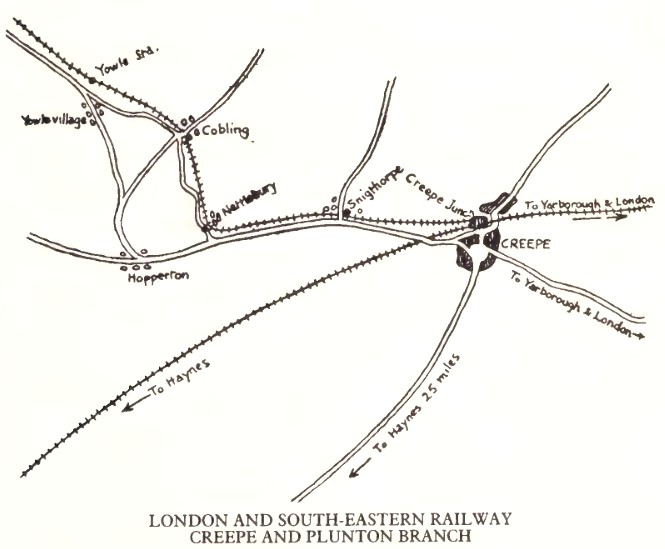
Firstly, Sayers, who would never publish another novel, little though we knew it at the time, provides nearly 8 pages of character notes, and plot points, plus discussions about sleeping draughts, the poison register and a map of Creepe and surrounds.
(Mem. the plan is not drawn to scale, because I can’t!)
It’s lovely to see that she hasn’t simply thrown lots of things in purely to provide grist for later mills, and interesting that some of what she prophesies here comes to pass in the novel itself.
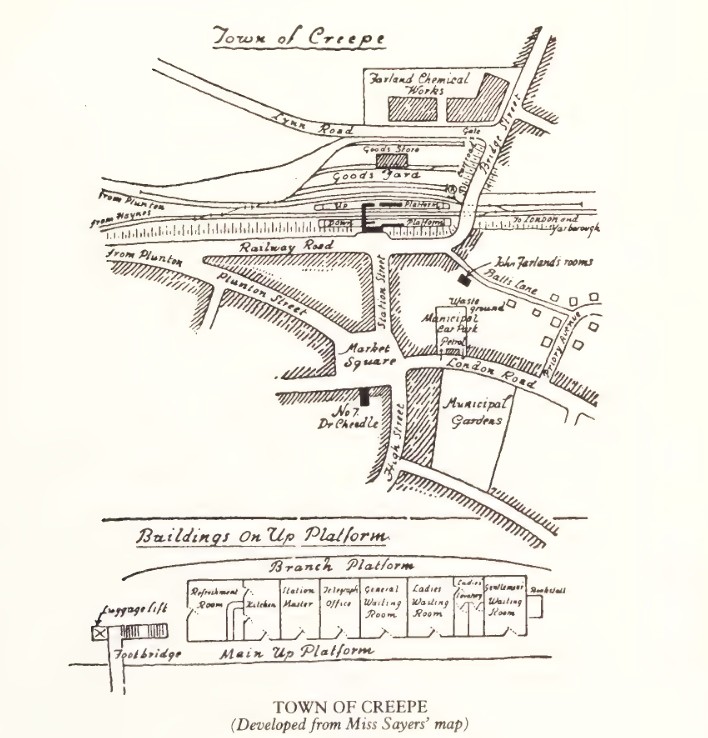
Crofts lays out how he sees the plot (“I am assuming that the following happened. Obviously it need not be assumed by anybody else.”), laying his points with the meticulous care that he had made his own (“If the question of goods-yard gate being opn on Sunday afternoon arises…”). Interesting to note, too, that he can see only one person being guilty from Sayers’ opening and so added in a possibility to make someone else the killer, as if the case Sayers laid out already cemented things in his mind.
Fun, too, to see his notes opening with a discussion of how overlooked or out-of-the-way certain places would have been for a parked car. In fiction its said to be a good thing that Sherlock Holmes decided to be a detective; in reality, we can be thankful that Crofts never got it into his head to kill someone. Unless he did. Also, a better map of Creepe is provided. Which, considering that nothing ever seems to rely on the geopgraphy of Creepe, seems to have been done just for fun.
Williams does well to expand on what she’s been given, showing a fair amount of thought behind what ended up being a fairly uninspired chapter. She explains her thinking for introducing a love triangle, and then examines each of the characters in turn without apparently having selected one as the murderer (surely, like, a key part of writing a murder mystery). One sympathises with her, however, that two murders had already happened by the time she received the MS, and so her hands were, plot-wise, perhaps a little tied.
Jesse then gives a sense of how tricky the whole thing has been…
I hope there is someone specially engaged to go through all the chapters and see that we have none of us overlooked any contradictory or superfluous facts. This sort of writing is so intensely difficult. For instance, I have had to have the temerity of suggesting to my predecessors that they alter one or two things here and there — so that there must be someone with an all-seeing-eye like that of God.
…while justifying the existence of a character she introduced by explaining that she sees the murderer going after this person and thus getting caught. All told, Jesse demonstrates a good understanding of the detective novel the like of which I’m yet to encounter in her writing or editorship.
Then poor Armstrong, who very gamely offer up suggestions for how his plot points may be utilised for the possible guilt of almost anyone (“…not forgetting Pearn, Pollinger, and Higham, Uncle Tom Cobley and all.”). This reminds me very much of Clemence Dane’s notes at the end of The Floating Admiral (“I am frankly in a complete muddle as to what has happened…”), though it’s very magnanimous of everyone to still consider the matter of the identity of the murderer so open at this stage.
On the whole, these notes are elucidating because they show the efforts everyone has gone to in raising possible points of development for later writers. And so, again, I say it’s a shame that Hume seems to disreagrd most of them and plough his own furrow. True, The Floating Admiral ended up a frankly impenetrable maze with all the specialists contributing their own takes on events, but the seeds of something clever were here, and to see all this promise flutter out is a little disappointing.
Frankly, I think it’s a shame we don’t have John Chancellor’s notes on what was required to make this as cohesive as it is. That would be fascinating.
~
Multi-author collaborations published by Gollancz:
- Behind the Screen (1930)
- The Scoop (1931)
- Double Death (1939)
- No Flowers by Request (1953)
- Crime on the Coast (1954)
 The Invisible Event