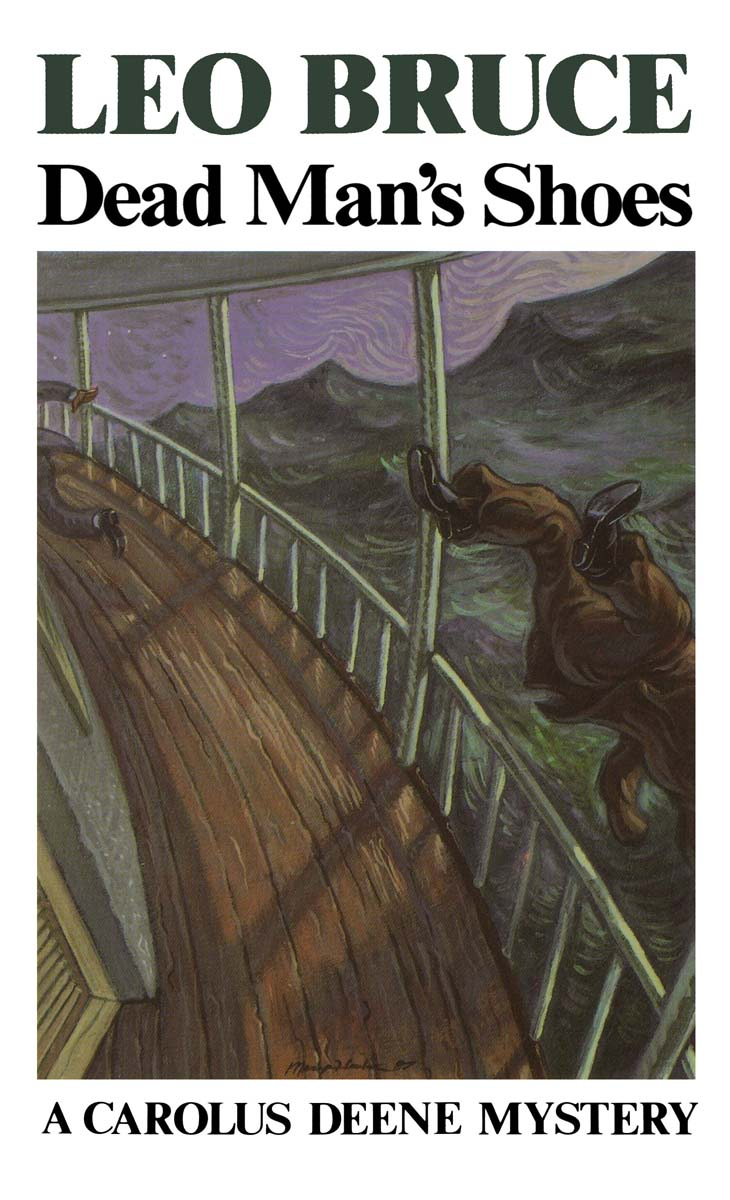


Having completed Sergeant Wm. Beef, I turn to the other series of detective novels Rupert Croft-Cooke wrote under his Leo Bruce nom de plume, those featuring schoolmaster Carolus Deene. The books are not easy to find, however, and so I am reliant on the recentish reprints by Academy Chicago Publishers, who neglected the first three in the series and began with fourth title Dead Man’s Shoes (1958). And it’s to be hoped that those earlier books were overlooked due to rights rather than quality issues, because this first encounter with the crime-solving History master leaves me somewhat underwhelmed. This was written by the convention-busting creator of Sergeant Beef? Really?
We start on the Saragossa, a cargo boat with room for a handful of passengers, on its way to London from Tangier. Among its half-dozen travellers is one Wilbury Larkin, who is returning to England under a duress of sorts, suspected of having murdered one Gregory Willick the last time he was in Blighty. Larkin is loud, boorish, and fond of stating his opinions regardless of the hurt he might cause, and things have reached a point where the crew consider it likely that “if there were to be a murder on the ship…Larkin would be on the receiving end”. Then, one stormy night, a cry of “Man overboard!” is heard and, when the manifest is checked, it is Larkin who is missing.
When one of the passengers is unhappy about the easy assumption of suicide, she contacts old school friend Carolus Deene and, with the holidays starting, he heads down to Willick’s country house to investigate matters, taking schoolboy Rupert Priggley, neglected by his parents, along to, I guess, help out (“You like my merry prattle.”). What unfolds is a pleasingly traditional mystery that hits the grace notes of the genre in a way that Beef’s cases never did: where Beef seemed indolent and ill-disciplined, Deene goes about his task in the idiom of the classic detective of lore, questioning everyone in an orderly manner, visiting locales important to the crime, and eventually using the Saragossa to travel to Tangier to meet Willick’s nephew, Lance. It is, in all respects, a very conventional Golden Age novel.
And here’s where the problems creep in.
Firstly, the plot is so very transparent to even the mildly accomplished reader that most people will figure it out in the first quarter. If you need anything in the second half — in fairness, an almost Humdrum undertaking, as Deene and Priggley fastidiously assemble testimony and implications — then you have a very happy GAD reading life ahead of you. But this plot was old hat in 1908, and it’s being written by someone who excelled in the Golden Age for an audience who, in 1958, probably wouldn’t be interested in this style of story anyway. So the very foundations of the thing crumble even as you watch them being assembled, and it gets dull.
Which is not to say the book is badly written; I think Bruce was too entertaining to fluff it entirely. Some excellent characters are allowed to bleed through: the taciturn Mrs. Roper who speaks in staccato bursts, the loquacious housekeeper Mrs. Hoppy finishing her interrogator’s sentences, even Priggley himself proves to be at least a little interesting in his perspectives (on sight of Willick’s house, his first thought is that “[i]t’s too beautiful to be allowed to belong to anyone in this day and age.”). Nice notes pervade the text, too, like a groundskeeper as “a cunning leprechaun of a man” or the local pub’s decorations being “a nightmare in the phoney antique”.
Historically, too, there’s an interesting air of a world changing: household televisions becoming normalised, an understanding that British food customs are fairly terrible, and the notion of individualism being lost as independent businesses are bought up and homogenised by national chains…the Swinging Sixties are on the horizon, and culturally there is a sense of a world crouched and waiting, of something of local identity that is being eroded, be that for better or worse. And, perhaps accidentally, that applies to Bruce’s sleuth, as well, with the wealthy widower (Deene has a “large private income”) he has chosen to face a new dawn in his career being swept clean of almost all character and simply blank and easier to fit into almost any situation.
He was in his early forties, a slim, dapper man, who was considered by the rest of the staff to be far too dressy and casual. He had been in a parachute regiment during the war, but gave the impression of being rather too precious for this or for the half blue he had gained for boxing.
Clearly Bruce wanted to try something different, but to find him so hidebound and uninspired is a disappointment. By the end of their run the Beef books definitely felt like the age which welcomed them was dying, but there’s an almost wistful sense of wanting an earlier time about this that makes it an usual change of direction. I’ll read on with what I can find, but it’s difficult not to feel that what this over-long and simplistic tale really needed was a bit of Beefing up.
~
The Carolus Deene novels by Leo Bruce
- At Death’s Door (1955)
- Death of Cold (1956)
- Dead for a Ducat (1956)
- Dead Man’s Shoes (1958)
- A Louse for the Hangman (1958)
- Our Jubilee Is Death (1959)
- Furious Old Women (1960)
- Jack on the Gallows Tree (1960)
- Die All, Die Merrily (1961)
- A Bone and a Hank of Hair (1961)
- Nothing Like Blood (1962)
- Crack of Doom, a.k.a. Such Is Death (1963)
- Death in Albert Park (1964)
- Death at Hallows End (1965)
- Death on the Black Sands (1966)
- Death of a Commuter (1967)
- Death at St. Asprey’s School (1967)
- Death on Romney Marsh (1968)
- Death with Blue Ribbon (1969)
- Death on Allhallowe’en (1970)
- Death by the Lake (1971)
- Death in the Middle Watch (1974)
- Death of a Bovver Boy (1974)
 The Invisible Event
The Deene books were written after Croft-Cooke was imprisoned for homosexuality. They are the work of a man who was probably traumatised.
For good reason, having been the victim of trumped up charges and false accusations, Croft-Cooke dropped his policeman Beef – but also much of the wit and playfulness of the Beef books.
The Deenes are rather joyless and, yes, humdrum – lots of serial interviewing, dreary atmospheres, would-be comic characters who aren’t, and plots that are either hackneyed or taken from other writers. (Doesn’t this one have the same solution as an early 1940s Carter Dickson?)
Overall, a depressing corpus. You’re probably best dining on good red Beef; the Deenes are suet pudding and gristle.
LikeLike
Yes, there’s a comment in a later Deene about an author not feeling compelled to produce unnecessary sequels to a successful book that feels like a very meta confession from a man who is tired to the bone of what seems to be required of him.
A friend has offered to lend me the first couple, which they rate but which were not reprinted, and I’d like to think there might be some of the old spark in this series somewhere, so we’ll see what happens there.
LikeLike
I agree with your review. When I learned that the Leo Bruce pseudonym also wrote another series of books, I was pleased given that I was a Sgt Beef fan.
Unfortunately after reading two Carolus Deene Books (Furious Old Women and Die All, Die Merrily), I can’t recommend them. They weren’t bad just ordinary. And when we’re blessed with so much excellent detective fiction, I won’t make the time to read something that is average.
LikeLike
I’m giving a talk on Bruce this summer, so am committed to reading a few of these — I already have two further Deene reviews written and scheduled to come out over the coming months — and it’s not been quite the success I’d hoped. It’s to be wondered if the ones that weren’t reprinted might be better, but that seems contrary to the wisdom of reprints…
LikeLike
I purchased a number of these Deene books. I started Our Jubilee is Death and gave up on it after becoming bored. Such an unexpected turn for a previously reliable author.
LikeLike
I’m giving a talk on Bruce at the British Library this summer, and it’s interesting to look into what happened to Bruce between the Beef books — which, let’s be fair, tailed off towards the end of the series — and the Deenes. The incredible thing is how many Deenes he wrote — the man was a machine!
LikeLike