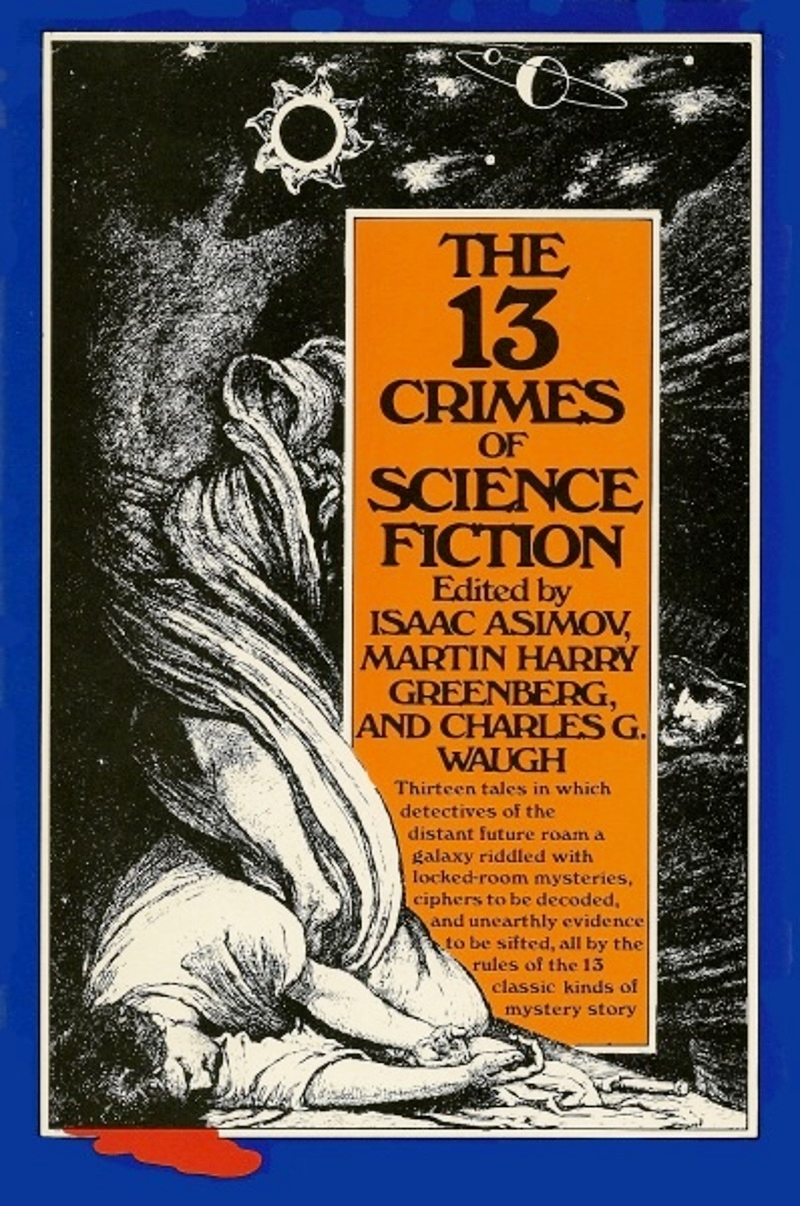
A fourth story from the 13 Crimes of Science Fiction [ss] (1977) collection, as I further explore my interest in the crossover mystery. Might this be the point where this collection springs to life?
Come with me as we experience…
Whodunit: ‘Coup de Grace’ (1958) by Jack Vance
The Story
Anthropologist Lester Bonfils, staying at intergalatic motel The Hub, approaches another guest, the famous detective Magnus Ridolph, to ask him for help with a delicate matter: “I am harassed by a woman. She is busily engaged in killing me”. Ridolph turns down the request, but when Bonfils is found killed the following morning, and when it’s clear that one of the other guests must be the murderer, Ridolph takes it upon himself to interview the other denizens and find the killer.
Genre Trappings
Vance is clearly keen to establish this as a ratiocinative story with his early rejection of science mumbo jumbo machines…
“I take it you have no criminological equipment?”
“You mean those truth machines, and breath-detectors and cell-matchers? Nothing like that. Not even a fingerprint pad.”
…and Ridolph pleased at the prospect of being “provided what appears to be a case of classic purity” in that matters like motive, means, and opportunity are all present and can be distilled down through examination of the fellow guests. And so a round of interviews begin, with “various men and women, near-men and near-women” from various alien races being brought in, questioned, and then dismissed for the process to be repeated.
That’s…that’s sort of it, really. The setup is simple, the structure is simple, the understanding of investigative techniques is simple…there’s no clever, telling clue, nor any sort of reasoned analysis done by Ridolph that makes sense outside of the SF trappings, about which more below.
What Does SF Add?
The resolution of this story relies entirely on the setting’s ipsedixitism, with the fact that various species from various cultures are involved being sufficient to provide a clue which Ridolph understands but which the reader is not brought in on beforehand.
“The suspects — the persons on this list and any other Bonfils had dealt with recently — are from different worlds. Each is steeped in the traditions of his unique culture. Police routine might solve the case through the use of analyzers and detection machines. I hope to achieve the same end through cultural analysis.”
A few interesting ideas present themselves — one of the suspects is from a gladiatorial race, and would only mar his standing in the eyes of his people were he responsible for something so simple and sordid as the shooting of a nobody rather than a more public kill as the result of a challenge — and Vance is to be commended for the range of different cultural trappings that he introduces:
“This morning I had occasion to review the folkways of the Kolar Peninsula on Duax. The symbology of clothes is especially fascinating. For instance, the blue and orange in which Thom 199 just now appeared induces a frivolous attitude, a light-hearted disregard for what we Earthmen would speak of as ‘fact’. Black and white, however, are the vestments of responsibility and sobriety. When these colors are supplemented by a black hat, the Kolarians are constrained to truth.”
Of course, this serves merely to simplify matters from an analytical perspective since Ridolph can say with absolute certainty that “Kolarians will perform violent deeds only when wearing gray pantaloons or the combination of green jacket and red hat”, which is hardly the sort of classic, observation-based detection that one hopes for when told of a famous detective and their facility for finding the truth.
As such, then, this needs it SF trappings, because that’s how it achieves its answer. Indeed, there’s really no reason to assume the eventual guilty party is guilty except that everyone else has been reasoned innocent and Vance is able to ascribe an uncommonly altruistic motive to a non-human race. Honestly, I think I’d prefer it if the killer was a Kolarian and had been wearing reversible clothing or something similar, but instead it’s just ‘Well, no-one else did it because I read a few books in the library for an hour and so understand the subtleties of their cultures…’. I feel like there’s a better way to use this conceit — like Ridolph misses a finer point, because it’s not possible to understand all the subtleties after an hour’s skim reading — but that’s not what Vance wants: this is almost Pulp writing in its determination for the detective to be right with minimum effort.
And so, well, The 13 Crimes of Science Fiction remains something of a damp squib. For the nonce, I feel no particular urge to rush back to it, so I’ll set it down now, look elsewhere for Tuesday posts in the coming months, and maybe review in the latter half of 2026 to see if it feels worth returning to. The fact that Philip K. Dick, Isaac Asimov, and Larry Niven all await is likely to drew me back in — but, well, let’s see what else the year brings first, eh?
~
The 13 Crimes of Science Fiction [ss] edited by Isaac Asimov, Martin Harry Greenberg, and Charles G. Waugh:
- ‘The Detweiler Boy’ (1977) by Tom Reamy
- ‘The Ipswich Phial’ (1976) by Randall Garrett
- ‘Second Game’ (1958) by Charles V. De Vet and Katherine MacLean
- ‘The Ceaseless Stone’ (1975) by Avram Davidson
- ‘Coup de Grace’ (1958) by Jack Vance
- ‘The Green Car’ (1957) by William F. Temple
- ‘War Game’ (1959) by Philip K. Dick
- ‘The Singing Bell’ (1954) by Isaac Asimov
- ‘ARM’ (1975) by Larry Niven
- ‘Mouthpiece’ (1974) by Edward Wellen
- ‘Time Exposures’ (1971) by Wilson Tucker
- ‘How-2’ (1954) by Clifford Simak
- ‘Time in Advance’ (1956) by William Tenn
 The Invisible Event
I will say that this does pick up in the latter half of the book, although it’s a curious collection, with many stories feeling like neither one thing nor the other, with only Niven’s ARM managing to succeed in being a locked room mystery in a sci-fi setting, see what you think!
LikeLike
I appreciate the reassurance to persevere. I’ll get back to this in the latter half of the year, so hopefully that improvement will be in evidence then.
Many thanks 🙂
LikeLiked by 1 person