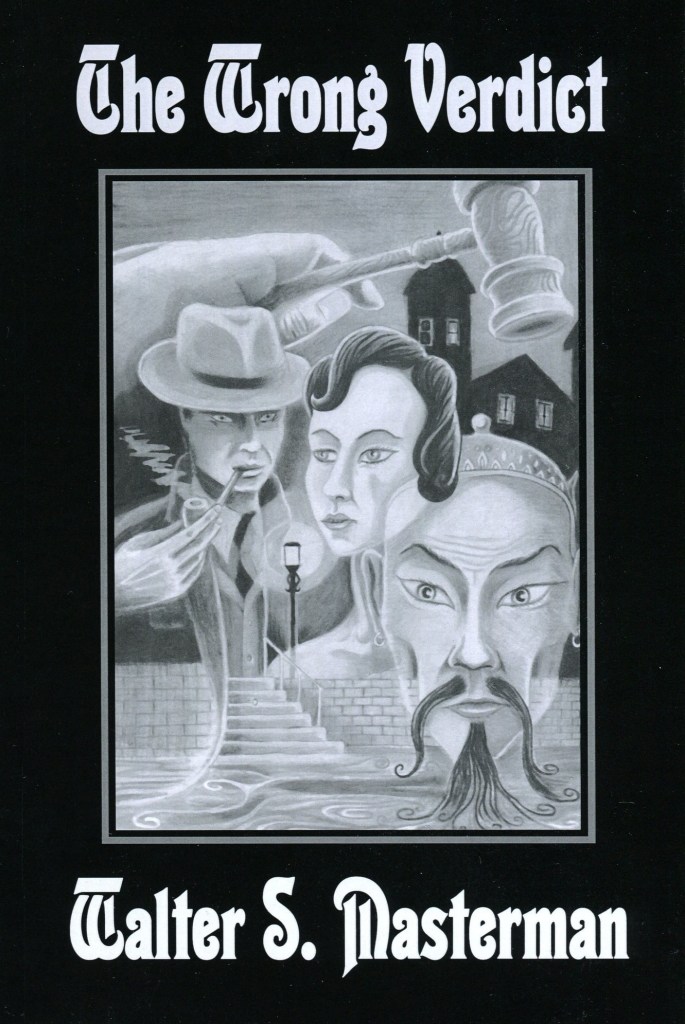


It is interesting to me that I’ve delved into the career of Walter S. Masterman somewhat contemporaneously with that of Edgar Wallace; the men were briefly literary contemporaries, of course, but they also share a looseness of structure that means you’re never sure if you’re on the verge of a masterpiece, always one sentence or clever idea from being wrong-footed…but equally you always feel one sentence away from what seems to have the seeds of genius turning out to be utter codswallop. It’s a tightrope I’m not sure either man meant to walk, no doubt genuinely trying their best with everything they wrote, but the similarity helps for some reason when, as with The Wrong Verdict (1937), all the promise collapses in a heap.
The opening chapter sees a man wrongly convicted of murder, his death sentence commuted to mere penal servitude for life, and his young wife reluctantly seeking solace in the arms of another. When her beau confesses on his deathbed that he was responsible for the murder that her husband is serving time on, there’s really nothing to be done and the woman’s daughter grows up to be the comely Vera Pollard, always believing in the shame of her father’s guilt. When Vera must reject the proposal of young Sir Ronald Watson, on account of his father being the layer who saw her father sent to jail, things are already complicated enough. But when Vera crops up again, she’s engaged to Charles Plattner…son of the man her mother turned to, the man who — little Vera knows — committed the murder in the first place.
And that’s all on show for the reader by the end of chapter 2. Whew.
There’s the germ here of a wonderfully tight little detective thriller, as a murder in a selective boarding house sees Ronald Watson suspected and a woman bearing a striking resemblance to Vera having quit the premises at around the time of the shooting. John Rhode, you feel, would make something workmanlike and enjoyable out of it. But it’s here that Masterman’s Wallacian tendencies rear and the whole thing sort of skates around for a bit and doesn’t really know what to do with itself for 80 pages or so. Some nice ideas — Ronald Watson was apparently viewed askance when his father died, and nearly charged with his murder — never go anywhere, and this is one of those plots that requires one conversation to resolve it and so of course that one thing’s not said, and there’s lots of Victorian soul-searching and staring out of windows instead.
By the time the sinister Chinese Lian Foo comes into proceedings, the whole thing feels rather lost, with the one piece of subtle clue placement squandered by a character essentially telling you what happened and Vera and her housemate escaping to France only to lounge around, be tracked down, and come back. And, my lord, isn’t Vera ever wet; everything about her has to be a Big Melodramatic Secret (“I was doing something with Mr. Plattner that was nothing but fraud…”) when, honestly, it’s really not that bad (considerations of the age aside, of course).
Chief Inspector Arthur Sinclair is brought into, and then kicked out of, matters, and I’m not sure if Masterman writes him intelligently or if he merely appears intelligent because Masterman always puts the right answer in his mouth. He has a little more character this time around (“Sinclair bore no love for his chief, whose main vocation in life was picking other men’s brains and taking the credit for their work…”), shows a streak of canny humanity in the matter of the valet Porson, and there’s a nicely confounding series of interpretations to be taken from the murder scene, but he always seems to come to the answer by a sort of divine intervention.
Some nice touches stop this being a complete bust — c.f. career criminal Mr. Snelling staring temptation in the face, the implication that a steam iron in 1937 would be loud enough to occlude the sound of a muffled gunshot, the folding in of the Chinese Civil War to one character’s background — but for all the occasionally excellent turns of phrase…
They put him on the train for London, with a third-class ticket and five shillings with which to start life again.
…this is a sort of mush by the end, despite one good reveal that ties it all up in a way that makes very little of what has come before. There’s also a moderate amount of casual racism, but that is hardly new for the era so maybe I just noticed it more because it feels so off-handed, with people saying things like ‘Well, you can’t really tell one Chinese person from another, can you?’ and everyone else just agreeing (c.f. The Clue of the New Pin (1923) by Wallace). It’s…weird, even for the far-from-tolerant 1930s.
Not the best or most edifying experience you’ll have in a book with Masterman’s name on the cover, then. Still, he had written the excellent The Bloodhounds Bay (1936) just before this, so maybe he was out of fresh ideas for a little while. I can’t believe there are many Masterman completists out there — even I don’t intend to read everything by him — but they’re the only people who really need this in their life.
~
Walter S. Masterman on The Invisible Event
Featuring Chief Inspector Arthur Sinclair:
The Wrong Letter (1926)
The Curse of the Reckaviles, a.k.a. The Crime of the Reckaviles (1927)
The Mystery of Fifty-Two (1931)
The Nameless Crime (1932)
The Baddington Horror (1934)
The Rose of Death (1934)
Death Turns Traitor (1935)
The Avenger Strikes (1936)
The Wrong Verdict (1937)
The Secret of the Downs (1939)
Back from the Grave (1940)
Featuring Inspector Richard Selden:
The Bloodhounds Bay (1936)
The Border Line (1937)
Standalone:
The Perjured Alibi (1935)
 The Invisible Event