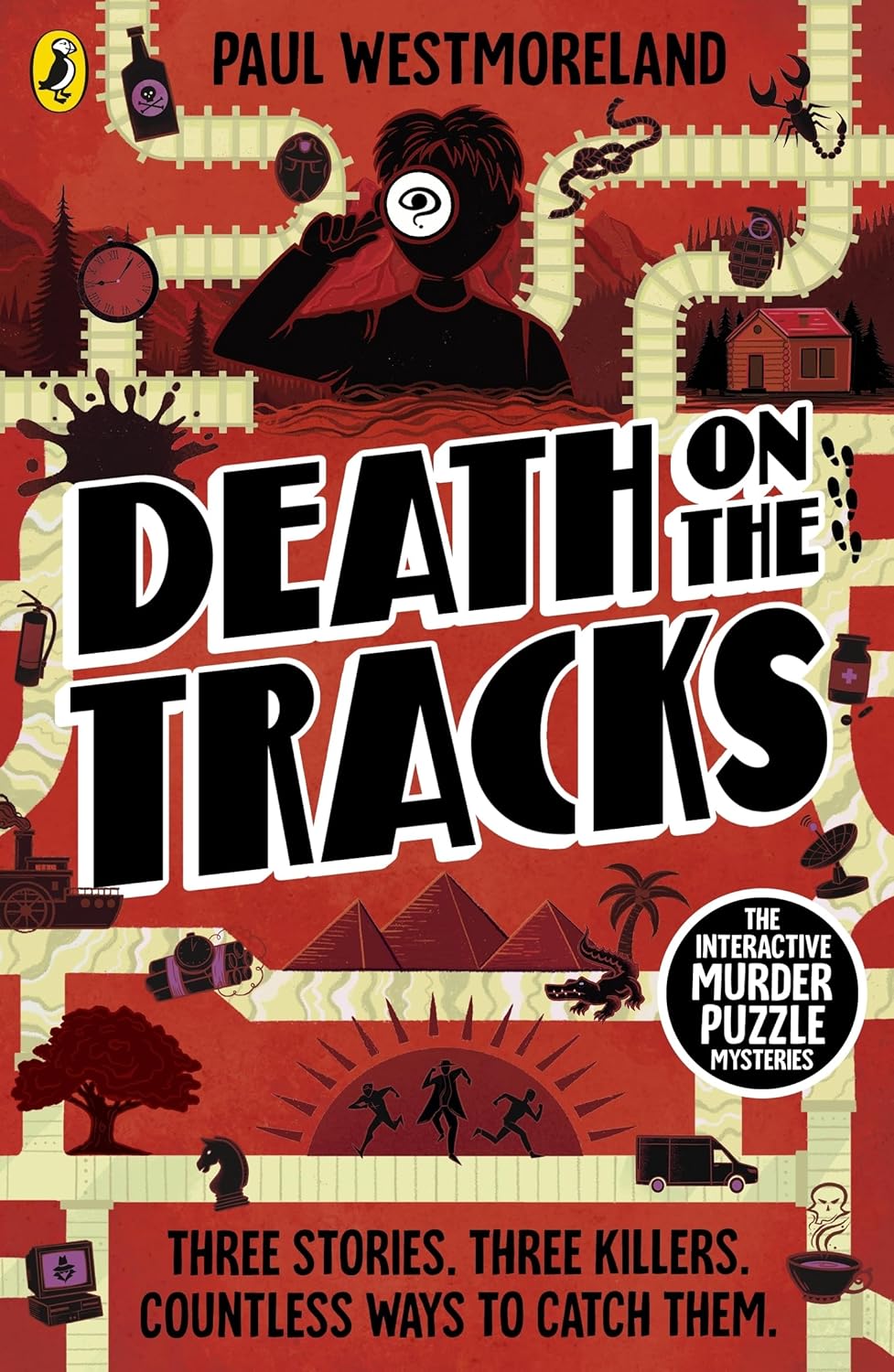
Another Choose Your Own Adventure-style mystery, this one aimed at the younger market. So how does it stack up in comparison to the other two I’ve tried thus far, which were more clearly for grown-ups?
For a start, Death on the Tracks (2024) by Paul Westmoreland is divided into three distinct sections, each a self-contained story. I was a little thrown by this, since nothing in my paperback edition made that clear and so, when I turned to the wrong chapter 45 early on in the first adventure, I found myself levelling an accusation at a woman I hadn’t even met yet…a character who doesn’t appear until the third story. Whoops. Once that was cleared up, however, I was fine from thereon.
Pleasingly, Westmoreland takes time in a brief introduction to encourage his readers to think about the choice they’ll make. Some of these obviously have a purely I-have-a-hunch-about-this approach — such as whether to chase a man who’s fleeing the scene of a murder, or whether to stay and read a note the victim has just dropped — but in other cases, Westmoreland assures you, to “read everything carefully and keep a close eye on the details. If something doesn’t make sense, don’t worry — I assure you all the information you need is right there”.
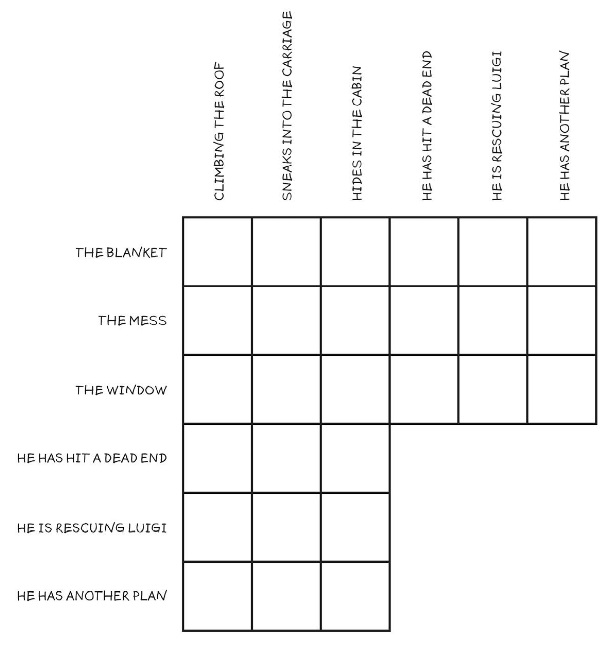
It’s interesting, too, that some of the choices really do force you to slow down and think, such as when you get confronted by one of those logic puzzles where you put crosses in boxes to strike out possible combinations, and only by filling it in can you deduce where to head next.
Westmoreland does a good job of keeping the chapters short, the choices largely quite distinct, and the pace fast. Obviously that last one depends on how fast you read the book, but the lack of pages between choices, and the way the decisions require different forms of thinking, all encouraged me to keep pressing on and on. This isn’t like Murder at Christmas (2025) by G.B. Rubin where you can sometimes go a long time without having any impact on the story, and I appreciated that, and I’m sure it helped many a juvenile reader barrel through it in very little time.
However.
While I’m aware that this is a book for younger readers, it must be said that some of the reasoning behind the choices as laid out in the solutions section is a little wobbly at times. I’ll not go through every single one, but want to justify that statement and so will explain a few examples from the first case ‘Death on the Tracks’. There’s no point spoiling this very well-intentioned book, and I really do admire the way Westmoreland has offered a range of thinking-it-out puzzles to encourage younger minds, but I can also understand how some clever kids might get a little vexed at times and — if anything — am wondering if it’s just me who feels like this (probably, Jim; very probably).
So, early on you’re tasked with picking a lock and are told you have a paperclip, a staple, and a pin badge with which to form a lock pick. The combination you choose determines the next chapter you turn to, and a chapter in the journal your character is carrying tells you how pin locks work to help your choice. But what’s not made clear is that the diagram in the journal exactly matches the lock you’re supposed to be unpicking…and even then it’s not clear that you make your pick by just sort of…putting two of the items on top of each other. This one’s fairly minor, but it vexed me.
Elsewhere, the suspect you’re chasing runs away and you hear a door slam and must choose which of four doors to go through. One of them is partly open, one has a DO NO DISTURB sign on, one has a lock on it, and then one he ran through is simply closed because, we’re told, the door slammed. But, like the other doors could all have slammed — the first one merely bounced open again, the second would be the one I’d choose precisely because you’re told not to go through it, and the one with the lock seems most obvious precisely because the guy had already locked one door after himself (see above). So, yes, if a door slams it’s closed at some point…but, no, this doesn’t hold.

Equally — last one, I promise — you’re later tasked with choosing which of three overlapping sets of footprints to follow, and the one that leads straight off the page without meandering is correct because you’ve previously been told that the suspect is “light on his feet”. Why does that translate into the correct set…? I’m not having it, I tell you!
The books is overall, however, far too well-constructed and entertaining in its variety of choices and puzzles for these tedious and pedantic queries of mine to (ahem) derail things too much. And Westmoreland is to be commended on introducing some element of (occasionally dodgy) reasoning into things given how the grown-up versions of these largely left the decisions down to a sort of ‘what do you feel in your gut?’ coin flip. It’s also only fair to suggest that he may very well have been tentatively experimenting with this first volume; two more books have followed in this series — A Killing at the Box Office (2025) and Xmas Marks the Spot (2025) — and so there’s no reason not to trust that he has got more confident and more rigorous as he has developed this idea in new ways.
I’m always acutely aware that I’m not the intended audience for these Minor Felonies books, and this might be the one time that’s affected my enjoyment more than anywhere else. Most people would probably pick this up, see which two items they’re supposed to combine to make the lock pick, and go ‘Oh, sure’ and just move on. Take, therefore, my criticisms with a pinch of Yeah But You Tend To Overthink These Things, and explore this at your leisure with, hopefully, no small amount of pleasure. I still remain immensely interested in these CYOA books, and I have no doubt I’ll pick up Westmoreland’s second book at some point, so the problems I discuss above clearly can’t have bothered me that much, eh?
 The Invisible Event