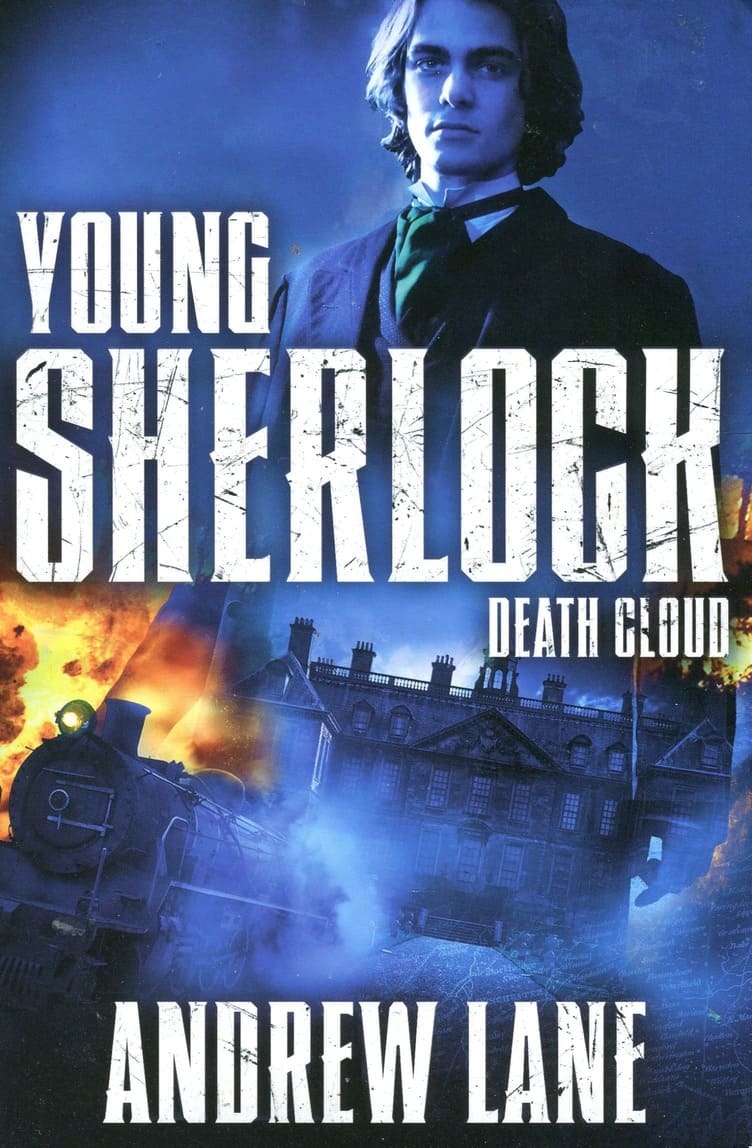
A final non-canonical Sherlock Holmes story this month, with Death Cloud (2010) by Andrew Lane being aimed at the 8 to 12 year-old market and setting up some Minor Felonies posts for Tuesdays in January.
On the last day of term, as he prepares to leave Deepdene School for Boys — the name can’t be a coincidence, surely — 14 year-old Sherlock Holmes is visited by his older brother Mycroft and told that their soldier father has been dispatched to India. As a result, Sherlock, far from going home to his immediate family, including his bedridden sister, will be sent to spend the summer with his Uncle Sherrinford and Aunt Anna in Farnham. The prospect does not fill him with much excitement and, upon being greeted by the elderly Sherrinford and the sinister housekeeper Mrs. Eglantine, his worst fears seem to be borne out. Even worse, it has been arranged that the unknown quantity of Amyus Crowe has been engaged to tutor the younger Holmes while on holiday, meaning that he won’t even get a proper break.
And then he encounters young Matty Arnatt, who claims to have seen a strangely-moving cloud emerge from a house just before a dead man was removed covered in boils. And then things start to get dangerous…

It’s surprising to me that so little seems to have been done with a pre-Baker Street Sherlock Holmes. The Barry Levinson-directed Young Sherlock Holmes (1985) gave me nightmares as an impressionable child, but that seems to stand in relative isolation when compared to the bulk of additional stories written about the man after he became a brilliant sleuth. So Lane’s decision to plot out, over a series of books, the gradual development of a 14 year-old social pariah into the World’s Greatest Detective is a creditable undertaking, and one that certainly gets off to an interesting, if slightly underwhelming, start here.
The teenage Holmes is already capable of some intelligent reasoning (“If he had been delirious then [the footprints] would wander about…”), and if the odd knowing reference sometimes feels a little wonky (“He wasn’t a natural storyteller, and for a moment wished that he had someone who could take the facts in his head and set them out in a way that made sense.”) there is at least something promising about him that you can believe would make Amyus Crowe want to educate him about more than just dead languages.
“[Y]ou can deduce all you like, but it’s pointless without knowledge. Your mind is like a spinnin’ wheel, rotatin’ endlessly and pointlessly until threads are fed in, when it starts producin’ yarn. Information is the foundation of all rational thought. Seek it out.”
It’s also interesting the way Lane captures the excitement of piecing ideas together for the young Holmes; encouraged to think in a different way by Crowe, he nonetheless feels the difference in the closing stages when, in outlining the situation to the Big Bad, he reflects on the difference of being listened to because “his deductions actually meant something, rather than just being theoretical answers to invented problems”. We’re a long way from the man who would prioritise the mind above all else, as we should be, but the seeds are scattered here in a way that feels right.
There’s a youthfulness to his learning, as well, such as the moment that he realises he’s overplayed his hand in revealing too much to the enemy and that this, in turn, might end up being his undoing. And, indeed, this naivety crops ups elsewhere, not least in a few encounters with a far unkinder world than, it is implied he has had to deal with to date — c.f. the men weighing down a duck in a pond and then sending their dogs after it, or the way Henchman #1 Mr. Surd (presumably an irrational man…) shatters Sherlock’s illusion that he has any options when it comes to demands made by the chief villain (“All [he] needs is enough of you [unharmed] to answer questions…”).
Away from the boy Sherlock, there’s some interesting work done in the plot, such as the threat of plague in Farnham (“Panic can spread faster than disease.”), and, indeed, the explanation of that seemingly sentient cloud. Given that Holmes expansion stories have taken in some wild permutations, it’s pleasing to report that the solution here would make sense in the Doyle universe, though it’s a little disappointing that, amidst all the fights and escapes, the only reason everything works out is because Sherlock serendipitously happens upon the heart of the villain’s scheme at a key point.
Of the villains there’s not much to say except that I liked Mr. Surd and it seemed fitting that Lane thanks Charlie Higson — author of some Young James Bond novels — early on, since the eventual Big Bad has about him the sense of the grotesque that Ian Fleming couldn’t help but invest in his own ne’er-do-wells. Also, the pacing of the final section is wildly out of keeping with elsewhere, with everything wrapped up in mere paragraphs and a few convenient actions tying this off neatly…with, of course, some lingering threads for the sequel. Also, you just know that something tragic awaits Crowe’s comely daughter Virginia. No way does she make it out of these books alive.
As a first entry in a very difficult undertaking, Death Cloud, despite some minor missteps (I can’t believe the Holmes brothers ever expressed love for each other, even in signing off a letter…), lays some good foundations and posits a few interesting possibilities for what lies ahead (I’m hoping my idea about Matty Arnatt turns out to be wrong — rot13: vg fbhaqf yvxr n onfgneqvfngvba bs Zbevnegl gb zr). I’m curious to read further, and hope that Lane continues to work in the necessary elements with the natural air that he largely achieve here; the series ended a decade ago, so I’m hoping that means he was able to see his masterplan through. Time will tell.
~
The Young Sherlock series by Andrew Lane
- Death Cloud (2010)
- Red Leech, a.k.a. Rebel Fire (2010)
- Black Ice (2011)
- Fire Storm (2011)
- Snake Bite (2012)
- Knife Edge (2013)
- Stone Cold (2014)
- Night Break (2015)
 The Invisible Event