
Intrigued by the apparent swathe — maybe I’m exaggerating it in my mind, but there do seem to be a lot of them at present — of Choose Your Own Adventure-style mystery books coming into the market in recent months, I undertook to try one. And having found Antony Johnston’s The Dog-Sitter Detective Plays Dead (2025) an easy read, it is to his contribution, Can You Solve the Murder? (2025), that I turn.
After some explanatory notes about how to read the book, we are dropped into proceedings speedily: you, a nameless Detective Chief Inspector, are being driven at high speed by your new colleague Sergeant McAdam towards Finchcote Manor, rebranded in recent years as a wellness spa called Elysium. It is here that guest — or “Friend”, as the management like to refer to them — and property developer Harry Kennedy has been murdered: stabbed in the chest with a small, handheld gardening fork and then pushed off a fourth-floor balcony. With the eager Constable Zwale on the scene and a variety of obstreperous types involved with Kennedy through various personal and professional relationships, can you find your way through the clues to identify his killer?
I’m old enough to remember the white-covered Choose Your Own Adventure books that seemed to be everywhere in the early 1990s, and while I’m not going to retrospectively claim any great fondness for them — they were fun, and I did a few without getting too carried away and then moved on — the format has about it a certain nostalgia for me. So to pick my way through Johnston’s take on this style of storytelling was, I will not deny, a mostly very enjoyable experience.

You’ll have a sense of how these things work, but just to be clear: at various stages, you will interview a suspect or have to make a decision about who to interview or what to do next, and the choice is then presented that you turn to a certain numbered section — the book is split into 200 of them — to see the consequences of that action. Along the way, this being a piece of detective fiction, you pick up clues which are given an alphanumeric label (J6, C12, etc.) which you’re asked to write down in your “notebook” (blank pages are provided at the back of the book, but I borrowed this form the library so used a piece of card) since possession of certain clues informs some of the later decisions.
- If you have C3 written in your notebook, turn to 158
- Otherwise, turn to 90
And, it must be said, after years of detective novels in which, no matter what you, you’ll be guided by the nature of narrative to the correct solution regardless, there’s an enjoyable tension to having to actually make the decisions this time around. Some of these feel like minor points that, while perhaps not informing much, still give you a chance to make a human decision — like whether to upbraid McAdam when she makes an illegal search to acquire some information — while others are about to whom you will speak next, whether to eavesdrop on a conversation, which clues to pursue, and how to progress with certain information that you possess.
One nice touch sees the introduction of coded messages into the skein, and, unlike, say, the similarly playful Miss Winter in the Library with a Knife (2025) by Martin Edwards, there’s a distinct advantage to getting involved since if you decode them yourself you’re able to skip ahead a few steps in the interrogation process. I really liked how each message contains a number which, if you decode it, then provides a key for which section to go to next…though, be warned, the decoding gets progressively harder (the third message is…extremely tough; I nearly gave up, but sheer bloody-mindedness refused to let me!).
It’s true that not all the deductions are left up to you to make, with some of the (potentially false…) leads being told to you in prose (“Suddenly a thought strikes you…”) but, equally, when you’re told to write down a clue you can also be told to cross that clue out later if it turns out to have had no value. At the end, Johnston provides a scoring system for the clue you have written down, and you’re able to place yourself on a scale of how successful your investigation was — a nice touch, and good for the ego if you’ve managed to avoid dying, messing up the case, or arresting someone with insufficient evidence against them.
The deconstructed nature of the experience means that the prose is fairly bland, but there’s the odd shot of humour…
One shelf contains biographies of successful businessmen, mostly American, some of whom you recognize as having been charged with fraud.
…and Johnston keeps things suitably classical and Golden Age-y via an absence of some of modern policing’s more useful accoutrements:
“Do you have CCTV inside the house?” she asks.
Stephen shakes his head. “The negative energy would spoil our ambience. Anyway, we’ve never needed it.”
So, how did I do? Well, I made one false turn — I don’t like to micro-manage my subordinates, y’see, more fool me — but apart from that made it through with none of the other enticing unsuccessful endings assailing me. At one point there’s a reference to a ceiling having collapsed which didn’t seem to have come from anything I’d previously read, but the book as a whole is so carefully plotted that I’m more than ready to believe that I turned to the wrong section despite my most assiduous efforts. And I scored 140 points in doing so, which the final scale tells us is “almost impossible”, so I’ll take them!
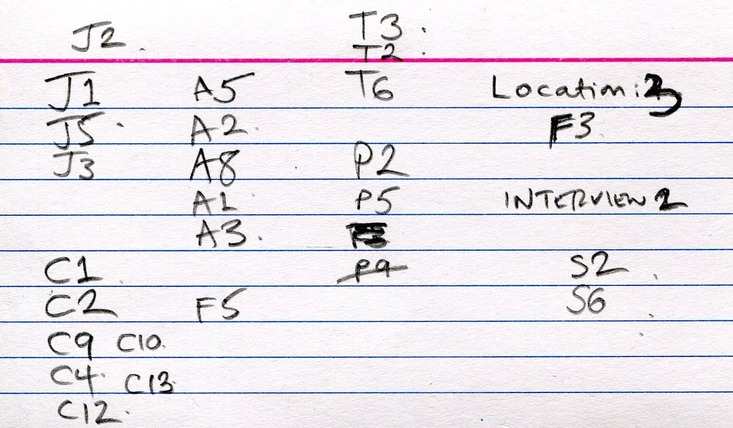
All told, Can You Solve the Murder? is a very enjoyable throwback to a bygone style of storytelling, and does a strong job of keeping the characters clear, the choices distinct, and the possibilities coming thick and fast. It’s also a great book to browse and see what paths you didn’t explore in your first attempt — in one possible ending you and McAdam drown…! — and so has a fair amount of value beyond the simple challenge of just finishing it. I could gripe that the final summation of the crime requires a bunch of unlikely events to happen one after another, but, in fairness, none of that impacts upon the clues you’ve collected to that point and so, really, doesn’t affect the experience this is designed to provide. Calm down, Jim, for pity’s sake.
And, if you enjoy this, Johnston hints in the closing pages that a second is on the way — and, indeed, it’s called Book One: The Flowers of Elysium on the title page — so it looks like the age of CYOA is back, baby. I, for one, am very much looking forward to diving into Johnston’s game again; well played, sir!
 The Invisible Event
It just took a place on my TBR pile, so I’m happy to see you had fun with it! One of my goals next year is to become a more active puzzle solver when I can! On my birthday, I’m entering an Agatha Christie escape room. This book will soon follow!!
LikeLike
No, I don’t believe it — you bought a book? But you’re usually so reticent and careful…
LikeLiked by 1 person
Hardy. Har. Har.
LikeLike