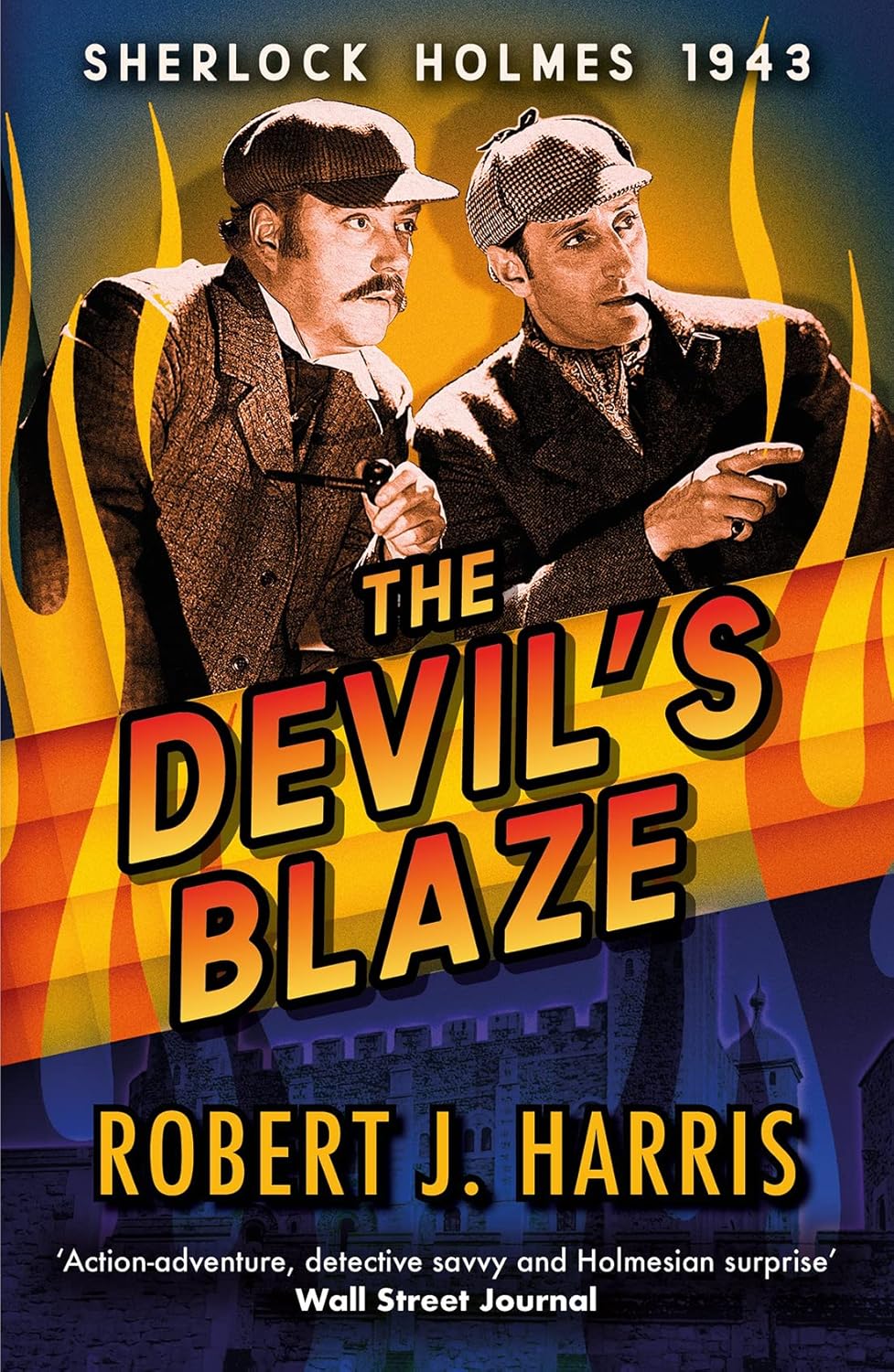
A second Sherlock Holmes pastiche from the pen of Robert J. Harris, The Devil’s Blaze (2022) sees him once again take his cue from the Second World War setting of the Basil Rathbone films rather than Arthur Conan Doyle’s original Victorian milieu.
As with his debut in this series, A Study in Crimson (2020), we begin with Holmes consulted on a minor case — the vanishing of a painting of a vampire — which, this time around, isn’t quite as successful as the impossible disappearance which started the first book. In both cases, this little episode will have zero bearing on what is due to unfold, and it’s to be wondered if Harris wrote these as a sort of homage to the short stories, since each would work perfectly well in isolation. Indeed, a collection of shorter tales from Harris would be a very welcome addition to this undertaking.
Following hard upon, Holmes is consulted in the matter of a variety of men who have been bursting into flames:
“As yet we have found no connection to any human agency,” said Shore. “This fire seems to strike like lightning. If it was more random in its targets, we might shrug it off, but the victims — Major General Talman, Sir Leopold Denby, Dr Wallace Carew — such men have surely been specifically singled out for assassination.”
“Talman was incinerated during a staff meeting with some of his junior officers,” said Colonel Lawford.
“Sir Leopold burst into flames while at home with his wife,” added Lloyd, “and Carew was consumed by fire in the middle of the street before a score of horrified witnesses.”
Partnered up with an expert, whose identity the military types will not disclose to Holmes and Watson, referring to them only to as “M”…
Irked by such foolishness, I could not refrain from commenting, “Well, I hope the alphabet contains sufficient letters to encompass all your security needs.”
With absolute seriousness he said, “We also have numbers,” and then hung up.
…our intrepid duo are swept to an analog for Bletchley Park to meet this person with whom they have been instructed to work closely, and, well.

Now, look. I don’t want to make a big deal out of this, but I think it’s a shame that Harris himself spoils the identity of M in both his preface and — in case you skipped over that — the epigram which opens the book. We’re only about a fifth of the way in when we meet M, and the fact that I’m going on about it at all will give, like, everyone an idea of who it is, but it would have been better to launch this as a surprise rather than tell everyone up front “Professor Moriarty is going to be in this one”.
Holmes and Moriarty fence (verbally), then Holmes and Sebastian Moran fence (swordily), and the scene is set for the two sides of this arrangement to be at each other’s throats while also attempting to work out who is behind these attacks and, perhaps more importantly, how they’re achieved. The recent Holmes and Moriarty (2024) by Gareth Rubin saw these two great enemies collaborate for the greater good, and Harris does well to keep the mystery on the boil…until, surprisingly, resolving it before the halfway point, with the miscreant identified when he attacks Watson. The method, alas, boils down to little more than “a poison previously unknown to science” and so prevents this being a clever impossible crime, but, well, the solution to the “spontaneous whadjamacallits” is in our hand and so…where now?
Well, you have the Napoleon of Crime at your fingertips, so what do you think happens?
From here, the novel takes on a different, more Adventure-esque hue to that of the whodunnit aspect of A Study in Crimson. Nefarious plans are hatched, reconnaissance is done, plot and counter-plot worked out, eventually we head into battle to face the enemy head on. It’s not what I had expected, but it’s bags of fun, with Moriarty achieving something of the aspect of a James Bond villain, complete with inescapable water torture trap and Watson knowing full well that his good friend has died at the hands of this previously-unsuspected nemesis. With 50 pages remaining.
It all goes a bit crazy in the final stretch, with a supercomputer and…well, mainly the supercomputer. Still, if you’ve come this far, and since we’re slightly unshackled from fidelity to the Victorian milieu of the originals, you can have a lot of fun imagining Rathbone and Nigel Bruce throwing themselves into this with gusto. It reminded me why I typically look for a Holmes pastiche to keep its feet in the 19th century, but I’d be lying if I said I didn’t enjoy the race to the finale, and the twist on the expected tale that Harris gives things at the close. Sadly it feels as if this is him unpacking his toybox for one last hurrah, however, and I doubt we’ll get a trilogy of these from him now, which is disappointing — he’s grown in confidence over these two books, and a final chance to see what he would come up with would be seized avidly.
You can tell that Harris is a lover of the films and of Holmes overall, with the obligatory references to cases we’ll never see (“…he had been of great assistance to us in connection with the mysterious affair of the Silent Piper, that elusive phantom whose appearance traditionally presaged the death of some member of the clan McKinnon.”) and legitimate care taken to present these characters favourably — Watson is no bumbling oaf, capable of some savvy observations of his own (“Moran hasn’t a drop of sweat on him…”), and the characters Harris invents are generally well-drawn, if a little honed to a single purpose before vanishing from the narrative.
I have enjoyed, then, the world that Robert J. Harris conjures up in these two books, and would meet with much enthusiasm news of a third adventure from Harris’s pen. After a couple of disappointing Holmes pastiches in previous weeks, this has given me new hope for this project, even if I acknowledge that I will have to kiss a lot of frogs in the process. As to next week, well who knows what’s going to happen?
 The Invisible Event