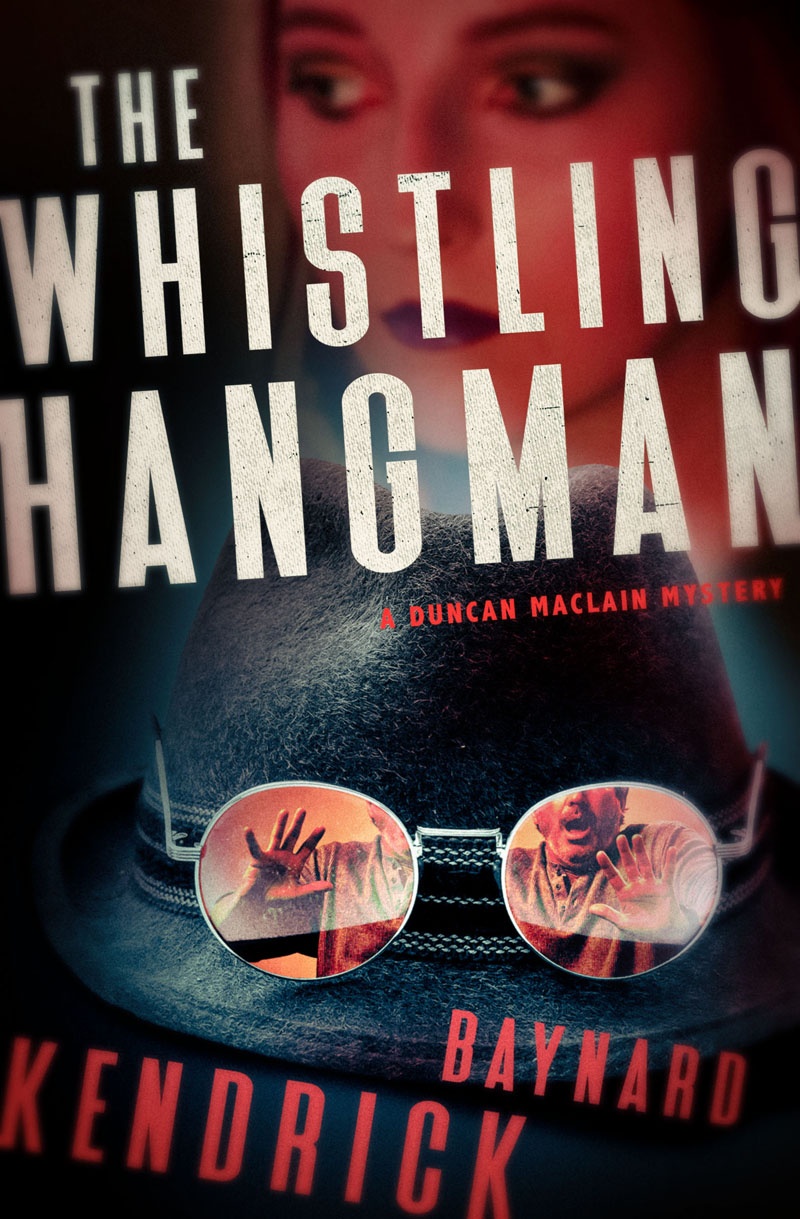


One of my favourite discoveries of recent years has been the character of Captain Duncan Maclain, the blind protagonist of a baker’s dozen of books by Baynard Kendrick. Having enjoyed The Odor of Violets (1941) and Blind Man’s Bluff (1943) as part of the American Mystery Classics range, I’ve been keeping an eye out for other books in the series, and got very lucky stumbling into a copy of The Whistling Hangman (1937) that was so severely beaten it must have owed money to six different loan sharks. And this was an especially exciting find as the novel has been praised by TomCat, apparently featuring some more ingenious impossible deaths in a large New York hotel…and, yeah, largely lives up to its billing.
The hotel in question is Doncaster House, a decidedly up-market affair which pitches for, and acquires, the patronage of Dryden Winslow, the successful businessman who is returning from two decades in Australia (uh-oh!) to meet with his estranged family. One by one the Winslow ménage arrive — adult children Gertrude and Baxter, the maiden aunts the Misses Forrest who raised them, two cousins who are in the book but honestly don’t need to be — and then the great man himself arrives, clearly ill and asking to be left alone in his room, sending notification that Gertrude should come along and meet him later that evening.
One of the things that’s both interesting and slightly frustrating about this book is that Kendrick clearly isn’t quite sure who to focus on, with the Winslow party most likely to be the core of things yet only ever really seen through the eyes of the hotel’s staff, right up to the moment of tragedy when Dryden Winslow is somehow plunged over his 15th floor balcony and hanged in midair while falling. It’s an interesting stylistic choice, not least because Kendrick has a good line on making what should be the fringe characters in the drama really breathe, such as assistant manager Tomas Fralinger writing the letter to solicit Dryden’s business “with the skill of an expert musician”, or head house-keeper Mrs. Colling-Sands reflecting on the apparently impersonal nature of the people we are to spend so much time observing.
Personalities are lost in a hotel — deliberately buried in graves of fine raiment and inscrutable mannerisms.
Winslow’s death is, of course, a disaster for manager Rudolph Bleucher — “If not promptly checked, calamity spreads through a hotel with the rapidity of dry gunpowder trailed carefully through halls and stairs and touched alight.” — but he happens to be playing chess with Captain Maclain, who sees the possibilities despite his host’s misgivings (“Everything to you is murder.”) and so launches his own investigation alongside the police. And, honestly, the arrival of the determined, driven, compelling Maclain saved the book at a point where I was starting to lose interest a little, despite Kendrick’s great turns of phrase:
“A visiting queen arrives, bringing with her the destiny of a nation, perhaps the fate of a troubled world. Statesmen come and go from her suite. Newspaper reporters swarm in the lobby — and Mr. Bleucher calls her [room] ‘nine-eleven’.”
I love Maclain, not only because of the driven nature of the character (“His freedom from confinement, gained through [guide dog] Schnucke, was important, but not nearly so important as his freedom from the clutching tendrils of helplessness which at one time had nearly dragged him down to oblivion.”) but also for the way Kendrick makes him intelligent and purposeful in so much that he does. We’re not kept clued in on all the developments — the sand, the will — but Maclain’s inability to be wrong-footed is wonderful to experience, and the book, which can lag at times, belying Kendrick’s unfamiliarity with how to structure narrative, most definitely revs to life whenever the Captain is on the page.
This is, it must be said, more successful in its minor characters — psychoanalyst Dr. Lorenzo Ynez dismissed as “a fungus on the medical profession”, hotel medico Dr. Sylvester presenting a visitor “with a bright air of having produced her out of a hat”, Gertrude Winslow reflecting on a marriage proposal that she does not remember receiving, Mrs. Sands’ observation about the conversational style of the maids under her command — than in its plot, which tends to meander. Maybe this is because we’re not getting so much from Maclain’s perspective, and maybe that’s a deliberate choice to try something out of the ordinary, however, so it feels wrong to hold this against the book too strongly.
The impossible murders are about as borderline as one can get in their impossible nature, and the explanation of the whistling and various factors is neatly explained (though it might send you scurrying to a Google search…). Maclain’s closing summary is pretty comprehensive, too, making you realise how the book might have been a lot shorter if we simply followed him around, though we’d miss out on some lovely writing had that been the case:
In New York [the moon’s] brightness dimmed, battering against sky-high steel, already bright with a million candles powered by motors below.
The experience of reading The Whistling Hangman almost makes me wish I was reading the series in order, because Kendrick definitely improved on this with the later two books I’ve encountered. But I remain keen to read further, and must now hope that either the AMC are moved to publish some more or that another chance encounter comes my way. It will become a mission of mine to read as many of these as I can, so expect more time to be spent with Maclain, Schnucke, and Driest in the months and years ahead.
 The Invisible Event
I laughed out loud when reading that your copy of ‘The Whistling Hangman (1937) […] was so severely beaten it must have owed money to six different loan sharks.’ The last Rae Foley I read fell apart in my hands, so I dread to think what that book was owing! It is good to hear that this was an enjoyable outing in the series. I shall have to get around to reading the Kendrick book I have on my shelf – Out of Control – I think it is called.
LikeLike
I read this abut two years ago and thought it was really enjoyable. A strong setting, a goodish mystery and I liked Maclain a lot.
The only other Kendrick book I’ve read so far is the stand alone Blood on Lake Louisa, which was and maybe still is available for a pittance on Kindle. He’s an author I want to read more.
LikeLike
You liked Blind Man’s Bluff, so The Whistling Hangman couldn’t possibly miss. Weird, isn’t it, how much we agree once the detective story as much as looks towards the pulps? Anyway, if you can find copies, I recommend you try The Last Express or Death Knell next.
LikeLike