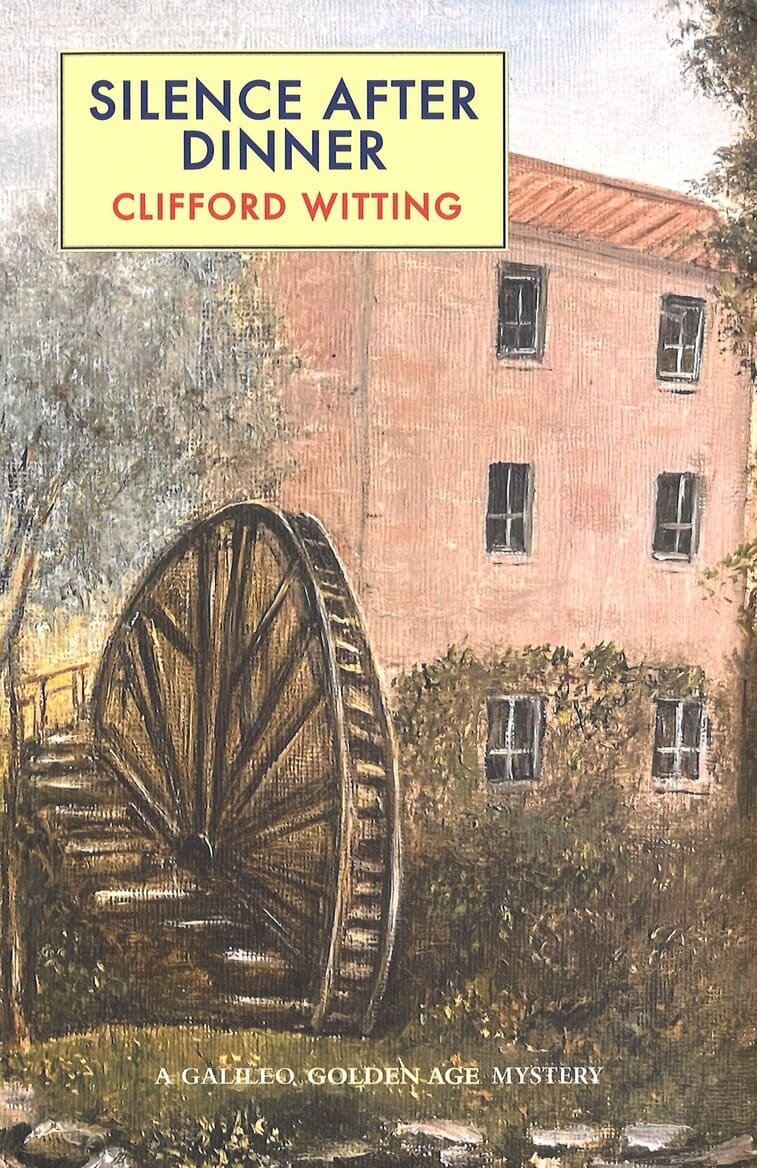


With an intriguing title taken from Oscar Wilde’s The Picture of Dorian Gray (1890) (“Murder is always a mistake. One should never do anything that one cannot talk about after dinner.”), Silence After Dinner (1953) is the eleventh Clifford Witting novel republished by Galileo Publishers. And since they were kind enough to send me a review copy, I can tell you about it fairly close to its release for a change. Opening with a startling, anonymous diary entry set in late-Communist Revolution China, we jump forward four years to the more bucolic South Downs where various people all seem to have spent time in that country and so might be the person responsible for the acts relayed in that opening. So, whodunnit?
This being Witting, the questions of crime and culpability take something of a back seat, with the opening half being given over to exploring the various relationships in the small town of Yateham. Events broadly revolve around one-time rector Andrew Micheldever, whose uncompromising attitude in seemingly all things find him increasingly isolated from his beautiful daughter Janet and his wastrel son Harold, who returns from overseas — the first of many, don’t start getting ideas — under a cloud and begins to drunkenly irritate just about everyone he comes into contact with.
Add in local landowner Sir Timothy Chatthume, childhood friend of Janet and Harold, who is making love to showgirl Sabina Danbury much to the consternation of just about everyone, and then mix new rector Bruce Gault, arriving much to the consternation of Rev. Micheldever who sees the role very much as his own, and before too long you have plenty on the boil. Oh, and don’t forget Dr. Richard Farringdon, who will be about the ninth man to propose marriage to Janet, and might finally break down her resistance to the idea. When murder of a character who has found their way in unwelcome fashion into just about everyone’s lives breaks up the social milieu, well, you can be sure that Witting will mine these relationships well on the way to his conclusion.
Silence After Dinner is at its most successful as an examination of the people and attitudes of a small village. The yokels are of course present to offer commentary like a sort of rural chorus, and Witting has an appropriately witty eye for character foibles and actions, c.f. a policeman “hovering with the massive immobility of a captive balloon” or a fairground described as “the opportunity to be thoroughly uncomfortable in or on a variety of contrivances calculated to turn the stomach and bring the heart into the mouth”. He’s also very good at telling you much about people through dialogue, even if some of the conversations in here do remain vexingly elliptical so as to maintain uncertainty for as long as possible.
An interesting accident of events sees the murder achieve a dimly impossible element — it doesn’t quite become impossible, but it’s pleasingly close — and there’s so much casual littering that you wonder the entire region isn’t under six feet of garbage by the time our killer confesses in the final stretch, robbing the police investigation of any real merit. Indeed, the police investigation goes sort of nowhere, except to have a few interchangeable men follow some suspects around. As a novel of detection, it’s a real disappointment, which might be why Witting has retired previous series sleuth Inspector Harry Charlton (“…on account of a diabetic condition…”) because he would have seen through all of this pretty quickly.
It’s a shame, too, that for all the good character-work, the guilty party is simply stated, rather than there being any hints or indicators to their guilt beyond…well, let’s dodge spoilers. But the under-used diary entries imply much about that person that we would otherwise have no reason to suspect, so they’re only there as red herrings…and once you realise this it’s not a long hop to whomustadunnit. But they still manage to come out of nowhere, and it’s a shame. Indeed, the most interesting thing about those diary entries is the kanji character used at the start of each one — one wonders why Witting didn’t either exclude these tracts altogether or go the whole hog and fully invert the mystery by telling us the author up front.
Interesting to see, too, an example of the Sinister Chinese archetype so late in the genre’s development, with Bruce Gault bringing two servants back from China with him. And while one character is belatedly berated for indulging in “Fu-Manchu stuff” when discussing Mr. and Mrs. Yin, it does also seem like Witting wants that cake he’s eaten back as soon as possible. Which, in a way, represents the difficulties with this book overall: if it had been written 30 years earlier, it would be an interesting exploration of the nascent form of strict detection alongside other genre trappings. As it is, I came away from this without any real sense of what Witting wanted to achieve; it’s a quick and very easy read, strung together with Witting’s consummate skill with breezy language, but it won’t linger long in the memory.
 The Invisible Event