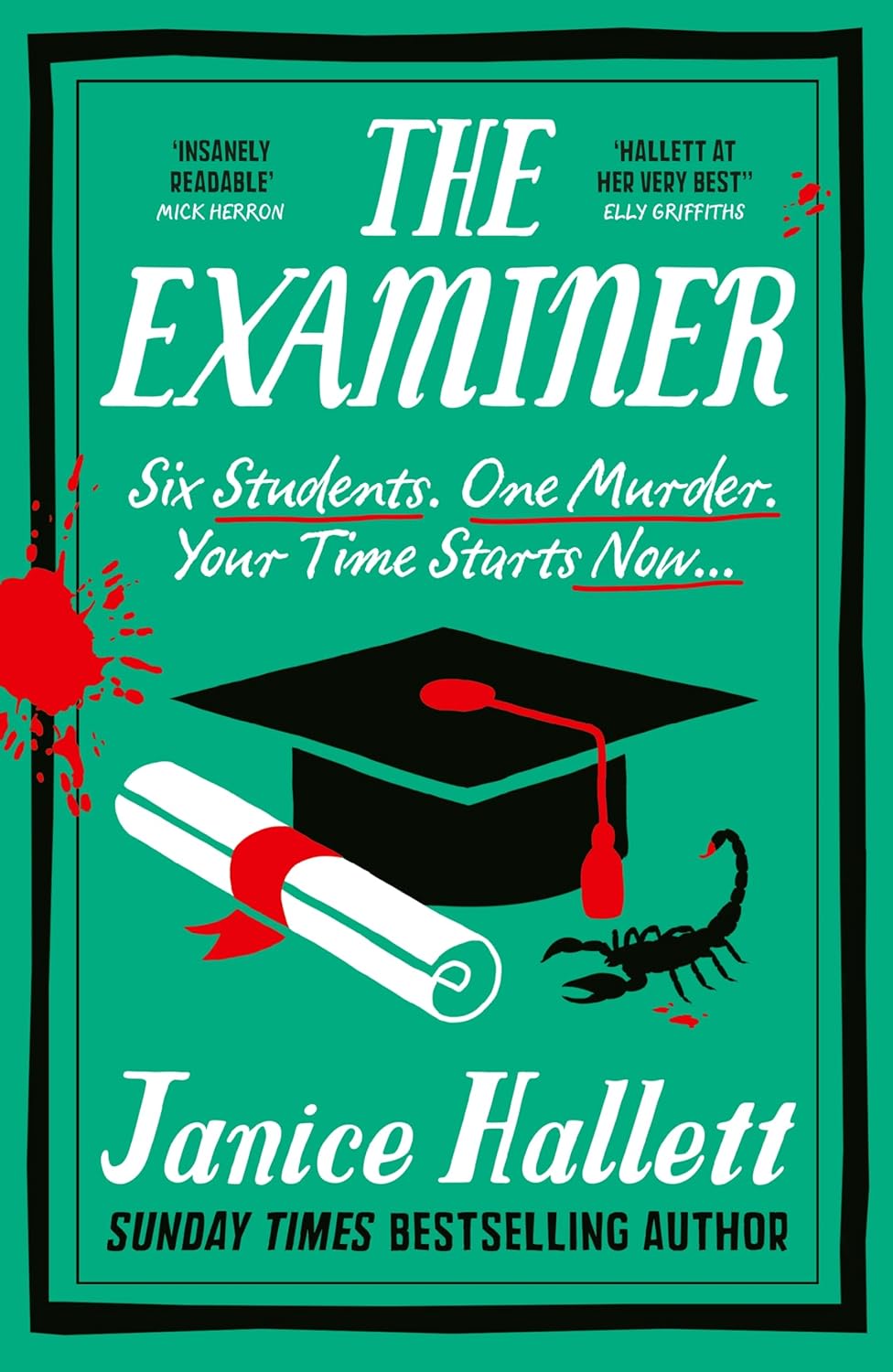


Janice Hallett fairly set the crime fiction firmament a-gaggle with her debut The Appeal (2021), a story of murder in a community theatre group told via emails and texts. Her third novel, The Mysterious Case of the Alperton Angels (2023), was, to my thinking, even more successful again, not least because of how it stirred in a speculative plot about the Antichrist and a forthcoming apocalypse so confidently, again told via various media rather than in straight prose. So when her fourth novel The Examiner (2024) was announced, I was at the head of the (library) queue, and, well, we might be in an her-odd-numbered-novels-are-the-good-ones situation.
Ostensibly, The Examiner consists once again of messages, texts, essay excerpts, and various other communications between the six students and course administrators of a new Multimedia Art Masters course at Royal Hastings university. These have been submitted to Ben Sketcher, the external examiner who is due to grade the course, and having read it he is of the impression that “[s]omething awful *may* have happened, and, if it did, everyone…is covering it up”. Can you, dear reader, figure out what that awful thing might have been? Your time, as the cover says, starts now.
One of Hallett’s genuine strengths is how adept she is at telling you about character only through their communications. We swiftly get a sense of the various personalities of the six students — Jem is boiling over with youthful enthusiasm, Ludya positively oozes a more mature cynicism, Alyson seems to observes everything from the distance of implied refinement — and, once they’re established, Hallett is quick to throw in subtle hints that there’s more going on below the surface. Some of these people seem to know course administrator Gela better than they should (“[T]hat’s not what we want. I know.”), and in some cases the balance of power would appear to be heavily weighted in the unexpected direction. It’s what I think we can safely refer to as ‘classic Hallett’, and a joy to immerse yourself in again.
And, well, this might be where the first problem creeps in for me, because Hallett is so good at this kind of thing that she seems to be unwilling to give it up easily, so the first half of the 460-page novel passes with very little in the way of incident as people bicker, assignments so wrong, and some of the students exchange private messages that hint at lots but achieve very little. The smaller cast is an improvement over the 40+ people in her debut, but that also leaves a very limited number of combinations for anything to happen. Hallett has a real skill with throwaway comedy (“I had to go to Stevenage every day for a week. That’s how committed I am.”) and the events which take on significance later on certainly lodge in the mind, but, well, I was getting a little bored at all the pages of clandestine hints. As Elvis said: a little more action, please.
When things start to fall apart, they do so with a sort of crumbling inevitability that has almost its own gravitational pull, but even then, the insinuations seem too ridiculous for words. Hallett negotiated this so well with …Alperton Angels, but here the possibly-misleading direction of things doesn’t carry the same dramatic heft, nor does it feel really entered into with the same degree of conviction. It’s a pale miasma of misdirection, sold slowly, lacking a compelling hook, and clearly the best cover story she could contrive to obfuscate the eventual direction of things…and then it turns out it isn’t, and this in fact the direction it was supposed to be taking all along and, wow, how thoroughly underwhelming.
Reactions will, of course, differ, but the slow build to the eventual payoff of what’s really happening on this course is, in my opinion, unwarranted. The book should really be about 130 pages shorter and would be a fun romp as such, but all this skulduggery for that aim is…hard to swallow. Clearly Hallett is passionate about her intent, as outlined in her acknowledgements at the end of the book, but, urf, the number of hoops jumped through, and the amount of convenient actions characters just happen to pull off to make it all happen — actions we’re, incidentally, not told about until after the fact, my least favourite kind of reveal — feel clunky and beneath the level of plotting acumen this very talented author has demonstrated before.
There are some lovely moments — a revelation concerning the acquisition of some course paperwork is dropped in with feather lightness about two-thirds in, and will make your brain scramble to catch up with everything you’ve read — and the frankly horrifying position certain people find themselves in are inventive, I have to give Hallett that, but this needs more heft or less time to stretch itself out so comfortably. The ingenuity and misdirection deployed in this style of novel is uncontested, and I hope Hallett has a long career of weaving her merry text-based-communications web ahead of her, but The Examiner falls short, and something something clever exam pun to end on.
 The Invisible Event
I loved The Appeal but while I did enjoy the next two, it’s been diminishing returns since then. This is the first book in ages that I’ve had a review request turned down for so looked like I might have had a lucky escape. 300 pages of waiting doesn’t sound like my sort of thing…
LikeLike
Hallett is clearly learning lessons as she goes, as the smaller cast here attests, but the book really needed a good edit to take about 80 pages off of it.
She’s really rather superb at building character — I don’t read loads of modern crime fiction, but I’d be amazed if there were too many people writing today doing it even half as well — and the germ of the idea here is good…but this is a third draft of a book that, for me, needed another couple of heavy reworks.
I’m sure she’ll continue to learn, and that the next one will be an improvement. We’ll find out next year 🙂
LikeLike
I think there are entertaining writers out there who still do that clue thing that are better at keeping the plot moving, even if they aren’t quite as ambitious in structure. Benjamin Stevenson, Anthony Horowitz, Robert Thorogood to name three off the top of my head.
LikeLike
I think Hallett’s characters top those three, but I get a great deal of pleasure out of Horowitz’ plotting and Stevenson’s snark.
LikeLiked by 1 person
Character is nothing without the plot – The Christmas Appeal, for example, was full of character but little of consequence, and for me, was a massive letdown. As we’ve often debated, plot comes first for me, so any book involving people standing around waiting for something to happen isn’t usually going to do it for me. There are always exceptions, of course, but not that many…
LikeLike
Actually, there’s a ton of “plot” in The Examiner, but I love how Nick puts it: in terms of the mystery genre (and any genre fiction as well), there comes a point where non-specificity doesn’t work. Agnes and Roger move into a new house and hire a new nanny. Agnes starts to get the feeling that there’s something wrong!! There are only so many weird noises and weird neighbors and bad dreams they can have before something SPECIFICALLY has to happen to Agnes to establish genre: either the nanny wants to have an affair with Roger and steal the baby or she’s a robot or she’s the Satanic head of the neighbors’ cult. The weird noises leading to this will only last so long. There are weird noises on every page of Hallett’s book. They’re never dull, but it takes way too long for them to gel – and this time the final picture may not be worth it (although, once again, it’s interesting, and all the “clues” do come together.) I’m with Jim: I wish Hallett would set her sights on more murder mysteries!
LikeLike
This review and Brad’s equally mixed reaction to this book has, I think, cemented my biggest criticism with Hallett. There is an unspecific quality to the way that the plots develop, and a lot of this feels intentional in the epistolary style. But it becomes frustrating to me when the lack of specificity feels like an impediment to my enjoyment and understanding of the book. While The Appeal framed all of this very explicitly as a Challenge to the Reader, Alperton Angels did not feel like a game and, as an example, the uncertainty about the number of bodies found at the scene of the crime or what police officer said what to what person did not feel like atmospherics that had to be parsed apart, just sloppy writing that I couldn’t follow.
I really enjoyed The Appeal enough that I have read her other novels, and chances are that I will one day read The Examiner, but I will probably only borrow it from the library.
LikeLike
See, I think the difference might be that The Appeal was genuine reader-as-detective, whereas everything since has been thrillers.
I hope she continues to write for a long time, because she’s shown remarkable invention in a short career already, but, like you, I would love some more actual detection in her output. We just have to wait and see what happens.
LikeLike
I read this book yesterday, as my reservation at the library came through last Friday. Hope to be reviewing this soon. I think you and I have had a similar reaction. I was nodding my head a lot when reading your thoughts.
LikeLike
I thought the camber of the world felt a little off — it was about time you and I found ourselves agreeing on a book.
I love how you read it in a single day, too. Took me bleedin’ aaaages to get through this.
LikeLike
Pingback: The Examiner (2024) by Janice Hallett – crossexaminingcrime