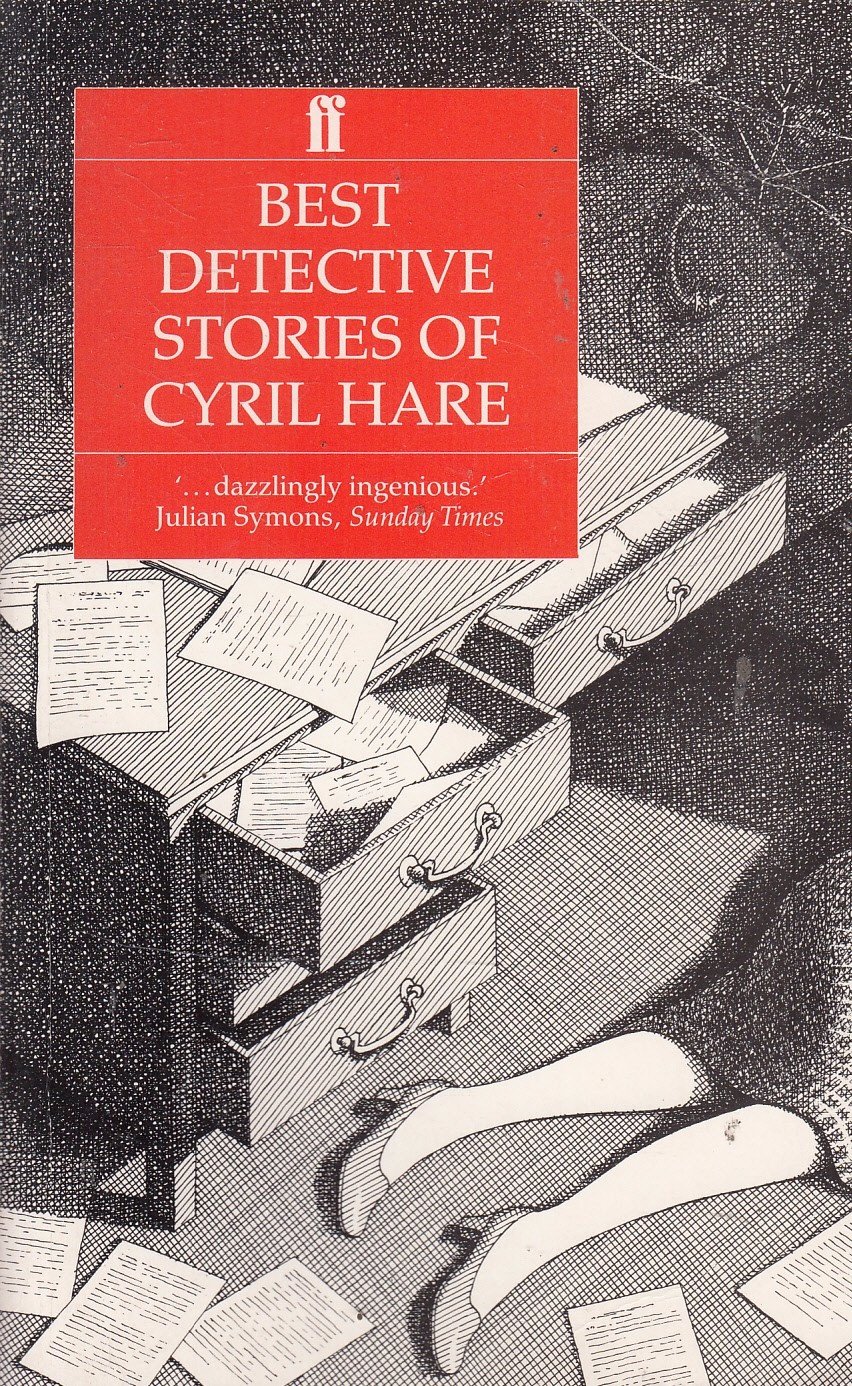
Thirty stories from the pen of Cyril Hare, an author whose legal-themed novels leave me rather cold, but whose scattered short fiction I have encountered is typically very positive. So a chance to dig deeper into that his miniature plots is to be seized.
The opening tranche, sectioned off in the contents under the title Legal, highlight some superbly astute character work allied to Roald Dahl-esque plot twists. The vindictive self-importance of the nephew in ‘“Where There’s a Will—”’ (1959) who is so keen to inherit his aunt’s property that he overlooks his own uselessness, or the garrulous breathlessness of the eponymous narrator of ‘Miss Burnside’s Dilemma’ (1939), with clauses and subclauses piling up in her sentences and ultimately empty platitudes offered when the matter of a death enters the picture. The webs of surprise in which both end up trapped are not only pleasing but also astutely woven.
‘Name of Smith’, a.k.a. ‘Blenkinsop’s Biggest Boner’ (1952) features Hare’s series character Francis Pettigrew and, following the story of a judge who summed up in a prejudicial manner against a murder suspect, ends with a closing fillip that’s more of a twist than the narrative one that drops several lines before. ‘Murderer’s Luck’, a.k.a. ‘The Unluckiest Murderer’ (1951) shares the story of a man whose undetected murder nevertheless shows his sheer misfortune in the crime being pinned elsewhere, and reveals a perhaps understandable thread of DNA with Miss Burnside’s earlier problem. Oddest of the lot, though, is ‘The Tragedy of Young Macintyre’ (19??), which starts off being about a diffident young lawyer getting elocution lessons, diverges to take a few potshots at the weary trope of the clueless, dozing judge, and then doesn’t know quite how to finish. Is it supposed to be funny?

The second subdivision — Murder — starts strongly: a semi-impossible crime in ‘Weight and See’ (1959) is resolved a little technically but with one good piece of behavioural evidence that adds a nice touch, and ‘“It Takes Two…”’ (1949) is a pleasingly amoral story of a meticulous murderer unable to anticipate the sort of ending that Francis Iles would have loved. Then there’s ‘Death of a Blackmailer’ (1952), a superb tale of a married woman who seeks revenge after receiving a demand for money to keep secret her affair with a younger man, which has a delightful double sting in the tail.
The quality dips slightly, as is to be expected, with ‘The Old Flame’ (1952) — in which a man seeks to be rid of his current beau in order to ensure his entry into a more salubrious family — not seeding its terminal development well and ‘“As the Inspector Said…”’ (1950) following the now-expected pattern of these shorter tales — presumably written for a newspaper, as they have that feel about them. Hare is at his best when lightly dropping in some aside which pays off dividends in the closing stages, and the lack of space in these smaller tales sometimes robs him of that opportunity. He does well in the love triangle of ‘Death Among Friends’ (1951), though, despite a complicated setup to get the various players and attitudes in place.
Sometimes the shortness works against Hare in other ways: is the eponymous heroine of ‘The Story of Hermione’ (1951) a jinx on those around her, or something more sinister? I don’t quite know. ‘A Surprise for Christmas’ (1952) is equally brief, but does good work in setting up the murder of a man not altogether to be missed which might just end up nevertheless discovered (shades of Stanley Ellin’s ‘The Moment of Decision’ (1955) here, no bad thing). ‘The Heel’ (1959) relies on a fairly classical trick, but its milieu of a small town overrun by American soldiers at the nearby air base is lightly, but pleasingly, rendered. I’ve read ‘The Rivals’ (1955) — in which two men accuse each other of the murder of a young woman they are both sweet on — before, but damned if I can remember where; the terminal deduction has aged poorly, but it was no doubt clever for its time. And ‘The Ruling Passion’ (1956) sees Pettigrew return, this time concerning a collectable teapot, murder, and one of those closing narrative fillips that Hare does well. Each of these is enjoyable, if minor.
This section ends with ‘The Death of Amy Robsart’ (1959), easily the longest piece in the book, accounting for over 10% of the pages herein. This story, told in five parts, suffers from the reverse of its predecessors in that it’s too long and spend too must cirumlocutory time on details that we don’t really need. The murder at its heart — that of a starlet whose new film has just been privately screened by its producer, to an underwhelming response — is, however, neatly managed, even if the precise details of how certain things were achieved are, bafflingly, not really covered in all that text.
Next up is Other Crimes. which starts off with the Dahlian ‘I Never Forget a Face’ (1950) in which a man with perfect visual recall but a lousy memory for names is telling a story about recognising a man on the train. This pays off its first-person narration well, and sells its titular premise engagingly. Things then go a little supernatural, with ‘A Life for a Life’ (19??) being a perfect for Ghosts from the Library (2022) and ‘The Markhampton Miracle’ (1953) turning the virtue of Christian charity into an effectively-realised joke featuring the football pools.
‘A Very Useful Relationship’ (19??) tells the story of an uncle and his dissolute nephew, with the defalcation of the latter contributing to the former’s disgrace. The ending isn’t hard to guess in this company, but in isolation it’s probably more surprising. The we have a man dealing with demands for money in ‘Sister Bessie’, a.k.a. ‘Blackmail — with Loving Greetings’ (1949), complete with one of those illogical leaps which lead the protagonists of such stories into great trouble. It’s again not hard to see the error here, and the surprise ending isn’t clued, but without so many other stories doing the same thing around it it’s doubtless more effective.
Two disappointing stories round out this section: ‘Line Out of Order’ (1952), concerned with international espionage, has, through no fault of its author, receded into redundancy on account of technological updates which render its twist difficult to understand in these advanced days, and so it lacks impact. The fault with ‘Dropper’s Delight’ (1954), however, is that the scheme of a man ‘dropping’ counterfeit banknotes into general circulation ends up terminating on a point that is, to this reader’s simple brain, over-subtle…I honestly didn’t know what to make of it, or quite what the point of it was. Explanations welcome, but I read it three times and can’t figure out quite what the purpose of it all is.
Final section The Children sees a set of six stories inspired by the famous nursery rhyme, each following the expected pattern of a neat setup and a late twist. ‘Monday’s Child’ (1958) sees a beautiful woman used as a pawn in a theft, ‘Tuesday’s Child’ (1958) concerns a theft during a church service where all may not be as it seems, and ‘Wednesday’s Child’ (1958) sees a couple meet a young woman who claims to be pregnant by their recently-deceased son…the twist here arguably not working as well as it perhaps should. ‘Thursday’s Child’ (1958) sees a man visit an isolated island to offer the sole inhabitant an offer he’ll be hard-pressed to refuse, and benefits from some canny scene-setting to inform its terminal surprise, ‘Friday’s Child’ (1958) sets up a confidence trick that falls apart but still manages to come off in its own way, and ‘Saturday’s Child’ (1958) has an over-stressed local GP attracting the attention of a tenacious constable following a series of thefts.
The settings of each are expertly limned in a very short space, showing the skill Hare obviously possesses when it comes to settling the reader into the accepted pattern of many different types of living. His mastery of tone and simple beats of behaviour is unquestionable, and on wonderful display here, even if the stories, when taken as a whole, feel a little minor in their achievements.
A top five from such a long collection almost seems like too much to ask, but ask you might and so I guess I’d go:
- ‘”It Takes Two…”‘ (1949)
- ‘Death of a Blackmailer’ (1952)
- ‘A Surprise for Christmas’ (1952)
- ‘Miss Burnside’s Dilemma’ (1939)
- ‘Sister Bessie’, a.k.a. ‘Blackmail — with Loving Greetings’ (1949)
The first reflection is that, for a collection promising the best detective stories by an author, there’s a surprising dearth of detection herein. Yes, maybe the detection tales — ‘Weight and See’, ‘The Heel’, ‘The Rivals’, ‘The Death of Amy Robsart’ — are his best examples of that form, but they make up the minority of this collection and so one has grounds to feel a trifle short-changed.
As ever, when collected together the impact of these stories gets somewhat lessened, and more than a few of them would have a stronger impact if read in isolation, as I’ve done with Hare’s short fiction in the past. What’s beyond question, however, is our author’s clear skill when it comes to setting a scene or establishing a backdrop for his schemes — his milieu always lives and breathes, which, given the need to also cram in a moderate amount of plot mechanics into ten pages, is really rather impressive. He also maintains a high standard throughout, with only a couple of false notes in this symphony of crime.
Might I, then, take this favourable impression and read some of Hare’s longer works? Well, never say never. I leave this collection with a new-found respect for the man’s writing, and maybe this store of goodwill could find outlet in one of Hare’s novels in due course. Wait and see…
~
See also
Bev @ My Reader’s Block: Nearly all of the stories have a surprise ending–some are more obvious to long-time mystery fans, but most did catch this mystery fan out. It is a very strong collection which I heartily recommend.
Rich @ Past Offences: Considered as a collection, the stories are competent rather than earth-shatteringly brilliant, but they are entertaining and deserve to be better known.
 The Invisible Event
If you’re looking for a Hare novel to try, I would have to say Suicide Excepted.
LikeLike
Seconded; it’s Hare’s cleverest plot.
LikeLike
My judgement: Some very good ones (most of the legal ones, especially “Murderer’s Luck”; “Weight and See”; “The Death of Amy Robsart”). However, too many are slight tales of career crime or Ilesian twist tales.
LikeLike