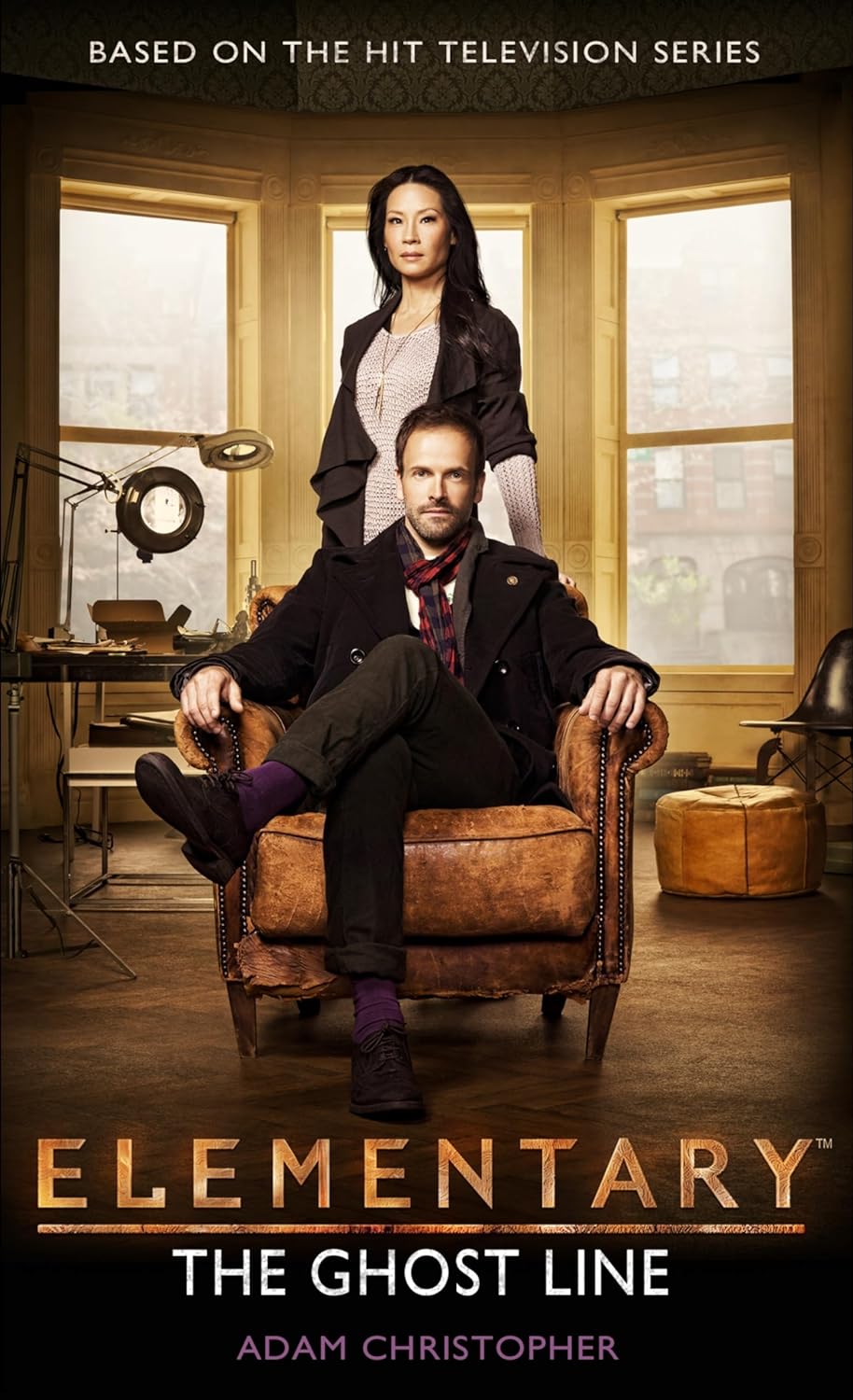
Another month, another Sherlock Holmes pastiche, this time from the very enjoyable US TV series Elementary (2012-19). My belated discovery of two novelisations in that universe was a source of immediate interest, and so The Ghost Line (2015) by Adam Christopher found its way onto my TBR.
Before even opening the book, I had reason to believe this would be a fun time, Christopher having written the very entertaining crime/SF crossover novel Made to Kill (2015), and full credit must go to our author for capturing the essence of the show so acutely. The slightly spiky Holmes-Watson dynamic, made so successful by the performances of Johnny Lee Miller and Lucy Liu, is here in full — Holmes’ speech patterns, physical mannerisms, and aloof arrogance are all on full display, and Joan Watson’s slightly aggrieved, more humanising responses to the prickly nature of her friend well-limned and in complete keeping with what has been shown to us as well as being in step with what we know from the canon of the Great Detective:
Having lived with Holmes for nearly three years now, she knew his moods — and their swings — very well. He could alternate from manic and effusive to withdrawn and self-conscious, his changes sometimes lasting hours, sometimes days. She wasn’t quite sure what phase he was in today — smug and self-satisfied, with just a soupçon of arrogance, it seemed. But an active case would be enough, usually, to snap him out of it. And all she could do was help, as best she could.
This being only the second piece of tie-in media I think I’ve ever read — the novelisation of Die Hard with a Vengeance (1995) by D. Chiel being the first, since you asked — it’s interesting, too, just how much this is written for those of us with an awareness of the show. If you don’t know who Everyone are, or if you want to know what type of animal Clyde is, you can get wrecked, loser — these references are tossed in casually for those of us who get them (in fairness, the most likely audience for this novel, so this isn’t a criticism) and then we skate on by to get to the meat of the plot. Similarly, if the character of Alfredo Llamosa seems to come out of nowhere, well, you should have watched the show, shouldn’t you?

This reminder that the show is so key to the existence of the book in the first place is an important one, because it also serves to remind you that there are limitations on what the novel can achieve. I believe I’m correct in saying that this was published when season 3 of the show was airing in the US, and so in order to fit into the canon of that you’re clearly not going to get any gigantic swings at anything different: everyone will have all their limbs at the end, the essential status quo of the series re-established, and no massive character moments are going to occur since they’d likely then have to be referenced in the show and so isolate the people — like myself — who weren’t reading the book in combination with watching along at home.
With all these factors taken into consideration, it’s a miracle that The Ghost Line functions as successfully as it does, feeling very much like a larger episode that throws in a couple of low-ball references to the originals (Holmes’ username when browsing an online forum, the jewel which forms part of an exhibition that the Museum of Natural History) so that you can feel smart for understanding them. And the plot develops well, too, exactly like an episode of the show would: from a shooting death in a locked apartment — swiftly resolved, so while technically an impossible crime it’s not one to get too excited about — to the city’s sewers to the aforementioned museum to a jewel heist, it nips along quickly, with enough filler scenes that feel like the sort of thing the show would show you to get to the required running time. I don’t mean that as a criticism, either: Christopher has done a great job capturing the beats and rhythm of the series, and he deserves huge credit for slotting so seamlessly into such a well-established milieu.
It also functions well as a Sherlock Holmes story, setting up a few of the later surprises without ever having to worry about playing fair where the detection is concerned. There’s a good late twist that again suits the style of the show, and then there’s another even later twist that feels particularly ingenious and is a very clever piece of novel (boom, cha!) invention. The Holmes stories were never designed to be fair play, and thus never had any obligation to set these things up, so it would be churlish to complain that there’s no real clewing, but, in fairness to Christopher, there’s a piece of…foreshadowing, I guess where that first twist is concerned, and I completely overlooked it in the race to barrel on through the good time I was having. And, hey, this isn’t even designed to function as whodunnit, since you know the guilty parties and the core scheme about two-thirds of the way in…so sitting back and enjoying the developments as they hit you comes recommended.
Are there flaws? Sure. You cannot hiss the sentence “What are you talking about?” and Joan Watson is sadly sidelined for the final third, mostly held at gunpoint or locked in a cupboard, but for the most part this is a swift and pleasing time that fans of the series will very much enjoy. There’s even a delightful foray into the trope of unwritten cases (“…a particularly fascinating case at the British Museum involving an exiled king from Eastern Europe, a scuttled German U-boat from the Second World War, and an Egyptian mummy.”) and a key aspect of the plot which echoes — maybe intentionally, or maybe I’m seeing things — Arthur Conan Doyle’s story ‘The Lost Special’ (1898) and an episode of British TV update Sherlock (‘The Empty Hearse’ (2014)). Is this a deliberate three-way tie in? Who knows? But I enjoyed it all the same.
Those of you unconvinced by Elementary can give The Ghost Line a miss: there’s nothing here that will change your mind, so save your time and money. If, though, like me, you have missed the show and are looking for an opportunity to spend more time in that highly enjoyable universe, this might just be the couple of hours of entertainment that you crave. The characters and their relationships are captured note-perfectly, and the plot is swift, fun, and unlikely to linger long in the mind. It’s perfect realisation of a sort of experience I have missed since completing the show, and Christopher’s second and final novelisation Blood and Ink (2016) will find its way onto my teetering TBR before too long.
~
Elementary recommendations on The Invisible Event:
 The Invisible Event