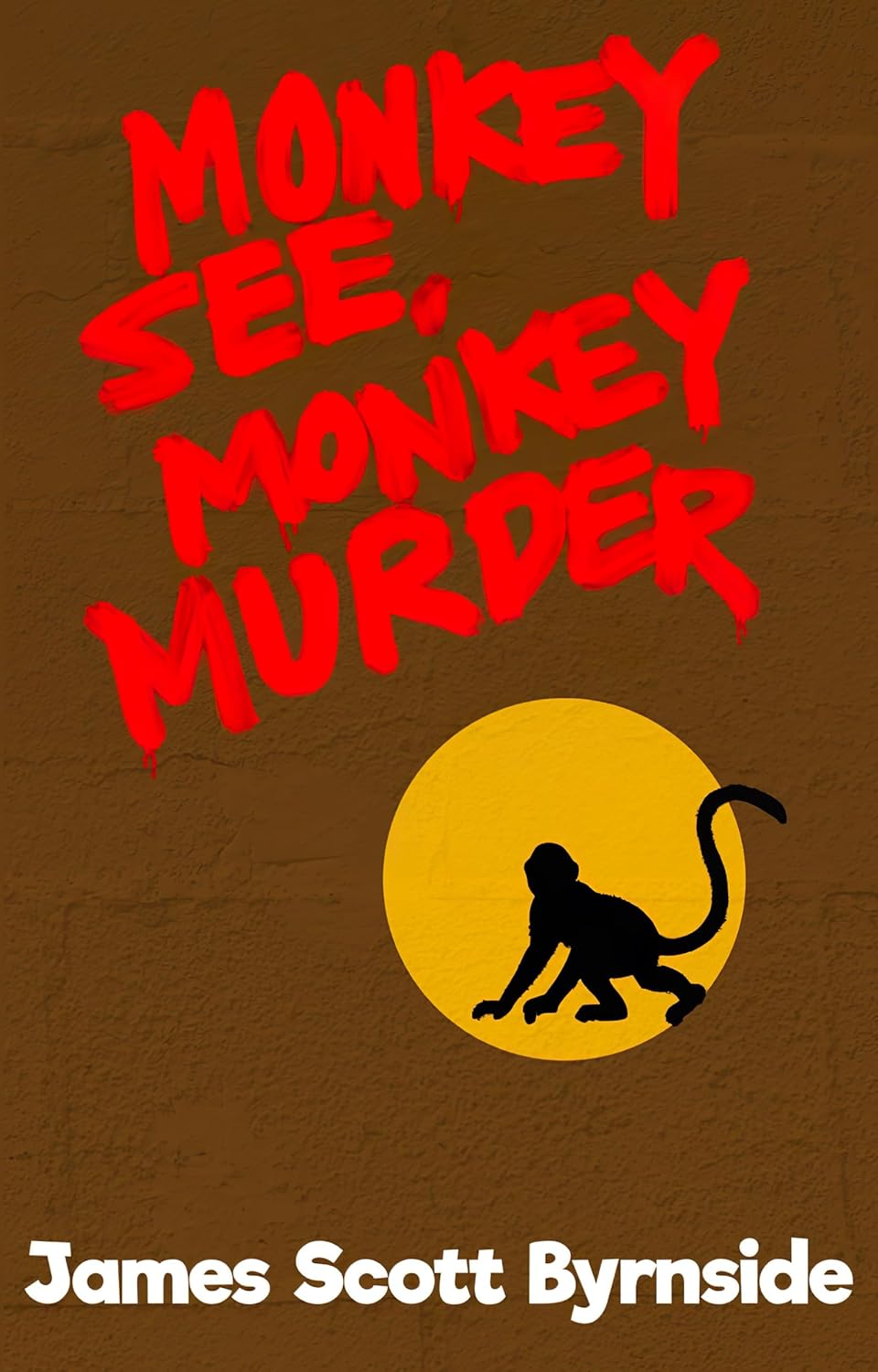
It’s incredible to think that Monkey See, Monkey Murder (2023) is James Scott Byrnside’s fifth novel, and wonderful to report that it continues to walk the line between classic detection and a 21st century motivation to create something quite unlike what you may have read in the genre before.
Following an unprovoked attack by a macaque monkey in Malaya, businessman Steven Rinehardt has been left brutally disfigured and abundantly paranoid, convinced that the assault was somehow achieved at the behest of mobster — uh, nightclub owner — Ivan Florkowski. Following a move to Boston, Rinehardt becomes ever-more convinced that Florkowski is intent on pursuing a vendetta against him, and P.I. Rowan Manory is hired, despite his misgivings, to look into matters. And what an unusual case this will turn out to be, with both a second attack from another monkey, and a baffling and bizarre locked room murder which will find yet another macaque at the scene.
After four books of quite delightful complexity, the relatively clear and straight lines of Byrnside’s fifth makes a pleasing contrast, even as the events pile up and, come a mid-book restatement of all the facts known to detective and reader alike, you know there just has to be something you’re overlooking. In a way, this feels like an author finding the voice with which he is most comfortable: where Byrnside had a tendency to rush scenes before, he now has the confidence to sit the reader down and carefully bring them along for the ride, too, with each development given the appropriate weight and space to breathe — including a mid-book locked room lecture stating the possible explanations for the murder.

Indeed, there is the confidence here of a writer who knows he’s baffled you before and so is content to confound you with a much simpler narrative — far harder to do — and indulge in his passion while doing so, resulting in a fascinating hybrid novel that walks the line between traditional P.I. and all-out insanity with quite wonderful aplomb. There isn’t quite the rigour here of true classic detection, but in that regard it fits the looser, more forgiving P.I. idiom quite beautifully — when the revelations hit in the final chapter, you’re arguably not prepared for some of it, and yet some quite magnificently subtle clewing, the sort of thing many an author would give a limb for, has been achieved in other parts.
Impressively, too, despite what feels like a shorter narrative, Byrnside has crammed quite a lot of minor character work in here, as also befits the P.I. novel of yore. The upright, precise Manory and his decidedly more casual assistant Walter Williams remain a delight, of course, but little scenes with the likes of Bradley Bouche or call-girl Victoria Davenport sparkle with the sort of diamond-hard richness that is this genre’s bread and butter. When the resolution comes sweeping in to tie events together, you see the cleverness of the design that’s lurked there as a result of who these people are, which is more of an achievement than tying together the mere technical explanations which can come at the denouement of a puzzle plot.
As to that locked room murder…well, it’s a doozy of a setup that I’ll not spoil here, and one that achieves both impressive complications in appearance and a rational, clearly-followed explanation in its unfurling. It’s the sort of thing you can feel Paul Halter delighting in: not original in its unravelling, but presented with such brio and pizazz that it’s honestly difficult to mind, so perfectly does it fit the story that surrounds it. Sure, you’ll probably have a couple of minor questions — that’s where the lack of classic rigour comes in — but those of us willing to be swept along on the tide of Byrnside’s love of the form and fondness for hybridisation (there are some giallo-esque moments in here, which has become more of a feature in his recent writing) are going to have a blast.
Bringing to mind my recent experience with Henry Kane, Monkey See, Monkey Murder left me a) hoping that Byrnside continues to write in this semi-seedy, semi-realistic vein from now, and b) determined to read more Kane in the immediate future. There’s invention here in spades — the second macaque attack is a piece of wonderful inspiration and explained magnificently — and an easy confidence in the presentation of this which bodes well for the future of Byrnside’s writing, whether that features Manory and Williams or otherwise. Byrnside remains at the forefront of authors working in the impossible crime today, and it’s a joy to see him go from strength to strength while enjoying himself immensely — surely the route any writer would choose for themselves.
More power to his wonderful imagination; I am very excited to see what comes out of it next.
~
James Scott Byrnside reviews on The Invisible Event
Featuring Rowan Manory and Walter Williams:
- Goodnight Irene (2018)
- The Opening Night Murders (2019)
- The Strange Case of the Barrington Hills Vampire (2020)
- Monkey See, Monkey Murder (2023)
- It’s About Impossible Crime [ss] (2025)
Standalone:
- The 5 False Suicides (2021)
 The Invisible Event
Sounds like a recommendation to me. I’ll take a look.
LikeLiked by 1 person
Oh, I haven’t read the recent Byrnside novels; I’ve been saving them up for a rainy reading day. 😬 Have you attempted a ranking of all the Byrnside novels? I’m wondering how this might fare on the ladder… 🧐
LikeLike
For me, rankings need a bit more distance, and even then I’m not sure a ranking of these novels would really make sense. Byrnside has written each of these books with a different sort of style in mind: this is almost a reworking of the ideas in The Dain Curse, Barrington Hills Vampire is Carrian, The Opening Night Murders is Christianna Brand-esque, and I’m not sure quite what the wildness of The 5 False Suicides is 🙂
You’d be better off thinking of the books in terms of their influences than their relative merits. We’re lucky to have someone who is able to play around with their style of writing so much, rather than be expected to fit into a particular idiom for book after book after book. Just don’t keep delaying reading him, because there’s a lot of fun to be had here.
LikeLike