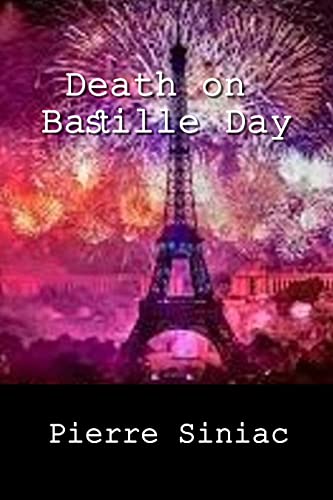


Published approximately a year ago, this translation of Un Assassin, Ça Va Ça Vient (1981) as Death on Bastille Day kept eluding my attention if only because I was holding out for a paperback edition. The vagaries of publishing have restricted it to Kindle only, however, and so I come to this story of a man in two places at the same time — dancing in front of some witnesses, while committing a murder in front of another — rather belatedly. And while I’m grateful for the opportunity to have read it, as with all translated works, I can’t help but feel that it would make an excellent short story, lacking as it does sufficient intrigue to support its far from excessive length.
Camille Feuillard, proprietor of the tawdry roadshow the Paris-Porno, has done much to put up the backs of both the denizens of the French backwaters where they typically perform and his own employees, not least Lise Dolari — an ex-lover he has now passed over in favour of the unworldly 17 year-old Camille. Lise has, in turn, taken up with Feuillard’s business partner Aymeric Malierras, who has grander ambitions for the theatrical troupe in which he owns a minority share, and the two variously plot and complain about Feuillard while Lise obsesses over what she perceives to be her imminent demise.
Eventually, things come to a head on 14th July — Bastille Day — when Feuillard, heading out into the celebratory crowds with a young couple, dances for an hour and a half with various strangers while Lise, some 60km away, is murdered in Feuillard’s house, screaming out his name and begging him for her life while a local watches through a window. Clearly some impersonation is at work, but author Pierre Siniac goes one further: with different people alternatively convinced of Feuillard’s guilt and innocence, the man is subjected to various tests — he is made drunk, he is questioned under anaesthetic, and, finally, he is fed a truth serum…and on all three occasions he describes down to the last detail the murder of Lise as he committed it. And so the question is…how is this possible?
Held against the relative moral uprightness of the Golden Age, there’s something quite striking about the seediness and grime here of the setting and people both. Siniac’s worldview feels very cynical, dressing his universe in people like Gilbert Givrette, a disgraced private investigator who comes into proceedings fairly late, and whose chief interest in regaining his licence is mainly because “he revelled in other people’s shit”, or a scene in which “a gloomy young couple sat in silence in front of empty coffee cups, distant looks in their eyes, like people crushed by an insoluble problem”. In many regards, the squalid, sleazy miasma that covers this is almost unpleasantly tangible…
An almost imperceptible rain was falling. The grey countryside looked like something out of an old film. Everything was drab. Drab enough to hang yourself. Drab enough to vomit.
…and then he’ll pierce the gloom with a comedic aside which lifts the pall slightly and shows you how deliberate his tonal choices are, such as this objection to corporate intrusion into celebratory events:
On a stage, a master of ceremonies dressed in a pink suit was cracking jokes, raising his voice whenever he spoke the name of a nappy or a washing powder.
It’s a shame that Siniac doesn’t quite have the plot density to support the weight of all this fascinating revulsion, as the plot really is just the killing and then three extended sequences of getting Feuillard to confess before someone realises the truth in the closing stages. The answer could do with a little more obfuscation — indeed, it makes one yearn for the overpacked narratives of Paul Halter — because, with just a little thought, there is plenty of time to see exactly what must have happened and so the, no doubt clever, answer occurred to this reader far, far too early.
A few playful touches help, like Feuillard’s insistence that he’d hardly be so stupid as to drop evidence pointing so directly to him at the scene, and Siniac has a light touch with some of his clewing — far more so than most of the other French authors John Pugmire has so tirelessly translated down the years — but one aspect of the solution does, alas, come out of nowhere (and gets a hefty ‘No, no, this would be possible…’ exposition dump at the same time) and, being rather key, disappoints hugely. A few days’ reflection left me thinking this a very clever idea, but its execution lacks, and the absence of a detectival heritage in the French school is shown very plainly in its construction.
As a curiosity, Death on Bastille Day has much to recommend it, not least the deliberately grubby nature of its setting and people that I’ll still be washing off my hands a year from now, and it’s pleasing to see a piece of puzzle plotting from an era when the interest was very much not aimed at this type of story. But it does little to enhance the reputation of the impossible crime or the puzzle plot, and it would be left to the likes of M. Halter to really improve upon this in a way that feels significant. More power to Locked Room International, and kudos John Pugmire, for finding these intriguing tales for genre nerds, but I think most casual readers will finish this a little too nonplussed for it to have felt worth their time.
~
See also
Aidan @ Mysteries Ahoy!: The explanation the author concocts for the business is certainly quite neat and is clued well, doing a good job of fitting the facts we have been given. Only one element of the solution felt a little underhand at first reading but even there, when I reread some key passages I found Siniac had set things up carefully, playing fair. I ultimately came away from this feeling that I could and should have reasoned through what had happened before the truth is revealed, making the moment of realization a pretty satisfying one for me. Those who are primarily focused on the idea of the puzzle should find plenty to like here.
TomCat @ Beneath the Stains of Time: Siniac came through in the end and delivered an extremely clever explanation how a man can appear in two different places at the same time neatly tied to the death vision and other incidents. Not until then can you see how snugly Death on Bastille Day fits in the lineage of the France detective story going back to the experimental Stanislas-André Steeman and his Golden Age followers to the plain realism of Georges Simenon and the seediness of Martin Meroy.
 The Invisible Event
Not quite the objectionable perspective you promised!
I think we differ on only one small point: yes, the plot is slender compared to the overpacked narratives of Paul Halter, but I don’t think this sleazy story with its seedy characters could have held up and carried a denser plot. A denser plot would have smothered the story and flattened the character under its weight. Siniac nicely balanced the two extremes of the squalid, modern-day crime novel and the traditional detective story, which proved why having a plot is kind of important. Death on Bastille Day would not have been worth preserving or translating had their not been solid plot at the heart of it. And that makes it a little more than a curiosity. But I’ll take the three-star rating.
Have you read the comments on my review? Some intriguing comments on Siniac’s second locked room novel and Golden Age hommage, Le mystère de la sombre zone (The Dark Zone Mystery)!
LikeLike
I’ve tried replying to this comment a few times, to no success. Let’s see fi this goes better:
Le mystere de la sombre zone sounds immensely enticing from the comments on your blog, and since there don’t seem to be the problems which hinder Boileau translations — there must be problems, for why else do we not have Six crimes sans assassin>? — maybe we’ll get it at some stage, either from LRI or some other enterprising publisher. Fingers crossed!
LikeLike
I have read Le mystere de la sombre zone . Yes, it is very suspenseful full of strange and crazy events, but it was spoiled for me by the how-dun-it which in my opinion would never have worked !
LikeLike
A little disappointing to hear but thanks for review
LikeLike
Yes, given the high praised heaped on this from French critics, I was a little disappointed. An interesting curiosity, and not without points that compel it, but not the timeless brilliance I’d — perhaps unreasonably — hoped for given its prestige.
LikeLike
Well, that was one of the weirdest reading experiences I’ve ever had. Never have I experienced such a rough if energetic style—like slashing charcoal strokes—matched with such a fair, superb solution. Thanks to you and to the linked Aidan and TomCat reviews—without the promise of a strong ending, I definitely would have stopped reading this. As it stands, though, I’m very glad I did, despite sharing many of your misgivings. The explanation slipped by me, and isn’t one soon forgotten. Now looking forward myself to a translation of Le Mystère de la sombre zone.
LikeLike
Glad you had a good time with this; there’s little more satisfying than a book that pays off more strongly than you’re anticipating as you read it. I could do with more of that in my life at present…!
LikeLike
I was also not much impressed by this book. Like you, I rate it as 3 stars.
LikeLike