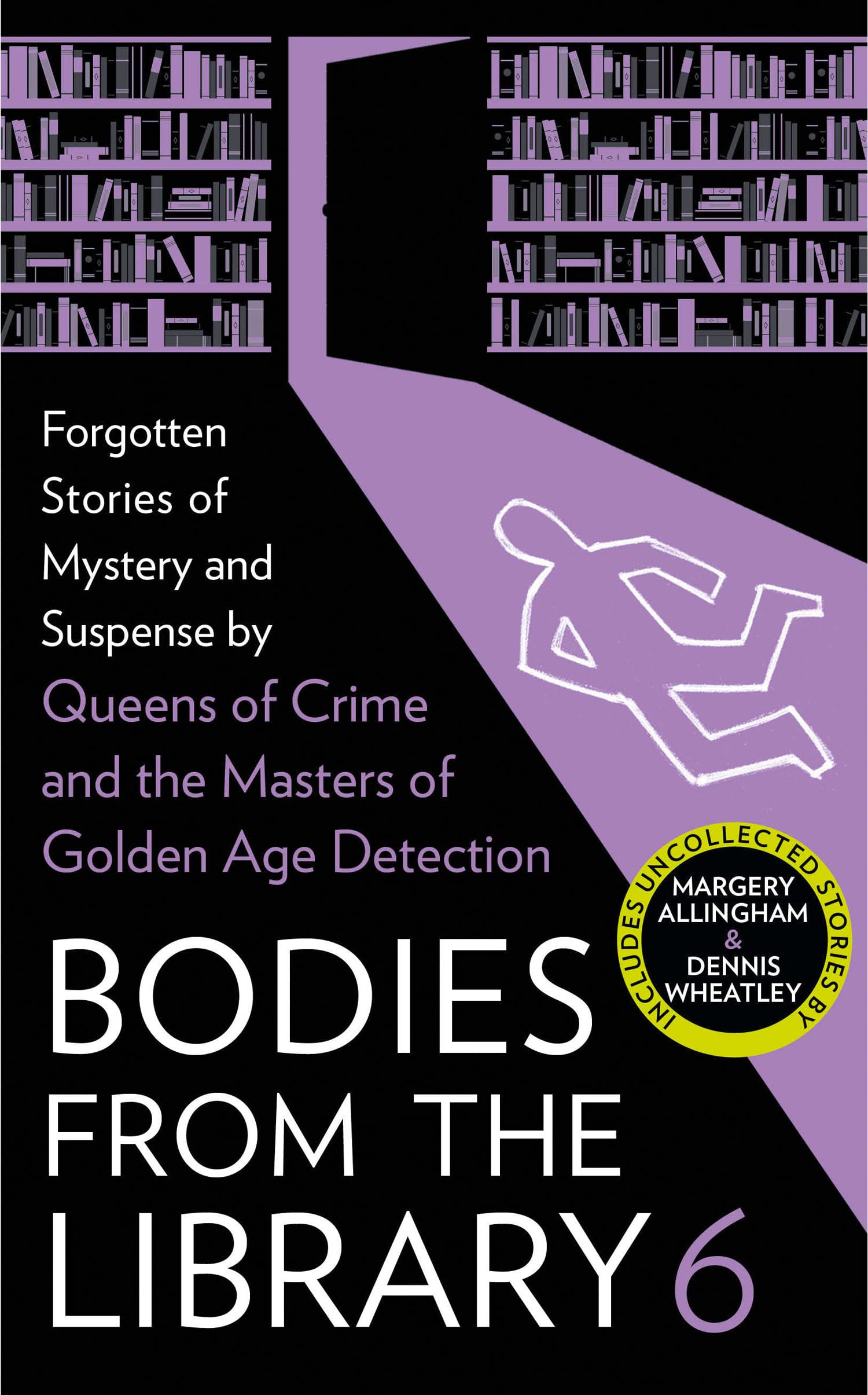
Bodies from the Library 6 (2023) represents another delightful foray into the neglected and forgotten stories from many of the luminaries of the Golden Age, as editor Tony Medawar puts his enviable genre awareness to wonderful use bringing yet more gems to public attention.

We open with ‘No Evidence’ (1930) by Alice Campbell, a story whose eventual direction will surprise no-one, but whose telling deserves huge kudos for its patient building and steady revelations. Millicent Clavering, exhausted after a long day’s work, first goes to the cinema to relax and then heads home…only for two policemen to arrive and inform her that the husband who walked out on her five years ago has been found murdered. Campbell does good, subtle work in some regards, and there’s a striking amorality about this when you think it through, making it an interesting tale and a strong start to the collection.
Next, ‘Post Hasty’ (1962) by Andrew Garve, an undemanding and well-written story concerning the theft of a post box which did good work in sliding a clue past this reader. It’s not going to be anyone’s favourite story of all time, but it passed quickly and pleasantly, and reinforced my determination to read one of Garve’s novels one of these days.
I’m sure E.C. Bentley had a wonderful time writing the Lord Peter Wimsey parody ‘Greedy Night’ (1936), but most of what’s probably funny about it went well over my head. A couple of funny lines do land (“Why do you amateur detectives always drive like bloody lunatics? You all do — except Trent, of course; he never does anything off-colour.”) and there’s a good surprise of sorts towards the end, but it feels more like someone telling a joke at your expense rather than bringing you in on it so you can enjoy it as well.
‘The Blackmailers’ (1929) is another example of these Bodies collections including delightful shorter work by Cyril Hare. An aristocrat visited by man of lower class with information to sell is as classic a setup as you’ll get, but Hare finds space to do something very enjoyable with it in very little space. I’ll say it again: I’m not a fan of Hare’s novels, but, damn, I need to check out his collected shorter fiction.
A two-part radio play, ‘Death Travels First’ (1940) by John Rhode sees various people leaving a train carriage at successive stops only for one of the last two remaining men to be shot by someone other than his companion. The second part sees Inspector Jimmy Waghorn collect the parties involved together and work through their various grievances with the dead man on the way to finding the truth.
This starts off seeming slightly baffling and ends up being resolved in a rather pedestrian way, but I’ve very much come to enjoy the radio scripts this series has reprinted, and Rhode’s functional characters and plotting are difficult to dislike. I feel like this is faint praise, but then I often come away from Rhode feeling that anything more fulsome than faint praise would oversell the man and his talents. In that regard, this is a flying success…!
Blackmail rears its ugly head again in ‘The Whole Truth’ (1935) by Anthony Gilbert. Anthony Hooke, K.C. visits a man who has information that Hooke’s wife would rather not come to light, but when the visit takes a sudden and unexpected turn the situation is rendered more perilous excellently. Hooke’s vocation makes him an interesting figure where speculations about crime and criminals are concerned, and the story overall is a very enjoyable experience…even if one does feel like there should be a little more about the ending than we get.
The brief, savage-edged ‘A Piece of Cake’ (1983) by Christianna Brand does good work in very little space underlining the generation gap twixt its various players, and Brand’s superlative dialogue drives a nail into your heart with each instance of a man’s grown up children objecting to his remarrying a mere six months after their mother has died. However, again — and maybe the shorter form just makes this more apparent, or maybe it was on my mind because I read this immediately after the preceding story — the ending just feels a little tepid, failing to support the great work that came before.
Anyone lucky enough to hear Jake Kerridge’s excellent talk on Margery Allingham at a recent Bodies from the Library conference will remember the great case he made for her minor characters, and I had this in mind throughout the tremendously bland novella ‘The Mystery Man of Soho’ (1933). There’s perhaps one interesting idea in the whole thing — when the reader is introduced to the eponymous criminal mastermind long before Detective Inspector Bob Fisher puts the pieces together — but, that aside, I found this difficult to get excited about.
Allingham’s novels benefitted from having the time and space to explore whatever shade of adventure and detection she was employing, but this is composed of everything and as such lacks a focus or clear intent. It’s an easy read, and breezes past without any real effort, but one wonders if the edited version previously published elsewhere was perhaps tighter and sharper.
Contrast Allingham’s positive glut of styles with the simple, charming, and ultimately rather elegiac tone of ‘The Commotion at San Giovanni’ (1939) by George Bellairs. When doubtful claims are made about a fresco painted in an isolated Swiss church, the upheaval caused in the lives of several people will ultimately lead to drastic action — a seres of unfortunate events so delightfully relayed that I’m half tempted to finally read one of Bellairs’ novels. You could cavil that this isn’t really criminous, but its very oddness makes it all the more enjoyable.
The slicing of a man’s throat while he stands alone halfway down an escalator is the problem that greets Senator Brooks U. Banner in ‘The Glass Gravestone’ (1966) by Joseph Commings. This is easily one of the strongest of the Banner stories — mind you, my memory of the Banner stories isn’t the most complimentary — and benefits from some clever ideas explored with Commings’ customary zest and vigour. It’s unlikely as all hell, but is unpicked well and proved a very enjoyable time for this reader. Hopefully the long-rumoured second collection of Banner shorts isn’t far off…
The eleventh and final standalone story, ‘The Mystery of the Corridor Express’ (1899) by Victor L. Whitechurch, also has impossible overtones, as a body is found hanged in a train compartment despite no-one apparently having unobserved access to it. The idea here is pretty simple, but Whitechurch writes it well and for its era it’s a nifty little scheme carried through with notable clarity. Especially pleasing is the entirely inessential diversion into secret societies, which gives everything a heightened and enjoyable ridiculous air which only serves to sweep the reader more fully along with events.
We finish with five-part serial Sinister Sequence (1953), a round-robin affair in the spirit of Behind the Screen (1930) and No Flowers by Request (1953), with each author furthering the story from where their predecessor left things and weaving an intriguing little thriller from slight beginnings.
Michael Cronin starts things off in fairly typical fashion with ‘The Sinister Stranger’: an attractive young woman subjected to some light menacing, a morally upright everyman who intervenes and finds himself swept along in events, and the gang of toughs who follow hard upon. Old hand Geoffrey Household then picks things up with ‘The Sinister Suitcase’, introducing an element of the playful — how George Manning ensures that the men dogging him are unable to leave the flat in which he renders them unconscious, for instance — and mixing in some fine hard-edged writing to proceedings:
Strains and stresses — well, they always produced molecular changes in any material.
Laurence Meynell’s section ‘The Sinister Smile’ lacks Household’s charm, alas, and reverts to fairly standard type, then Dennis Wheatley brings a little more character — not least the moment that Lanning, fleeing for his life, goes into a pub and orders champagne and lobster to revive himself — to ‘The Sinister House’. It’s fairly clear by this point that the focus is on quickly-constructed thrills than anything more demanding, but Wheatley at least has some pizazz to his oddness, even if his notion of how people fall in love feels wide of the mark by an Olympic distance.
It falls to L.P. Hartley to clear up the mess in ‘The Sinister Clock’, which reduces everything to a pleasingly small situation — rather than, say, big car chases and shoot-outs — and contrives a creative death-machine into the mix before petering out a little at the close. It would have been remiss to have expected anything too rigorous from the opening pages, however, and the uniformity of purpose — keep it light, keep it fast, don’t get clever — makes for an entertaining close to the collection.
So, a top five for Bodies from the Library 6? Well, how about:
- ‘The Blackmailers’ (1929) by Cyril Hare
- ‘The Mystery of the Corridor Express’ (1899) by Victor L. Whitechurch
- ‘The Glass Gravestone’ (1966) by Joseph Commings
- ‘The Commotion at San Giovanni’ (1939) by George Bellairs
- ‘The Whole Truth’ (1935) by Anthony Gilbert
The collection overall shows once again just how much great unheralded material from the Golden Age there is out there, and continues the high standard of the preceding volumes. Indeed, if you’re not buying these alongside the superbly-curated British Library short story collections, what’s your excuse? There’s obviously a limited amount of this unpublished and forgotten material in existence, but Medawar has done a superb job in ensuring a strong mix of styles and an enticing combination of famous names and unjustly-overlooked obscurities. Add this to your Golden Age bookshelf right now, and hope there’s a seventh volume in the works!
~
The Bodies from the Library collections, edited by Tony Medawar
- Bodies from the Library (2018)
- Bodies from the Library 2 (2019)
- Bodies from the Library 3 (2020)
- Bodies from the Library 4 (2021)
- Bodies from the Library 5 (2022)
- Bodies from the Library 6 (2023)
The Ghosts from the Library collections, edited by Tony Medawar
- Ghosts from the Library (2022)
- Wicked Spirits (2024)
 The Invisible Event
You always have such glowing comments when you talk about the collections holistically, but I feel like when I read your breakdown of the individual stories you always seem lukewarm on them! Better than the sum of its parts?
Glad to see Christianna Brand be a consistent and solid inclusion, though! She’s written a few of what I consider the best mystery short stories of the genre. “Hornet’s Nest” gives Anthony Berkeley a run for his money in his own game, and in a tenth of the page count at that.
LikeLike
I suppose I always try to be positive about multi-author collections because — especially with short stories — the individual responses of each reader will vary so much. My opinions are only my opinions, and I recognise that what works for me might be anathema for someone else, and vice versa. It would be a very bad collection indeed that I didn’t encourage anyone to buy 🙂
Separately, I do also just love these Bodies collections. So much work is so over-anthologised, and to have someone digging up stories most of us never even knew existed is a wonderful state of affairs. Who wouldn’t want more of that?
LikeLike