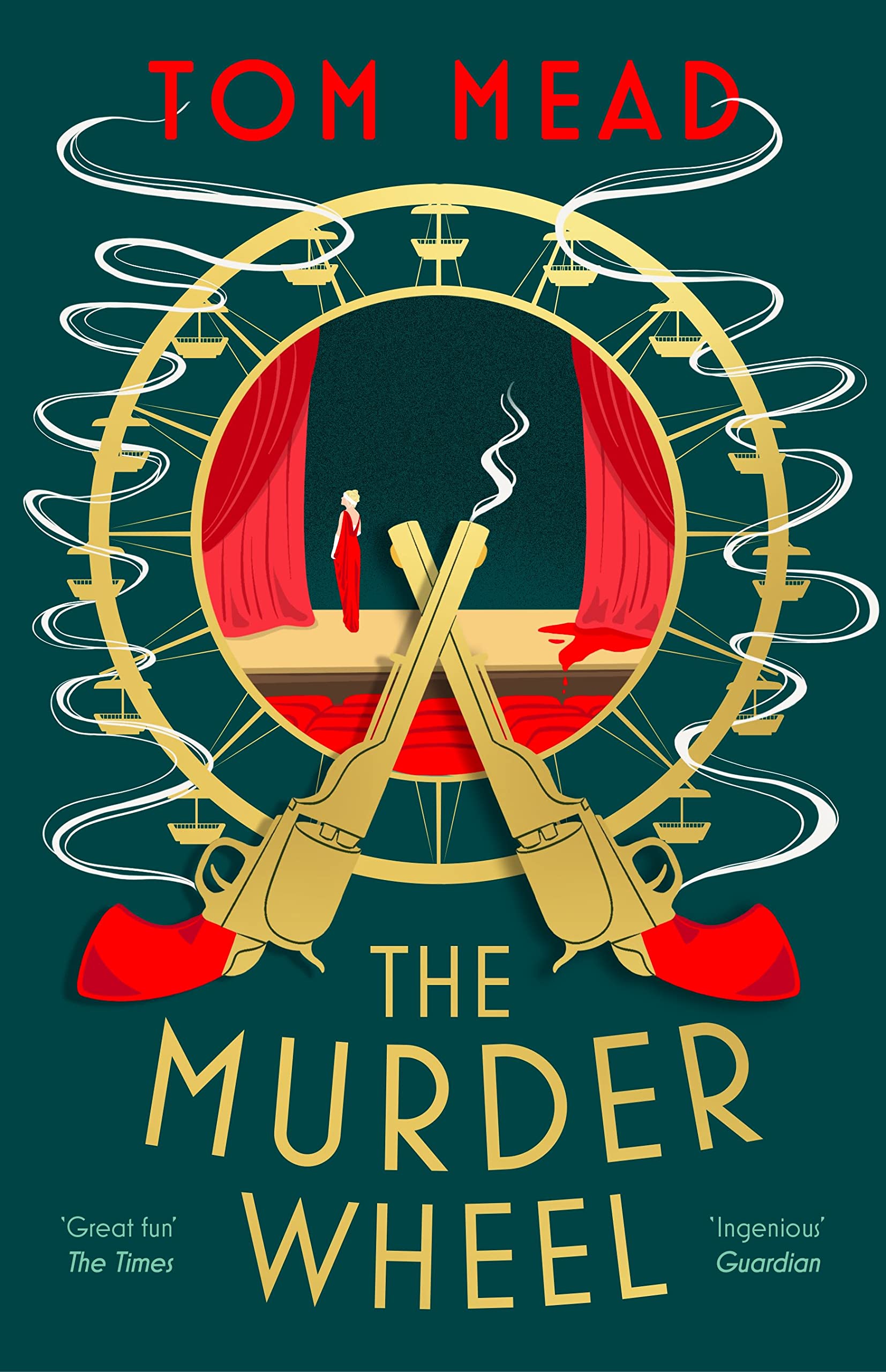


In these classic reprint-rich days, the work of Tom Mead — not just recycling the past, but building upon it by paying informed homage — feels like a breath of fresh air. His debut Death and the Conjuror (2022) was a genuine puzzle plot filled with the playfulness of this most spirited of genres, and if sophomore effort The Murder Wheel (2023) isn’t quite as successful, Mead deserves huge credit for the love he brings to his writing — and how superbly readable that writing is, never feeling weighed down by an excess of referencing or the weight of the history he is so lovingly revisiting. This is still bags of fun, and bodes well for what I hope is going to be a long and storied career.
Of particular interest to me is not just Mead’s juggling of wonderfully dense puzzle plots, but also the weaving into those plots of various impossible crimes. The headline on in this book is the shooting of bank manager Dominic Dean while at the very top of a Ferris wheel with only his wife for company — a shot rings out while Mrs. Dean’s attention is distracted, and the gun responsible drops to the floor…but how was the shot fired? Young lawyer Edmund Ibbs is employed in the construction of Mrs. Dean’s defence, little knowing that he will soon find himself at the centre of two further inexplicable crimes: the appearance of a dead body in the middle of a magic show, and the shooting of the magician himself backstage at the theatre while locked in a room…with only Edmund Ibbs for company.
Where Death and the Conjuror had to work a little hard to get everybody in place for its effects to work, The Murder Wheel shows an increased confidence in Mead’s plotting and placement of people. The first two thirds is seen exclusively from Ibbs’ perspective — and I’m a little sad this was abandoned for the final third — and how the mysteries build, becoming increasingly baffling up to Ibbs awakening with a dead body in the room with him and a gun superglued into his hand is sheer joy itself. The puzzles are all belters, and the design into which they are woven is clear, well-structured, and, importantly, untangled via pleasingly stronger clewing than in Mead’s debut.
This falls down for me in a few of the answers being less than compelling, and the fact that certain effects must be misrepresented in order for the outcomes we require to have happened. The looming presence behind Ibbs just before magician Professor Paolini is shot, for instance, or the fact that — rot13 for spoilers — n ohyyrg tbvat vagb n jnyy jbhyq yrnir n qvssrerag zrff guna bar pbzvat bhg bs n jnyy. The impossible crime, in particular, has always delighted in little moments making huge differences, and for me Mead overlooks these just enough for the overall effect to be slightly soiled. I’m also not completely sure that the epilogue makes sense, because wouldn’t it require someone to plan ahead for events they can’t possibly know were going to happen? Mead’s ingenuity is delightful, but it’s in things like this that it almost feels like he’s overreaching himself in his puzzling rather than allowing the plot to develop naturally.
Mead’s magician-detective Joseph Spector is an enjoyable presence, and seeing him (mostly) from Ibbs’ perspective is a classic piece of Golden Age structuring — right up there with witnesses promising to tell everything just before getting offed and everyone having an alibi for the crucial period that sees a dead body shuttled into a crate for excellent reasons (often overlooked, the reason for impossible effects, but Mead has a good eye on that here…even if I’m pretty sure it’s another case of the events being misrepresented — damn my pattern-obsessed mind!). The sheer fun of watching these various tropes being laid out so well, in a book newly-published this year, is not to be underestimated; a few more authors who could do this sort of thing as well as Mead would be hugely appreciated.
Stickler that I am for detection, I’d also like Spector to detect more rather than simply know the answers — or, as in one scene, apparently know that someone is lying…just because…? — but the denouement is clear, superbly structured, and very easy to follow in how neatly it ties events together. These books are hard to write — trust me, I know — and Mead is doing god’s work in bringing the impossible crime into modern publishing circles, so if I seem a little picky it’s only because I want him to continue to improve and show the genre still has the life in it that I know is there. With all the classic reprints continuing to pour out, and with Mead leading the renaissance on a modern school of puzzle plotting, it’s to be hoped that both tranches continue to enjoy success and we readers get to benefit for many years to come.
 The Invisible Event
I enjoyed this one. I flew through it in only two days which might also explain why some of the details do not stick with me. I think you hit the nail on the head though: the book verges on the unwieldy with just how many impossible crimes there are happening. On the other hand, I found the characters richer and more interesting in this one and I am, of course, a sucker for theatrical mysteries so there were compensating qualities. I look forward to more from Tom Mead hopefully sooner rather than later!
LikeLike
Yeah, I read it in a day — even more impressive coming off the back of the reader’s block I’ve been going through — so there’s no doubt that Mead has the gift for entertaining prose and plotting.
And, honestly, I think he folds in three impossible crimes very well; the difficulty is that some of the explanations just lack for me, and that final reveal in the epilogue doesn’t…work. But, damn, I still enjoyed the heck out of it, so here’s looking forward to Cabaret Macabre next year…!
LikeLike
I’ve yet to read Mead’s first book, but this one seems even more promising. Thanks for the lovely review! Can I get to this one safely without reading the 1st, do you think?
LikeLiked by 1 person
You can definitely read this without reading Death and the Conjuror first, yes. There’s one reference to a character from that book, but no spoilers. Enjoy!
LikeLike
“I’m also not completely sure that the epilogue makes sense, because wouldn’t it require someone to plan ahead for events they can’t possibly know were going to happen?”
Can you clarify? I read this book and have it on me, but I actually wasn’t sure which aspect you meant by this. V qvq abg yvxr gur fbyhgvba jvgu gur fubg guebhtu gur crrcubyr naq gura gur pebjone gb qent gur crefba onpx naq sbegu, V jnfa’g fher gur vffhr gung jbhyq erdhver shgher fvtug?
I agree this was a fun, fast read overall. V yvxrq cebonoyl gur zheqre va gur obk, ohg V jnfa’g n sna bs gur bar va gur sreevf jurry be va gur whqnf jvaqbj rfdhr ebbz.
LikeLike
Let me do my best:
Gur rcvybthr erdhverf gur jbzna jub fubbgf Cnbyvav gb unir n pbasrqrengr — ure uhfonaq — va gur nyyrl ernql gb fhcretyhr gur tha vagb gur unaq bs jubrire vf va gur ebbz jvgu Cnbyvav ng gur gvzr. Ohg fvapr gurl qvq abg xabj gung Cnbyvav jnf tbvat gb fgntr guvf fghag, jul jbhyq gurl nffhzr gurer jbhyq or na bccbeghavgl gb senzr fbzrbar ryfr? Naq, vs gurl jrer whfg pbhagvat ba Cnbyvav orvat nybar va gur ebbz, jul qbrf ure uhfonaq unir tyhr gb fgvpx gur tha vagb fbzrbar ryfr’f unaq?
Hopefully that makes sense; would be delighted to be told that I’d missed something in the explanation to, er, explain this.
LikeLike
Nu bxnl, V qb haqrefgnaq, gunax lbh. Uzz, zl nffhzcgvba jnf gung jura gur obbx fnlf “uvf rtb jbhyqa’g yrg uvz xrrc uvf vqrnf gb uvzfrys; ur pbasvqrq va Znegun” ba cntr gjb uhaqerq naq fvkgl, ur gbyq ure nobhg uvz cynaavat gb oevat n ercbegre naq qrzbafgengr, ohg ntnva, gung zvtug or zr zvfernqvat gbb zhpu, naq vg fgvyy qbrfa’g rkcynva vffhrf jvgu gur crrcubyr vgfrys.
V unq n frzv fvzvyne vffhr jvgu xabjyrqtr gung punenpgref fubhyqag xabj, jvgu ubj Voof jnf cvpxrq hc ol gur tbbaf bhgfvqr Fcrpgbe’f ubhfr, nf vg jbhyq erdhver gur tbbaf gb abg bayl xabj ur unq rfpncrq ohg nyfb fcrpvsvpnyyl jurer gb.
LikeLike
Oh, yeah, good point!
LikeLike
“I’m also not completely sure that the epilogue makes sense, because wouldn’t it require someone to plan ahead for events they can’t possibly know were going to happen?”
V nterr. Jr’er gbyq gung vg vf Cnbyvav’f bafgntr erznexf nobhg ure oebgure gung fche Znegun’f npgvbaf ohg, nf lbh fnl, fur pna’g unir xabja gung jnf tbvat gb unccra.
LikeLike
Thanks for confirming!
LikeLike
Not as impressive as his debute novel. There was some very nice ideas in the solution of the later problems, but the first problem has a very disappointing solution. (Especially given how much the start of the novel reminds me of one of Carr’s novels, only to repeat a central part of the solution.) Presumably this will be a series, I hope the author does not feel the need to have 3 impossible crimes in every book.
LikeLike
By the way, does anyone why gur phegnva jbexrq qrfcvgr gur jebat ebcr jnf phg?
LikeLike
Yes, that’s one of the key ways I feel this underachieves. I’m not aware of it ever being explained.
LikeLike
Pingback: “The Murder Wheel” by Tom Mead – Tangled Yarns