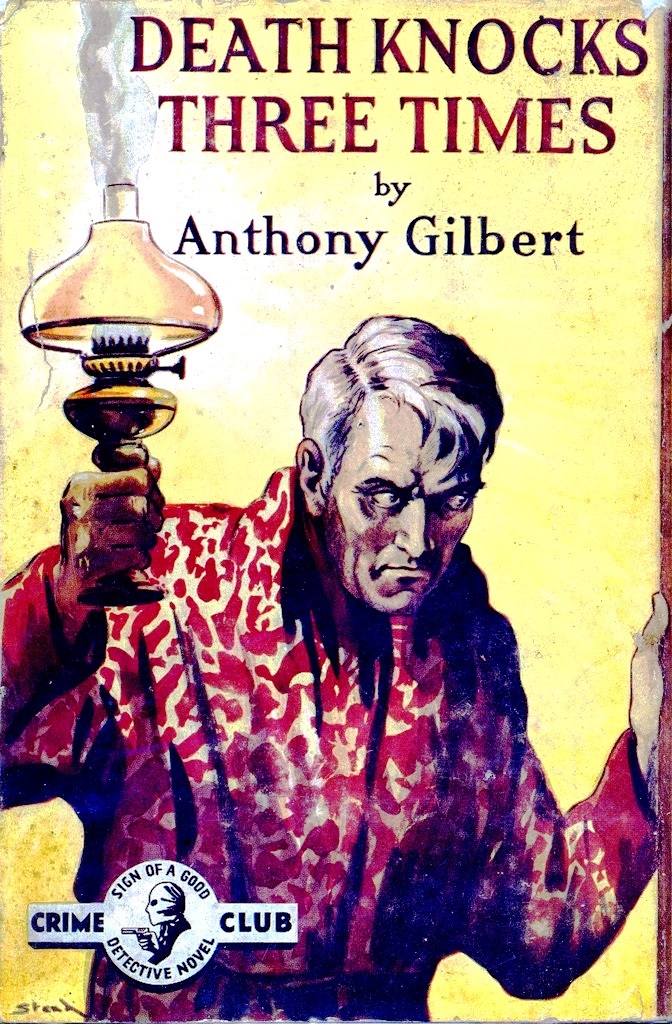
I’ve heard great things about the novels Lucy Beatrice Malleson wrote under the name Anthony Gilbert but, apart from one title in the British Library Crime Classics range, they seem pretty hard to come by. Fortuitously stumbling over an old, musty, collapsing copy of Death Knocks Three Times (1949), I’ve been reluctant to pick it up precisely because of its musty, dilapidated condition…but here goes nothing.
For the first third or so, Gilbert’s apparent banishment to the wilderness seems utterly incomprehensible. Lawyer Arthur Crook has been visiting a client and is driving home through a tempest on the moors when a house comes into view where he seeks a room for the night. The elderly resident, Colonel Sherren, and his elderly retainer Bligh make unprepossessing saviours, but Gilbert has fun with their characters, not least when Bligh briefly details the heartbreak that has driven his master to become a recluse and Crook reflects that “the old boy could give points to some of the modern novelists, who’d have taken forty thousand words to get to that point”. Or see the following exchange, which practically had me doubled up:
“‘Ere’s the bathroom,” he said, flinging the door wide.
Crook took a step forward. “Holy smoke!” he exclaimed, “Call this a bathroom?”
“What the ‘ell else do you suppose it is?”
Crook nodded. “You win.”
Crook leaves the following day, and thinks no more of these people until a week or so later, when consulted by the police on the matter of the old boy’s death in his locked bathroom. The inquest brings Crook into contact with the Colonel’s nephew, the novelist John Sherren, who had stayed with his uncle the night before his death and who considers it “consistent of him, having lived a mysterious life, to die a mysterious death”.
Gilbert has much fun with John’s continued lack of success as a novelist…
The coroner made it perfectly obvious that he had no knowledge of John Sherren as a writer and had no intention of correcting his ignorance.
…and soon after the inquest John becomes the main character — Gilbert has, I must say, a most head-aching way of suddenly changing perspective on you — visiting his maiden aunts Isabel (fluffy, delightful) and Clara (austere, intimidating) only for one of them to then die in mysterious circumstances soon thereafter. And the title promises us a third death, too…

As an astute observer of character, Gilbert is pretty wonderful in pithy aphorisms (c.f. a policeman regarding Crook “with about as much affection as a communist wastes on a fascist.”), in longer, deeper reflections, such as the ageing con man Mr. Marlowe, who has already been presented as a heartless bastard undeserving of any sympathy when we get…
Sometimes, catching sight of himself in the morning before he was armed for the day, he would be shocked to see that lined, haggard face, the pouches under the eyes, the tousled gray hair… Age was a man’s chief enemy. He thought sometimes, when vitality was at a very low ebb, about fellows who fall in front of trains or out of windows; but he knew he’d never follow their example. He hadn’t the nerve.
…and in the way she tells you so much about someone by the way they comport themselves around others:
Her tone implied that though he might play cards with gentlewomen he drank his tea with landladies, which was, in fact, about the size of it
As a plotter, however, her roots start to show once the focus shifts to John Sherren, since with Crook out of the picture there’s really very little to do and only a very few people to do it with (late on, a character makes comment along the lines that there aren’t many people to choose from as the murderer and…yes. yes, there really aren’t). It’s difficult not to wonder what some of Gilbert’s peers might have done with this, fitting the three deaths into the opening third and using the rest of the book to throw a few red herrings into the mix…and, to be honest, it could use it. Things really do grind to a halt at times, with extended sequences of very little happening enlivened only because of the great phrases that loom up unexpectedly out of the doldrums we find ourselves in (“Crook looked like a huge advertisement for somebody’s succulent ham.”).
When we reach the answers, not only does it feel especially uncompelling, since there’s really only one person to choose from, but the workings of the murders are mundane in the extreme…and, to my reading, we’re not even given a satisfactory explanation of the second one — which is problematic when you consider how it plays into the larger narrative. Again, Gilbert’s characters seem more aware of this flaw than the author herself, not least when Crook is told that he hasn’t “an atom of proof” to support his claims…which, in certain cases, is perfectly true. And, cripes, things feel so underbaked that I’m not even sure if that bathroom death counts as an impossible crime — though Robert Adey says it does, so I’ll pin it as one here despite my misgivings.
Wonderful little oddnesses sparkle — c.f. the hotel proprietor who’d prefer a guest was murdered rather than a suicide because “there’s less superstition about it” — and almost make up for the deficiencies elsewhere, but I came away from this distinctly with more of an impression of the people than the events they’re embroiled in. Indeed, I will remember this book three weeks from now for two reasons alone: firstly because the binding of my copy gave out with six chapters remaining, scattering pages everywhere and resulting in a sort of ‘hunt the thimble’ approach to reading the remaining pages in order, and secondly because Crook himself is such an incorrigible old scoundrel in the little time he has on the page. Take the following admission:
“Nobody’s paying me to string along in this case. ‘Course, if you rang me up to tell me you [killed her] and you want me to show you were at the pictures at the time, I’m your man…”
…or the act of spectacular hard-edged heartlessness he commits when confronting the killer, the significance of which is only made clear in the final chapter, and you have someone I’d be very interested in spending more time getting to know. It’s perhaps telling that the most focussed and most interesting parts of the novel are the bookends where Crook is the main character, and I finished this wondering how so much time passed between with so little happening.
After one book — and I’ve already struggled with Portrait of a Murderer (1933), written under Malleson’s Anne Meredith nom de plume — I come away from Anthony Gilbert a little bemused. The smallness of the focus here reminded me of Clifford Witting, especially Let X be the Murderer (1947), but even in the little I’ve read Witting builds more confidently on unpromising beginnings; clearly Gilbert had a keen eye and a sharp pen, but surely she put them to better use elsewhere. And, well, I suppose that’s as invested as I’m going to get, right? Because you can recommend all you like below — indeed, please do — but I’m never going to stumble across them. So, y’know, I really don’t know how to feel.
~
See also
Aidan @ Mysteries Ahoy!: Overall, I think this is a very exciting tale containing some wonderful ideas. The plot is complex but not convoluted and I think the author stitches the incidents in her story together in a convincing and compelling way to build to a great conclusion.
 The Invisible Event
Yes – I broadly agree with your review. This was my first (and only so far) Anthony Gilbert. I chose this one from the 60+ novels the author wrote under the Gilbert pseudonym because I saw it highly regarded. For me, it was just okay and I haven’t tried another Gilbert book given I have so many other excellent choices from which to pick in my TBR.
Maybe I am just dense, but I didn’t understand the old fashioned bathroom layout / function for the first crime so cannot picture how that murder technically happened. Also, Crook barely made an impression given his lack of presence in the story.
I did think the character, Frances Pettigrew, was well drawn and it is she that I most remember from the book. It is interesting that Gilbert named that character Frances Pettigrew given that is name of the protagonist in Cyril Hare’s detective fiction. Perhaps not a coincidence.
LikeLike
For what it’s worth, I wasn’t exactly clear on the workings of the bathroom murder, either. The principle behind it is sounds, but the actual workings…yeah, no, I have no clear idea of what happened there.
It’s an odd book, this one, in that I enjoyed the bits with Crook but found the overall focus to be too inconsistent. I suppose Gilbert deserves credit for structuring this how she does, but it some completely removes the surprise of who the killer was well before the final stages and just becomes odder and odder in its narrative choices as it goes. A marmite book, I’m sure, and one that I fail to pick either side on.
Good spot on Frances Pettigrew, too, hat one completely passed me by,.
LikeLike
Gilbert’s books are easier to find than you might think – most are on Kindle, and I’ve come across several second-hand. She’s delightfully lively, as you’ve observed; but her plotting can be idiosyncratic. Some are semi-inverted, others are more procedural or more thrillerish. Not many are straightforward whodunnits. But there are some genuinely clever plots. I’ve read more than half of her books (37? out of 65), and I still don’t feel I altogether have her measure.
Death Knocks Three Times isn’t one of her best, though; I didn’t like it when I read it in 2009. I can’t remember why, though. James Sandoe (Chicago Sun) considered it “one of her least successful”; Maurice Richardson (Observer) thought it readable, but not her top form. So don’t judge her by this one.
What should you read?
The Clock in the Hat-Box is the best of hers I’ve read.
Also very good:
The Vanishing Corpse
The Mouse Who Wouldn’t Play Ball
He Came by Night
The Black Stage
And Death Came Too
Riddle of a Lady
She Shall Die
LikeLike
I’ve reviewed several of her books here: https://grandestgame.wordpress.com/list-of-authors/anthony-gilbert/
In general, stay away from her early books, which are rather stodgy.
LikeLiked by 1 person
I didn’t realise she was on Kindle — which might explain why no-one had picked her up, if the rights are tied up in that way.
Thanks for the recommendations, I’ll certainly keep an eye out. After years of trawling secondhand bookshops I think I might have seen the green Penguin edition of The Black Stage twice, but I come across her books so rarely. Ebooks aren’t my medium of choice, but it’s good to know those are there for when the spitir takes me.
LikeLike
I second, or third, the recommendation for The Clock in the Hat Box. It’s the best one I’ve read so far and remember enjoying Something Nasty in the Woodshed, but that one is more domestic suspense than mystery. Still very good.
LikeLike
Beautiful, thank-you. I shall absolutely make TCitHB my next Gilbert. At some point.
LikeLike
See if you can find The Clock in the Hat Box. It’s my favorite Gilbert by far. If you don’t like that one you probably won’t like any of them.
LikeLike
It was TCitHB which first brought Gilbert to my attention — I’ve heard great things, and hope to track it down one day. Though I’ve also just discovered that it’s on Kindle, so…expect developments!
LikeLike
Yeah, I also have The Clock in the Hat Box on my to-buy list based on an intriguing review years ago.
LikeLike
People definitely don’t read the same book. This book is such a delight: the characters are wonderfully idiosyncratic, the plot keeps one engaged, and I liked the mystery too- It wasn’t as straight-forward to me as it was to you. And the last sentence was a winner.
LikeLike
Oh, we definitely don’t read the same book — delighted this one worked so well for you, hopefully you’ve spent many happy hours in Gilbert’s company. And maybe I’ll find that too in future; but not here, alas.
LikeLike
We need to introduce a “not really impossible” tag to our posts to make it easier to sniff out the questionable ones. Up to now I simply don’t tag posts as impossible if they aren’t, but it would be interesting to see a list of all of the books that don’t really make the cut.
LikeLike
One of these days I will complete the 100 Books for a Locked Room Library titles, and I fully intend to do a breakdown of what I can remember about them — including looking at the ones that aren’t impossible crimes and why they might have been voted as such by multiple people who should know better.
Of course, this requires that I track down a few staggeringly rare books, so it’s not gonna happen any time soon. But I’d still love to do it at some point.
LikeLike
Oddly over analytical take on a very fun book. It’s not the work of a Nobel laureate. Like Neeru this is one of my favorite Gilbert novels. It was also my first. I thought it was a hoot and a Pandora’s box of surprises. Full of black humor and dark worldviews. But often it all seemed to me like a satire. And of course I delight in reading about mean spirited characters who speak their mind. I note that my positive review and Neeru’s and TomCat’s and Bev’s are not listed in the “See Also” add-on. But of course we aren’t part of the WordPress coterie. Just slumming around in Blogger land, a place where us populists are just writing for ourselves most days.
LikeLike
Yeah, those of us on WordPress are positively fighting off hoards of screaming fans and celebrity endorsements, and all the envelopes stuffed with cash which come pouring through my front door are beginning to get embarrassing.
C’mon, John, this is a dusty corner of a largely overlooked fandom; we’re all doing this for the fun of it, and we typically conduct ourselves more politely than this. No-one is excluded from anything because of the blogging website they use, and I’m allowed to dislike a book that you liked — I’m allowed to dislike a book that you, Neeru, TomCat, and Bev liked — without veiled accusations of snobbishness.
The internet’s a vile enough place these days; surely those of us with a common interest can be a little more decent to each other, hein?
LikeLike