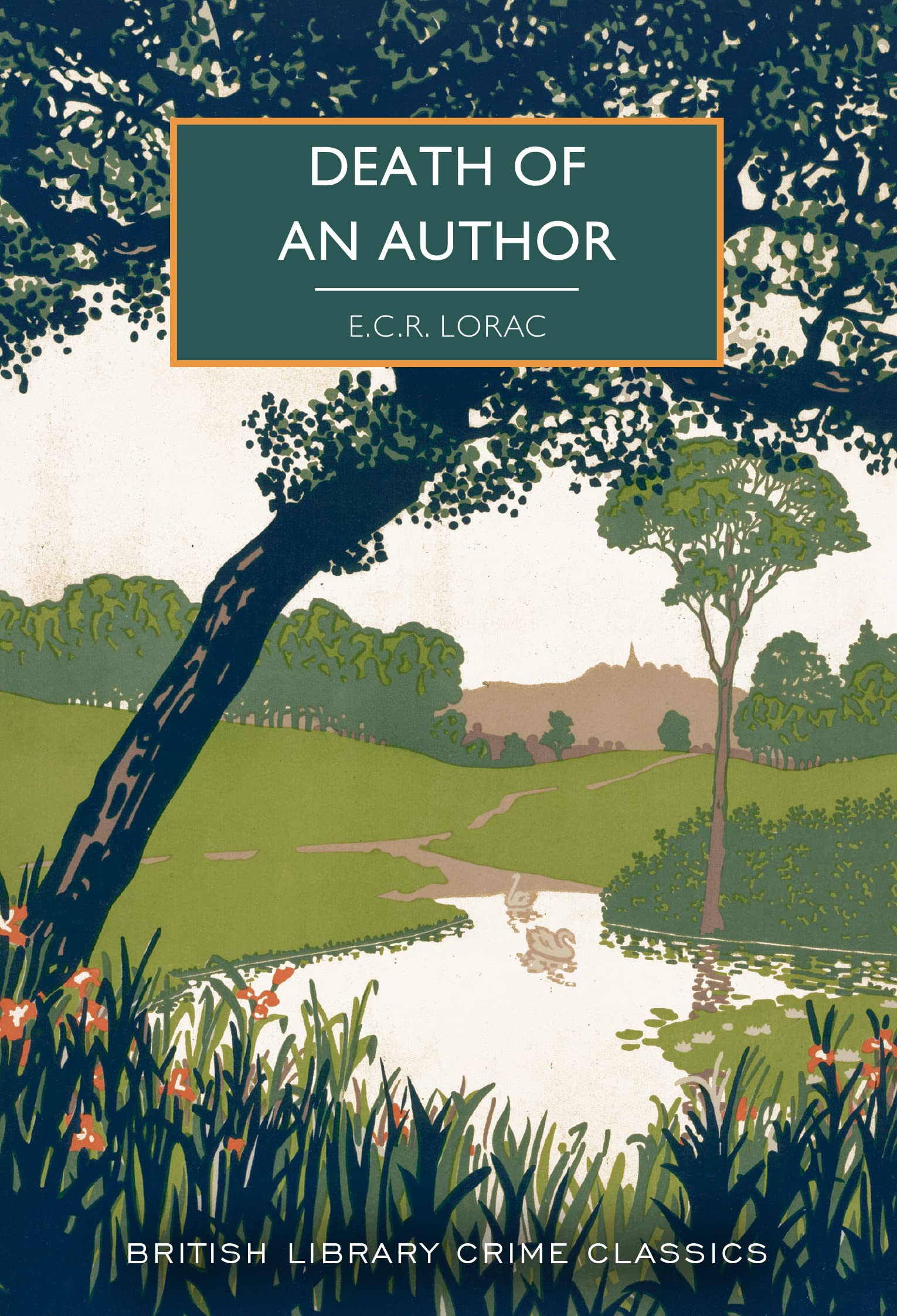


I’ll let you in on a secret: much as I struggle to read two books by the same author close together, there are certain writers whose diversity of approach enables me to sidestep this consideration. One such personage is Erle Stanley Gardner, and I’m starting to suspect that E.C.R. Lorac might be another. Lorac’s country-set novels featuring Inspector Robert Macdonald are very different beasts to his London-based cases, and Death of an Author (1935) — not featuring Macdonald at all — is different again: a zesty, propulsive, and supremely clever little puzzler dug out from seemingly inescapable obscurity by the British Library for our not inconsiderable enjoyment.
Lorac was, of course, the nom de plume of Edith Caroline Rivett, and mistaken as a male writer by even so an astute reviewer as the Observer’s Torquemada, Edward Powys Mathers. As such, you can feel a tongue positively bulging in a literary cheek at this story of the apparent disappearance and — spoilers? — possible murder of the crime writer Vivian Lestrange, whose precise personage and gender is up in the air for a majority of the action herein. And you’ll appreciate, too, the gentle irony when I say that the combination of this intriguing setup and the patient, methodical, and intelligent investigation comes across as something not unlike a collaboration between Anthony Berkeley and Freeman Wills Crofts.
It is Eleanor Clarke, Lestrange’s amanuensis, who brings the author’s disappearance to the attention of Inspector Bond, and Bond — after finding Lestrange’s house “unreasonably well polished” and with an apparent bullet hole in a window — who brings in the big gun of Chief Inspector Warner. The Berkeleyesque elements of this, then, come from the differing stances the two policeman take: Bond liable to suspect Eleanor Clarke of underhandedness on account of a magnificent early narrative fillip, while Warner investigates the other end of things. The conversations twixt these two, in which interpretations are thrown back and forth, are among the most enjoyable writing I’ve read in the genre for a long time — I had no idea Lorac could be so much fun.
“You go from pillar to post asking interminable questions, and eliminating one theory after another until you’re left with the only tenable one. If truth resides at the bottom of a well, you have a lot of pumping to do before you uncover it.”
The intelligence with which new pieces are added to the jigsaw is delightful, with little matters like why a dead body isn’t staged to appear as an accident or why a murderer might draw attention to themselves by using a little-known location adding to the “wheels within wheels” while remaining remarkably clear. And the small matter of Lestrange’s life, lived away from public attention, with only Eleanor Clarke and his housekeeper allowed into his home, is perhaps the biggest wheel of all, adding as it does to the complication of establishing whether Lestrange himself — or herself? — even exists. I found it utterly, utterly charming.
Crofts’ style of humdrum detection — the word is used by Warner in the closing stages — comes in when trying to trace the movements of our murderer and resultant body, if either exists. You feel here the sheer size of the police as an organisation, just as in Crofts’ works, with intelligent reasoning on the part of our detective married to nationwide searches, and then insightful thinking applied to the information gathered. It’s a shame, really, that the resolution is brought about by means less intelligent — the only flaw I can level at this — since I would have loved the answer to have been properly divined by the ancient art of rigorous detection, but the answer is still pleasing even if the manner in which it is reached slightly underwhelms.
Into events is mixed the occasional reflections on the nature of women in society, with the likes of publisher Andrew Marriott remarking that “I have seen three eras: the Victorian, the Edwardian and the post-war, and…there is hardly a single conception of my youth which hasn’t had to be modified to fit the manners of today”. In an age which sees conceptions overturned or challenged on a seemingly daily basis, there’s something pleasing in seeing this idea raised 90 years ago even if it is a simplified version of events which, on account of said challenges, we are largely able to take for granted these days. Lorac’s focus is definitely the plot and the puzzle, but it would have been remiss of her to overlook this aspect of events, and she plays her hand well.
Mined from an early and all-but-forgotten era of her long career, Death of an Author is a complete gem, and probably my favourite Lorac reprint to date. Divested of capturing a setting or a group of characters with her usual acuity, she goes all-in on the plot and has produced one of the best little puzzles I’ve read in a long time. It just goes to show how much quality in depth still remains in unheralded Golden Age works, and it is to be hoped that the British library Crime Classics series continues this to bring such delights to our attention for a number of years yet — my thanks to them for all their work, and for the review copy of this completely superb little book.
~
E.C.R. Lorac on The Invisible Event:
Death of an Author (1935)
Bats in the Belfry (1937)
The Devil and the C.I.D. (1938)
Slippery Staircase (1938)
Black Beadle (1939)
Case in the Clinic (1941)
Fell Murder (1944)
Checkmate to Murder (1944)
Murder by Matchlight (1945)
Crook o’ Lune (1953)
 The Invisible Event
Not unlike how Gardner can be pigeonholed, I have a sneaking suspicion that Lorac’s incredible output might have led to an assumption of mediocrity that is belied by the fine, original work in her plots, above even her more obvious facility with dialogue and setting. In motive, method, and complication, there’s always a lot of hard work in evidence–and, yet, as you point out, she really seems to have fun with the actual writing. Even apart from this amusingly self-referential look at a writer hiding behind a pseudonym, she always gives the impression of thoroughly enjoying her hours at the writing table.
And as far as her hours in the reading chair go, I suspect your extremely apt Crofts/Berkeley characterization was backed up by an enjoyment of both.
She’s really one of the most multi-faceted GAD writers there is.
LikeLike
“…I have a sneaking suspicion that Lorac’s incredible output might have led to an assumption of mediocrity…”
I have said this before in another comment on a Lorac review, but the British Library cherry picking her best work to reprint has proven her tarnished reputation was due to what was easily available for decades. If your reputation hangs on a book like Murder by Matchlight… well…
LikeLike
It stands to reason, given the sheer size of her output, that some of Lorac’s stuff is going to work less well than others, but the BL are doing a good job of showing her diversity in what they’ve picked so far (and I’ve not read all of them — I still have Fire in the Thatch and Crossed Skis to get, plus the “new” Two-Way Murder).
Certainly with ten of her books under my belt I can appreciate her strengths, and it would be interesting to have her fully reprinted like Christie, if only — like Christie — to see what the consensus on her “good” and “bad” books is. For now, however, I’m happy to have found the joy in her that this book has unlocked, and look forward to those titles above and more to come.
If the BL are asking, some more standalones might be an interesting read…
LikeLike
It goes without saying I’m keeping my fingers crossed for a reprint of the Carol Carnac novel The Double Turn and a twofer volume of Lorac’s Murder in St. John’s Wood and Murder as a Fine Art. Like they did for John Bude’s Death in White Pyjamas and Death Knows No Calendar. A reprint of one or all three of those titles would be a tremendous help in my, uhm, scholarly pursuits… at genre archaeology…? And not at all to get another 7 percent solution to sooth a crippling locked room fiction addiction. Certainly not that.
LikeLike
I know The Theft of the Iron Dogs is up next…so that’s one more cleared out of the way, bringing your wish ever-closer…
LikeLike
Glad this is a good ‘un! Will have try a book of hers sometime…
LikeLike
This and Crook o’ Lune are my favourites — very different books, but each achieves its aim excellently.
Oh, and The Devil and the C.I.D.
LikeLiked by 1 person
I know taking Jim up on a recommendation is always risky undertaking, but have added Death of an Author to the wishlist on the strength of this review. I eagerly look forward to your review of the criminally underrated and often overlooked Captain Cut-Throat!
LikeLike
We share a dislike of Murder by Matchlight, which means this might be one of those rare books to please both of us. It’s certainly more of a playful puzzle than I’ve seen from Lorac before, and you’re a fan of those…so fingers crossed.
As to the Carr, I’ve been intrigued by it ever since you put it on a “favourite impossible crime novels” list some years back. It’s just taken me this long to get to it…!
LikeLike
Well, in the apples and oranges realm, I’ll put Murder by Matchlight—with its fabulous motive—up against CCT anytime!
LikeLike
See, now you’re making me wish I could remember the motive of that book, because I bloody hated everything else about it 😄
LikeLike
Like you said, apples and oranges, but the best thing you can say about Murder by Matchlight is how it used its World War II backdrop. And not very memorably by all accounts. Captain Cut-Throat is a grand historical spectacle and tense spy-thriller that has everything from the low-key ghostly stabbings of Napoleon’s sentries and the identity of Captain Cut-Throat to the exciting chase scene at the Field of Balloons. One of the best scenes Carr ever wrote!
LikeLike
There was a well-realised scene in which a bomb hits a house mid-confession, I think…but then I might be getting confused with a certain Christianna Brand novel there…otherwise, MbM was not to my liking.
But, hey, we can’t love ’em all, right? Gotta have some standards 🙂
LikeLike
(rot13) Svggvat gur jnegvzr frggvat cresrpgyl, gur zheqrere jnf orvat oynpxznvyrq ol gur ivpgvz sbe univat nqqrq svsgrra lrnef gb uvf ercbegrq ntr gb nibvq orvat pnyyrq hc.
And great to see Captain Cut-Throat next up!
LikeLike
I wish I could say I remember this, but it rings no bells whatsoever. Thanks for providing it, though — it’ll at least save me rereading a book I didn’t enjoy!
LikeLike
I’ve read 14 of her books and and don’t always recall the details of her puzzles, but have felt that some aren’t strong (Fell Murder for one). However, I always appreciate the high quality of her prose. She’s a gifted writer, and in my opinion that sets her apart from some of the authors featured by BLCC.
This one won’t be released on Kindle here until April of next year, but I’ve already pre-ordered it.
LikeLike
I had a similar reaction to the solution of Fell Murder, but in reviewing that JJ made a really good point about how Lorac scaled plot to setting:
Though this and others are certainly more in the mode of Tey–a cited Lorac favorite–than that of a Rhode or Crofts, it’s really surprising to me that someone so invested in character and that fine prose style can, when it’s required, weave and invent at such a high level.
LikeLiked by 1 person
I also love Tey’s books but not for the puzzle elements. I just find her prose such a pleasure to read. At times it’s beautiful.
LikeLike
Yes, her writing is usually more than sufficient to carry things, even when her plotting fails. That, as you point out, is not something that can be said of everyone…!
LikeLike
I’ve read only one by Bude but didn’t think much of his writing ability, which is a disappointment given how many of his titles the BLCC have printed. I was similarly underwhelmed by Wynne in that regard. On the flip side, the one I’ve read by Crofts makes me think he’s been underappreciated as a writer. Farjeon’s style isn’t exactly my cup of tea, but he can write.
LikeLike
Yes, I think I’d agree with this on all counts 🙂
LikeLike
And I’m not picking on BLCC. I’ve also had both good and bad luck with the Otto Penzler American Mystery Classics.
LikeLike
Yes, these multi-author undertakings are inevitably going to have high and low points. I’ve equally loved some of the AMC books, while also finding some of them unreadable — and everyone’s opinions on which are which will vary wildly, too 🙂
LikeLiked by 1 person
I recently finished my second by Stuart Palmer. They were….okay? (I liked one more than the other.) But I’m in no hurry at all to read more.
LikeLike
I’ve had a similar response to Palmer — The Penguin Pool Murder is out soon, or possibly now, and I…want to feel more enthused for it, but honestly don’t think I’ll bother.
Frankly, anything that isn’t by Craig Rice, Cornell Woolrich, or Charlotte Armstrong in the AMC range feels like a missed opportunity at present 🙂
LikeLiked by 1 person