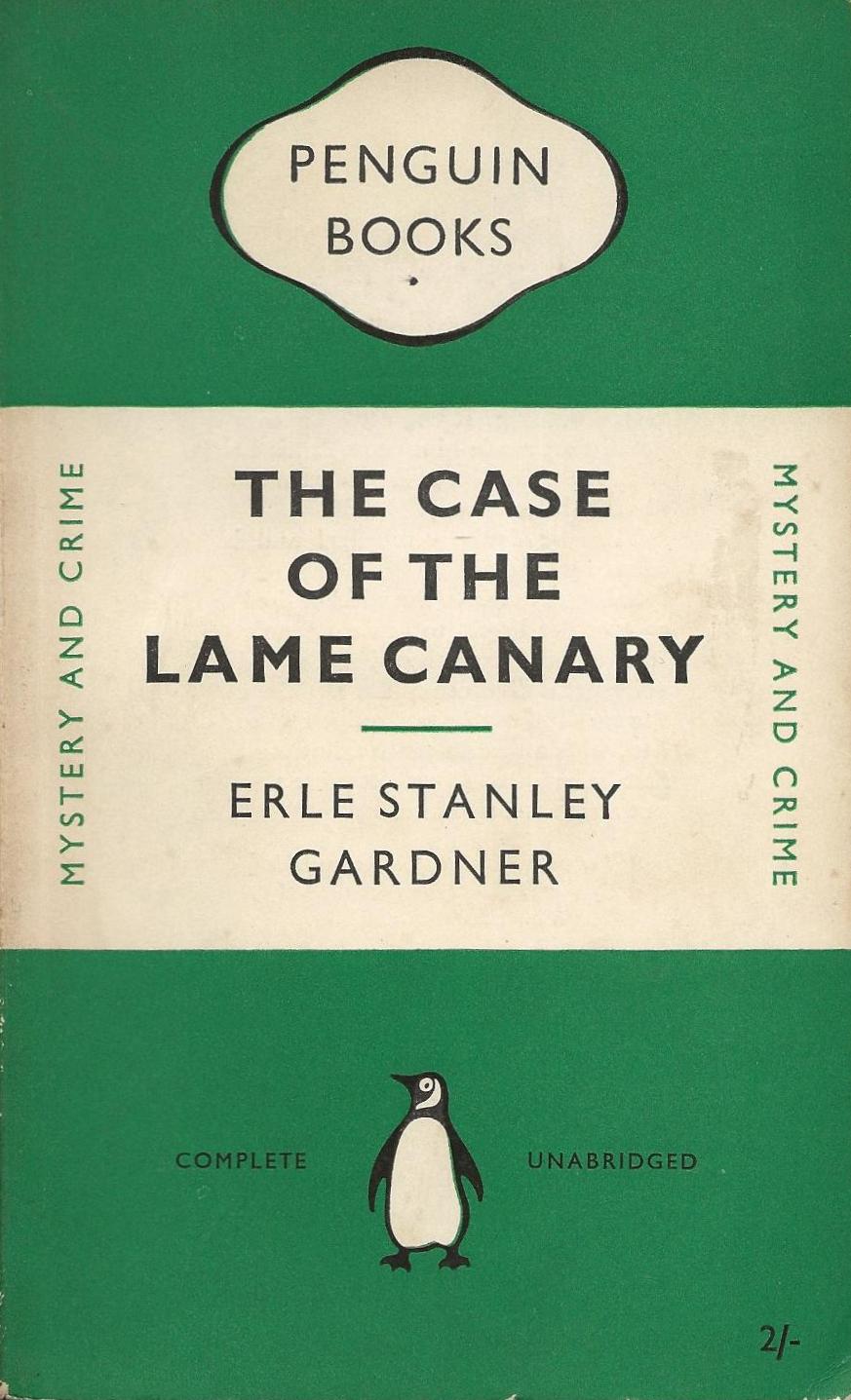
I might have read as many as half of Erle Stanley Gardner’s 80-some Perry Mason books — it’s difficult to remember, I didn’t used to keep track — and am fond of stating the opinion that eleventh title The Case of the Lame Canary (1937) is perhaps the peak of those I have encountered to date. So let’s revisit it, eh, and see how my memory stands up.
It’s my understanding that, after writing ten Mason books between 1933 and 1937, Gardner felt that his lawyer wasn’t quite getting the traction he wanted, despite a series of films being made from the opening tranche of books (though plans for tenth Mason novel The Case of the Dangerous Dowager (1937) were largely torn up and it was filmed as a, er, comedy Western entitled Granny Get Your Gun (1940)…so he might have had a point). As such, Gardner decided to pack in the Mason books, possibly handing the great man’s legal practice over to a Bright Young Turk, and perhaps focus on new stories with new characters. If I understand my chronology correctly, Gardner had already broken away from Mason with his first Doug Selby novel, The D.A. Calls it Murder (1937), and so there was perhaps less fear that he could be successful without what had been until then his ‘main’ creation.
Thus, The Case of the Lame Canary was planned as a farewell…until it sold for lucrative serialisation in the Saturday Evening Post and Gardner was able to parse that itch for something new into the persons of Bertha Cool and Donald Lam, Terry Clane, Gramps Wiggins, Bill Eldon, and other characters who sprang from Gardner’s fertile imagination in the early 1940s. Of course, the collective output of all these characters would eventually be dwarfed by the size of the Mason oeuvre, and so it’s difficult not to wonder if Lame Canary might have had a bigger role in revitalising Gardner’s zest for this querulous attorney than we suspect.

When Rita Swaine bustles into Perry Mason’s office carrying a canary in a cage — a canary with an injured foot, no less — the sheer absurdity of the situation appeals to Mason’s love of a mystery, and he agrees to listen to the woman’s reasons for seeking him out. Alas, we don’t always get want we want: not only Miss Swaine seeking to engage Mason for what is essentially divorce work, the mystery of the lame canary is so simply explained as to immediately disappoint.
“[Y]ou’ve explained a perfectly intriguing mystery into an uninteresting commonplace.”
However, Mason is human enough to feel bad about turning Rita Swaine away after she reveals the difficulties her sister is going through (“Remember, this is just a business with us. It’s something else to the client.”), and so he agrees to look into the matter of getting said sister, Rosalind, a divorce from her aggressive husband, Walter Prescott. It’s in part this humanity that makes Mason — and, indeed, most of Gardner’s protagonists — so interesting: he’s not simply out to get whatever he can, he has a keen eye for the people behind the cases, and this comes out again and again. Whether getting a gossipy busybody to spill beans by intimating that what she knows is unlikely to be interesting or relevant, the recognition for the need to be brutal when he suspects his client isn’t being entirely open with him (“If you’re lying to me, they’re going to put a coarse hemp rope around that pretty neck of yours and drop you through a trap…”), or the casual dismissal when someone tells him they have a more trustworthy attorney of their own and don’t want Mason’s help (“Yes, you would fall for a dignified manner, proper clothes, a big mahogany desk, and the usual background of hokum.”), the man’s acuity is undoubtedly on display in matter more than merely the legal side of things.
He’ll need that acuity, too, since despite his misgivings it’s not long before a dead body turns up…and, of course, who could look more guilty than Rita Swaine? Stir in a car crash, the aforementioned busybody seeing Rosalind hiding the gun which committed the murder, and a vanishing man who might just hold the key to the whole thing, and you’ll sympathise with Della Street’s desire to get away from the business of crime for a while — a thread no doubt sewn in when Gardner intended to pack the series in, and exploited well throughout the narrative. And was hot young thing Rodney Cuff — not a patch on series antagonist Hamilton Burger, of course, but a clearly very bright attorney with more than enough legal know-how up his sleeve — the one earmarked to take over from Mason should Gardner have gone through with this retirement? We’ll never know, but it’s intriguing to read the character in this light.
“You see, his manner contrasts very much with my own. I sit in court with an armful of legal monkey-wrenches and toss them into the machinery whenever I see a couple of wheels getting ready to move around. Cuff is one of those chaps who apparently wants to co-operate all the time. He was so nice down there at the inquest that butter wouldn’t melt in his mouth. Yet he managed to squeeze out from under and leave Rita Swaine holding the sack.”
One of the most enjoyable elements of these books is just how damn well they work as puzzles, too, with Gardner stringing together a variety of approaches — frank hunches, cavilling over medical evidence (“Now, isn’t it possible that there is, perhaps, one case in a thousand…”), and modern wonders like ultra-violet and infra-red photography to allow the acquisition of evidence — that all combine to wind the plot noose tighter. There’s one piece of misdirection there that’s breath-takingly simple, and yet there are so many other irons in the fire that I’m willing to bet a lot of readers will only realise its significance when Mason points it out in the final summary. And the scheme itself is freakin’ ingenious, easily one of the most superbly-handled reversals from this era, able to stand shoulder-to-shoulder with the very best of the genre.
You can find a little fault with Gardner’s answer, since once very, very slight element is unaccounted for (rot13: jul qvq abobql urne gur thafubgf?) but when Mason says that “a solution of any crime which doesn’t account for all the various factors involved is no solution at all” he gets to feel rightly proud for putting these complex-yet-inherently-very-simple machinations together. Hell, for figuring out the significance of the lame canary alone he gets to feel a little smug, as I’ve read books that hinge on significantly less misdirection than that.
Anything else? His minor characters are lovely (the paragraph opening chapter 10 about the coroner Emil Scanlon is as perfect a pen portrait as you’re going to get), he manipulates your sympathies in exactly the right direction (Rita’s short speech about making choices and not having regrets — while she faces down a murder charge, no less — is very well-timed and -weighted), and, hot damn can Gardner write (c.f. the coaching of Rosalind about what to say when the matter of divorce is brought up). It’s incredible to think that Gardner ever wanted to part ways with Mason, especially when the character and the plots he allowed were so redolent with possibilities for ingenuity that not only showed the author off at his best but also enabled such a variety of clues and ideas to get deployed from book to book. What more could an author want?
So, is The Case of the Lame Canary the best Perry Mason novel? With maybe half of them under my belt I’m willing to put it in the top ten, maybe even the top five, but I’ll obviously need to read (and reread) further…and, even then, the sheer volume of material will likely make any meaningful comparison next to impossible. I can say, however, that anyone looking to see the series at close to its best could do much, much worse than starting here: it’s light, fast, very clever, delightfully complex, full of great writing and authorly ingenuity, and contains the sort of scheme that Agatha Christie and John Dickson Carr would have been delighted to have deployed. If you want more than that from your mystery fiction, you’re in the wrong genre.
~
Perry Mason on The Invisible Event
Novels:
11. The Case of the Lame Canary (1937)
12. The Case of the Substitute Face (1938)
13. The Case of the Shoplifter’s Shoe (1938)
15. The Case of the Rolling Bones (1939)
16. The Case of the Baited Hook (1940)
28. The Case of the Borrowed Brunette (1946)
Novellas and Short Story Collections:
 The Invisible Event
I’d read one Perry Mason (Borrowed Brunette) prior to getting hold of this to which I’d thought “Meh” but this one put me right.
LikeLike
I’ve reviewed Borrowed Brunette on this blog, and agree that it’s fairly middle of the road. Found it an odd choice for the American Mystery Classics to reissue, given all the surefire hits published around the same time. But, hey, not my imprint, so they can republish whatever they like…!
LikeLike
I still have yet to read a Perry Mason, which is embarrassing for multiple reasons. Not only is Erle Stanley Gardner a significant practitioner of puzzle plots that I’m silly to neglect, but also because he was one of the chief inspirations for Ace Attorney, a mystery series I greatly adore. I absolutely need to read this book, you’ve made it sound so good!
LikeLike
Well, with so many authors to get into it stands to reason a few will go overlooked — especially if it’s someone like Gardner, about whom there is no consensus about what the “must read” titles are.
Expect plenty more Mason on here in the coming years to help with this decision; I thoroughly enjoyed revisiting this, and will be mixing rereads with (possible…?) first reads now.
LikeLike
Hey! It turns out I own this one in a snappy little pocket book from the 40’s that will no doubt dissolve in my hands as I read it! I want to tackle this one and The Case of the Substitute Face before too long!! Stay tuned!
LikeLike
I look forward to you reading this six years from now. Tenters are well and truly hooked.
LikeLike
Pingback: PERRY WALKS THE PLANK: The Case of the Substitute Face | Ah Sweet Mystery!