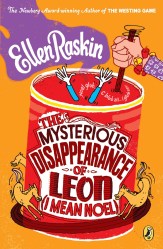
Tuesdays, themed posts, November = mysteries for younger readers, and Ellen Raskin was a name that appeared in the comments a little while ago promising riddles and word games and puzzles and all sorts of other joys…so what to make of this, her debut novel?
Honestly, I don’t quite know. It’s a weird one, the sort of book that only the 1970s would produce as legitimate children’s literature, in that it deals with nothing approaching a serious theme in a serious way and is absurdly thin on…anything. But at the same time it has an undoubted charm in its helter-skelter freeform skittishness that works brilliantly…but can you honestly see the average 9 year-old being all that bothered?
It is, though, gigantically charming for the most part. Two young children end up heirs to a soup fortune and are married to ensure its success, only to then be separated — she aged 5, he aged 7 — and not meet for 14 years. This opening alone is full of many of the joys and weirdnesses that work so well in its favour, Raskin’s footnotes in particular, and if the idea of a five year-old being turned away from all the respectable girls’ schools because she’s a married woman amuses you (as it did me), well, you’re in good hands here. The humour is coarse enough and yet reliant enough on simple ideas (such as Caroline’s father constantly repeating mantras like “Money is money, “Boys will be boys” and essentially every variation on “X is X”) to stretch the concept of what qualifies as a joke enough that you clearly have to take things on Raskin’s terms, so pay attention. No small achievement.
 It’s the footnotes I really fell in love with, though (especially the one about soy sauce) — ranging from the startlingly, delightfully pointless to the so on-the-nose that you go back at the end and wonder how you missed it, there’s a fun being had here that I’ve not experienced since I stopped reading Terry Pratchett’s Discworld books about 12 years ago. Raskin tells you a clue is coming up, or that this section contains a word that helps complete the message, but equally will throw in an aside to point out that a phone number given in the text “has been changed here just in case some crank knows how to read”. Thankfully it’s nothing so crude as “the text is for the kids, the footnotes are for the grown-ups”, though there is a maturity in purely appreciating the timing — and especially the phrasing — of a lot of what they contain.
Clues?, you say. Clues to what?
Well, upon being reunited with her lost love, Mrs. Carillon (it’s a long story) loses him over the side of a pleasure boat and the central plot is set in motion. As he sinks beneath the waves, he struggles out the message that gives the remainder of the book its focus:
“Noel glub C blub all…I glub new…”
When she wakes up in hospital, Mrs. Carillon learns that the man she was with has been discharged and — determined to track him down — she seeks the meaning in these words, seeing them as the only clue to his whereabouts…filling in the blanks obviously first being in order.
 From hereon, what you essentially get is an extended piece of wordplay — for example, “C blub all” could be “seals”, possibly in “new” York — and we skip ahead several years to find Mrs. Carillon still searching for her husband Noel (or is it Leon?) by stringing together all possibilities from these meagre beginnings. And…that’s it. It’s fun, but very slight, and I’m guessing possibly too unfocused to hold younger minds — Mrs. Carillon adopts orphan twins, starts a riot at Bloomingdale’s and accidentally catches a notorious perfume thief, wins a year’s supply of camembert cheese, and is made into a “living martyr”. The twins attend school, where Tina feels awkward because she doesn’t get many Valentine’s cards and Tony had trouble making decisions…the humour remains sly, but it’s like every page is a New Thing without any structure to it. It’s one of those books that you go “Well, that was probably really easy to write” and it turns out it is, so long as you’re happy to repeat a few unconnected points here and there and make sure to work in a few repeating motifs.
And it gets a little dull.
It makes no pretence of being a detective novel in the traditional sense, and that wasn’t what I expected when I went in anyway, but if you want to force a GAD analogy it’d be like interviewing the suspects in chapter 5 and still interviewing them in chapter 17. There is no progress at all, and it makes a weird sort of reading experience. I started out a little nonplussed, then began to really love it, and then at about the two-thirds mark found myself wishing that it contained something more than just a loosely connected string of coincidences and some left-of-field context-free jokes. Yes, there is a revelry in the joy and absurdity of language, but there’s never really enough happening to genuinely engage you in anything — something which becomes agonisingly clear in the interminable final chapter that takes time to give everyone a happy ending because…that’s what books are supposed to do, I guess?
“But JJ, it’s for kids, you’re missing the point,” you might be thinking (you might not, of course); sure, but I just don’t see this having enough heft for kids to really get into. Does Augie Kunkel winning third prize in a crossword-setting competition have any effect on the reader? No. Does the footnote telling us he won first prize a year later have any effect on the reader? No. These things are included almost because they’re the sort of context-free information that we’re expected to associate some sense of positive meaning to…but nothing is done to earn it. I work with kids, and kids are smarter than this, you need to give them– as with any reader — something to connect to rather than simply the connections between things.
But all is not completely lost.
 The Invisible Event
I haven’t read this one, but I enjoyed both THE WESTING GAME and THE TATTOOED POTATO when I read them first as a 10-year-old and then twenty years later. A baroque structure, multiple solutions, language-based clues, even (from memory) a dying message – it’s Ellery Queen for children.
LikeLiked by 1 person
I’ll definitely get onto more Raskin in future, there’s more than enough here to suggest that she wrote a great example of this kind of thing at some point. Hopefully those later ones — now I’m suitably acclimatised — will strike me more favourably.
LikeLiked by 1 person
“Hey, Mister, I took your advice and picked up my first Agatha Christie book.”
“Oh, that’s nice, I -“
“Yeah, I got Postern of Fate. It sucked!”
“Why ever did you choose that one? I gave you at least ten -“
“I ain’t never gonna read her no more. Thanks for nuthin’!”
I told you to read The Westing Game. We all told you to read The Westing Game! Follow instructions, my dear sir, and you won’t go wrong.
Darb, I mean Brad
LikeLiked by 2 people
Tush, sir, tush — everyone knows you don’t start with the best one, as then there’s nowhere to go but down. I enjoyed this enough to give more a go at some point, and I’ll get to the others before, erm, I read any more Galdys Mitchell (I’m not putting a definite timescale on anything at present).
JJ, I mean — uhm — JJ
LikeLike
“JJ, I mean — uhm — JJ”
Out of sheer curiosity, why did you choose JJ as your blog name ? Is it because J is the first letter of your middle name or because it is a palindrome ? 🙂
LikeLike
Aaaah, I think I’ve shared enough personal information on here for this month, Santosh 😉
LikeLiked by 1 person
You’re probably going to receive dozens of comments along these lines, but I can’t resist writing in to say that The Mysterious Disappearance of Leon is by far Raskin’s weakest book, and not at all typical of her work except as a demonstration of her skill at wordplay. The Westing Game is her masterpiece, The Tattooed Potato is well worth reading, and so is Figgs & Phantoms, though it’s more an eccentric fantasy than a mystery. All these books have well-drawn characters and satisfying plots.
LikeLiked by 1 person
Thanks, Daniel — it stood to reason that the first one wasn’t going to represent Raskin at her best (see, Brad — other people understand…), so I’m delighted to have the confirmed. Everyone needs a loosener to get their eye in, or whatever metaphor one typically reaches for in this situation, and this sort of free form loopiness would take a few run ups in order to perfect. Tattooed Potato will follw in due course, I might skip Figs & Phantoms by the sound of it, and then Westing Game to round out the experience.
Much appreciated!
LikeLiked by 1 person
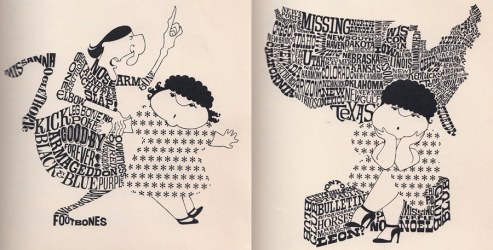
Hate to believe that there can be such a thing as too much bonkers, but it is possible. Still, I like* footnotes and the art looks rather good. What I would have thought of it aged nine or so (when Professor Branestawm and the word ‘fridge’ were the funniest things in the world) hard to say.
* preposterously overuse^
^I have documented reviews
LikeLike
Were it possible to set up footnotes in blog posts, my writings here would be littered with them. So it’s probably a good thing I don’t know how to, if we’re being honest.
No, please, nobody tell me how it can be done; my readers will not thank you for it.
LikeLiked by 1 person
I really enjoyed this post, which I came across when I was preparing for an episode on The Mysterious Disappearance… for the podcast I co-host, Rereading Our Childhood. I loved this book as a child, but as an adult reader I agree with your not-so-positive comments (as well as with the positive ones). I agree that only the 1970s could have produced this very unusual book.
LikeLike
Lovely to know that these older posts are being discovered by people. I can’t say I loved this or The Westing Game, but it was an interesting read and — yes! — very 1970s.
LikeLiked by 1 person
I have a blog too and it’s always fun when people discover and comment on old posts. I look forward to reading more of yours.
LikeLike
I randomly came across this while skimming through your author list for recommendations and can I just say, in opposition to everyone else in your comments, that this is my favorite Ellen Raskin book? It worked perfectly on me both as a kid and as an adult. I genuinely don’t see any of the flaws you guys all see, though there is one significant hole in the solution. It’s just incredibly fun, sweet, and clever.
People push The Westing Game, which I like, but it feels much more like Raskin trying to stay in the “real world,” when the whole fun of her comes out when she’s 90% in fantasyland, like in this one. (Though her tonally sketchiest book is Figgs and Phantoms, which combines whole pages where I was like “Ms Raskin what are you DOING?!” with a moment or two where I was actually sobbing.)
I’d HIGHLY recommend you check out The Tattooed Potato and Other Stories, which is very fun despite some tone/pacing issues (and one joke in particular at the end that is repeated about ten times too often)- some nice Sherlock Holmes parody while also being something more interesting.
LikeLike
Can I tell you something that has never previously come up on here? Just between the two of us, like? I really did not enjoy The Westing Game. It was…well, I’ll not waste time going over it all, but, god, if I hadn’t been told beforehand what a classic it was then I’d’ve assumed it was some sort of weird, forgotten, crab-sideways thing that no-one cared about. It was not good.
This was…fine. I don’t remember much about it now except the pomato soup. I’m not even sure if I still have it after all these years. So I’ll bear your recommendation of The Tattooed Potato in mind, but I’m not exactly taken with Raskin and so may never get to it. Time will tell…
LikeLike
Yeah, I’m not that surprised- the story isn’t as strong as it’s often made out to be and the attempt at quirkiness while also staying in a realish world is generally not as successful as it seems to think it is. I don’t DISLIKE it but it really doesn’t hold up. I think it’s a lot of American kids’ first murder mystery/intro to the genre, which I think is part of the nostalgic appeal.
In terms of Tattooed Potato, I have absolutely no idea if you’d like it because on the one hand it has some of the silliness that Mysterious Disappearance has that I loved and you didn’t seem to hate, and also a number of very fun mystery plots (it’s more episodic than one central mystery). But it also, again, is clunky in both style and pacing at times. It’s definitely worth an hour or two IMO just to see what it’s like if you happen to come across it, but perhaps don’t go out of your way for it.
LikeLike