- Comment
-
Subscribe
Subscribed
Already have a WordPress.com account? Log in now.
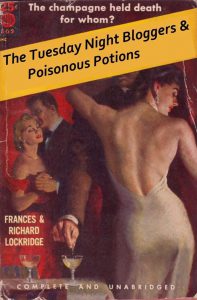
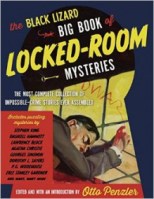 Sayers’ story concerns Egg making a routine call upon an existing customer only to discover the police in residence because the man has been found poisoned, the poison apparently being administered via the titular port that Egg sold the household on his previous visit. It’s a good story, my first encounter with Egg who is a very likable sleuth full of aphorisms from The Salesman’s Handbook, and like all short short stories where the identity of a murderer is intended as a surprise suffers solely due to the inevitably small cast. But the bottle of port at the centre of the mystery tickled something at the corner of my mind…
 …which turned out to be that Stanley Ellin had written an absolutely marvellous story centred around a bottle of wine, ‘The Last Bottle in the World’ (1968). There’s a case here that this doesn’t fit the “Poison” theme of the TNBs, but I’ll jerry-rig it in by pointing out the corruption of the heart of the killer in that tale — it’s a spell-binding piece of work, as virtually all Ellin’s short stories are — is symptomatic of the poisoning of man against his fellow man necessary for these crimes to be planned and carried out. “Poisonous Potions” up top, you say? Well, anyway, moving on…
 …this reminded me that, after I’d discovered Ellin’s The Speciality of the House and wouldn’t shut up about how good he was, someone pointed me in the direction of the episode of Tales of the Unexpected spun from this particular story. You can watch that here, though for my money you’re better off reading the story first. Tales of the Unexpected was, of course, the brainchild of the incomparable Roald Dahl, who wrote two stories that instantly crowded into my brain here: ‘Taste’ (1959) which revolves around a bet being made over someone’s ability to identify a fine wine, and ‘The Butler’ (1974) in which a gauche millionaire seeks to convince others of his refinement by having his butler stock and serve the finest wines available so that the millionaire might memorise their properties to eulogise in front of the assembled company…
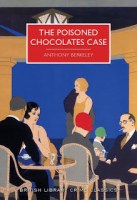 …and the deception inherent in both these stories, especially the fact that in both cases the deceivers rely on the fineness of their palette (be it genuine or counterfeit), then reminded me of Anthony Berkeley’s ‘The Avenging Chance’ (1925), which went on to become the first solution when the story was expanded up to the stone-cold classic novel The Poisoned Chocolates Case (1929). This story, of course, also relies on an unfair bet being made, but I always found it interesting that Mrs. Beresford, upon eating the poisoned chocolates and experiencing sensations such as the overpowering flavour of almonds and her tongue going numb, kept eating. And then from here…
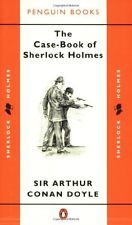 …spousal deceit, albeit originating now from a very different direction, brought me to one of my favourite late Sherlock Holmes stories in the shape of ‘The Adventure of the Sussex Vampire’ (1924), one of the stories comprising The Case-Book of Sherlock Holmes. This is another example of Conan Doyle doing something far finer with his detective duo than he usually gets credited for (see also ‘The Yellow Face’ (1893), which is even more beautiful). A man’s second wife attacks his son from his first marriage and is then found attacking their own baby, with bite marks on the child’s neck and blood around her mouth. Some may like to gripe that the solution is obvious, but the motivations of the titular vampire are, for my tastes, immensely moving. The “attack on a child” aspect of that story brought me back to……Stanley Ellin and his story ‘Robert’ (1964), in which a sixth grade teacher harasses and is harassed by the eponymous 11 year-old student in her class. This one involved accusations of poisoning, too, I remembered, though I’ll confess I had to reread it to get the details straight. It’s an especially harrowing tale come the final line: where it would be easy to simply paint Robert as an uncommonly vindictive and vicious little so-and-so or possibly leave the precise order of reality up to the interpretation of his grief-stricken teacher’s imagination, Ellin gives you something that actually just might rend your heart in two. I don’t want to spoil what that is, but this domino then fell over and hit…
 …’The Scientist and the Poisoner’ (1973) by Arthur Porges, wherein a millionaire eating dinner in his usual place at his usual time experiences the unusual event of his own demise. Inevitably no-one was anywhere near him at the time and the meal he was eating is examined and found to contain nothing noxious or harmful (from which we may conclude that he wasn’t eating at Nando’s). Like all of Porges’ Cyriack Skinner Grey stories, this is a supremely compact and speedy puzzle, bordering on an inverted mystery since the who is simply a choice of three people and it’s the how that needs to be established…
 …and so the “man is poisoned impossibly at a restaurant” conceit therefore brought my reminisces to ‘The World’s Smallest Locked Room’ (1959) by Clayton Rawson where exactly that happens: a man keels over while drinking coffee in a public cafe despite no-one coming near him…conclusion: poison! If these two stories share any other DNA beyond their fundamental idea it must surely be that the killers in each case go out of their way to get caught — choosing methods that leave no scope for interpretation, smearing clues all over the place, failing to tidy up after themselves… Anyway, where was I? Oh, yeah, a man poisoned by a drink when it’s inconceivable that anyone could have been present to administer said poison and the notion of suicide is able to be dismissed out of hand. Now what did that remind me of? Something I’d read fairly recently, anyway. Oh, I remember now: Dorothy L. Sayers’ ‘The Poisoned Dow ’08’. Which I then had to reread because I’d been so busy thinking about other things that none of it had gone in.
 The Invisible Event