- Comment
-
Subscribe
Subscribed
Already have a WordPress.com account? Log in now.
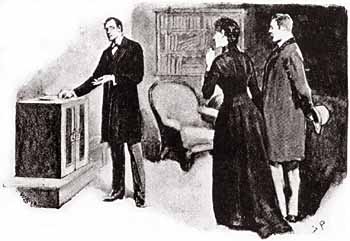 Since I can’t quite go the Full Sherlock – he’s out of my era, after all – I thought I could at least have a look at the three Arthur Conan Doyle-penned short stories that comprise the (official) entirety of his impossible crimes: ‘The Adventure of the Speckled Band’, ‘The Adventure of the Empty House’, and ‘The Problem of Thor Bridge’ (I’m excluding novella The Valley of Fear because it’s not technically an impossible crime, and remains a mystery for all of about six lines). It’s also a lovely excuse to get some of Sidney Paget’s gorgeous illustrations out for airing, too, and I don’t think anyone is going to mind that. So, first up going chronologically, is my least favourite of these three: nonsense-fest ‘The Adventure of the Speckled Band’.
 Conan Doyle’s solution is akin to the ‘poison with miraculous effects’ (an explanation I seem to remember him using on one occasion), but crucially a shade removed: it gives something that, while utter nonsense, at least edges towards practicality. I have no desire to spoil it if you’ve not read this one, but there is arguably a set of circumstances that could – with some rather key changes – possibly be just about workable. As a step in the genre, this is of paramount importance. It would (and always will) remain central to the explanations of these sorts of stories that a certain suspension of disbelief be required – some comments on exactly this topic were exchanged recently in the wake of my review of John Dickson Carr’s The Crooked Hinge – and so penalising Conan Doyle for making a stretch seems a little harsh, because many authors in the 123 years since have done exactly that to resolve this type of conundrum. He also took a key step in establishing the hermetically-sealedness of the room in which the unfortunate lady perished: “…the flooring and walls are sound…the door, windows and chimney are impassable…her sister must have undoubtedly been alone when she met her mysterious end”. There is one slight lie in there, as you’ll be aware if you’ve read it, but the fundamental reasoning is the same (and has been reused many times, cf. Anthony Boucher’s Nine Times Time, which occurs to me purely because it’s on a shelf at eye-level). Conan Doyle can be trusted not to throw a surprise tunnel in your face after stating something this baldly.
 The Invisible Event
Great post, it’s been ages since I have read the SH stories, as I read them when I first got into crime fiction properly. I remember once when I was reading quite a few of them in a go that I managed to solve one of the cases before Holmes did – I was and to a small extent still am fairly impressed with this achievement. Looking forward to your next post on Wednesday.
LikeLiked by 1 person
Going back through these particular stories has been a delight, especially as I wouldn’t even consider them among my favourites (I’m wrangling with myself over whether most of the last collection being published in the 1920s makes it acceptable do a “Five to try…”). Some of the early stories are pretty guessable on account of them having two charatcers who aren’t Holmes or Watson – someone who’s being terrorised and some mysterious benefactor/relative/etc – but there are some genuinely great examples of proper mystery in there, too. I have no doubt, of course, that it is these later tales that you figured out, natrually!
LikeLiked by 1 person
ha ha I can’t remember which one it was and yeah I think a Five to try post would be a good idea as I would be interested to see which ones you single out.
LikeLike
Ah, this story. Solution is so much bull, but I remember being terrified of it back in fourth grade.
LikeLike