- Comment
-
Subscribe
Subscribed
Already have a WordPress.com account? Log in now.
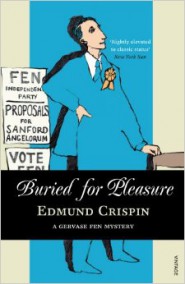 Do anything for long enough – spelunking, chicken farming, marriage, presenting live television – and you’re bound to make some mistakes. Thus, no novelist with more than a few books to their name is going to have a perfect run, even allowing for the subjectivity of readers’ opinions; class being permanent and form being temporary, everyone writes a dud now and then. Which brings us to Buried for Pleasure, the sixth of Edmund Crispin’s nine detective novels based around Gervase Fen, Professor of English Literature at a fictional Oxford college, sometime detective, and springer spaniel in human form. A more likeable, enthusiastic, and chaotic protagonist you are unlikely to find, and here the joys of Don-ship have worn off and so Fen has decided to stand for parliament as an MP for an out-of-the-way country constituency in the upcoming General Election. And then there’s a murder, and then another murder, and our springer spaniel is suddenly up to his bloodhound tricks again…

 The Invisible Event
I remember really enjoying this book when I read it… but having read several hundred books in between I can’t remember why! May have to have a reread and figure out why I liked it. Have you read many Edmund Crispins?
LikeLike
This is the sixth of Crispin’s novels I’ve read, and I’ve also done his two short story collections (Fen Country and Beware of Trains). Everything else has been at least good, so this is definitely an outlier, and there’s probably enough to enjoy here if you’re in a forgiving mood so it’s not a book I’d be amazed to learn someone found enjoyable. I find my patience wears thinner the more I read, because time spent reading something with obvious and avoidable faults is time that could be spent potentially discovering something wonderful – only so much time and so many books left, after all!
LikeLike
I don’t think I was as much of a fan of Crispin’s short stories or his novel Glimpses of the Moon. The Moving Toyshop though is a brilliantly conceived idea for a detective novel. I read most of Crispin’s work when I began reading crime fiction in a serious way so I don’t know whether my opinions of his work would change if I read him again now. I do agree with though on Michael Innes. He has never been a particular favourite of mine and I think the only one I properly enjoyed was What Happened At Hazelwood (1946), as I enjoyed the different narrative point of views. It doesn’t feature Inspector Appleby.
LikeLike
Crispin’s short stories are quite different from the novels, for sure, but I liked them possibly because of this rather than in spite of it. It was great to see how focussed he could be on a core idea for only a few pages given how sprawling his novel plotting tends to be, but anyone looking for the level of wit or charm of the books is going to be disappointed, I agree. And I have struggled through as much Innes as one lifetime can bear, the same as with Nicholas Blake, and I’m onto other things now, but it’s nice to know there may be one worth checking out if I ever change my mind in future, so thank-you.
LikeLike
I’ve tried Innes and Blake and I have to agree with you. Actually I find Blake’s nihilism rather distasteful.
LikeLike
Delighted to find someone who agrees with me, I was starting to think I was the only one! Marion Mainwaring’s Murder in Pastiche does a fabulous job of skewering the pomoposity of a lot of detective novelists, but her take on Innes is particularly sharp. It’s not a great book, but it’s very nearly worth reading for how well she dismantles Appleby…
LikeLike
Yes I tend avoid Innes novels now, as like you said earlier, life is too short and there really are too many books to read. I quite like Nicholas Blake though. I think the first 5 novels are the strongest. After that I think the quality is rather mixed and not as high as the first quintet.
LikeLike
Thanks for your review. 🙂 Having enjoyed the verbose and urbane wit of ‘Love Lies Bleeding’ – strangely, my favourite character was the bloodhound, not Gervase Fen – and I was tempted to purchase another Cripsin novel. I am glad that I got hold of ‘Swan Song’ instead of ‘Buried for Pleasure’.
LikeLike
Buried for Pleasure is probably a fine book on its own merits, but it’s a poor Crispin. Swan Song has even less of Fen’s charatcer (there are two wonderful skits of pure Fen, but the rest is rather more straight detection). If you enjoy that one then any of the previous three will be your cup of tea, but The Moving Toyshop is for me the crowning achievement of his writing.
LikeLike
Thanks for putting a good word in for ‘The Moving Toyshop’ – for the reviews I’ve read tend to have an even more unfavourable opinion of it then for ‘Buried for Pleasure’… 🙂
I am usually more forgiving of poor expression if the puzzle holds up, than the reverse – hence my sufficient favour towards Ellery Queen despite some of their more poorly written efforts. The only exceptions may very well be Edmund Crispin and Anthony Berkeley; perhaps I find myself laughing too hard…
LikeLike
Crispin’s not quite in Queen’s league of puzzling – very few are – but there’s always plenty to enjoy. Mystified that …Pleasure would frequently be considered better than …Toyshop, though; people are weird.
LikeLike
Pingback: #29: The spurns that patient merit of th’unworthy takes: To complete or not to complete? | The Invisible Event
Pingback: #104: The Tuesday Night Bloggers – The Light and Shade of Gervase Fen | The Invisible Event